

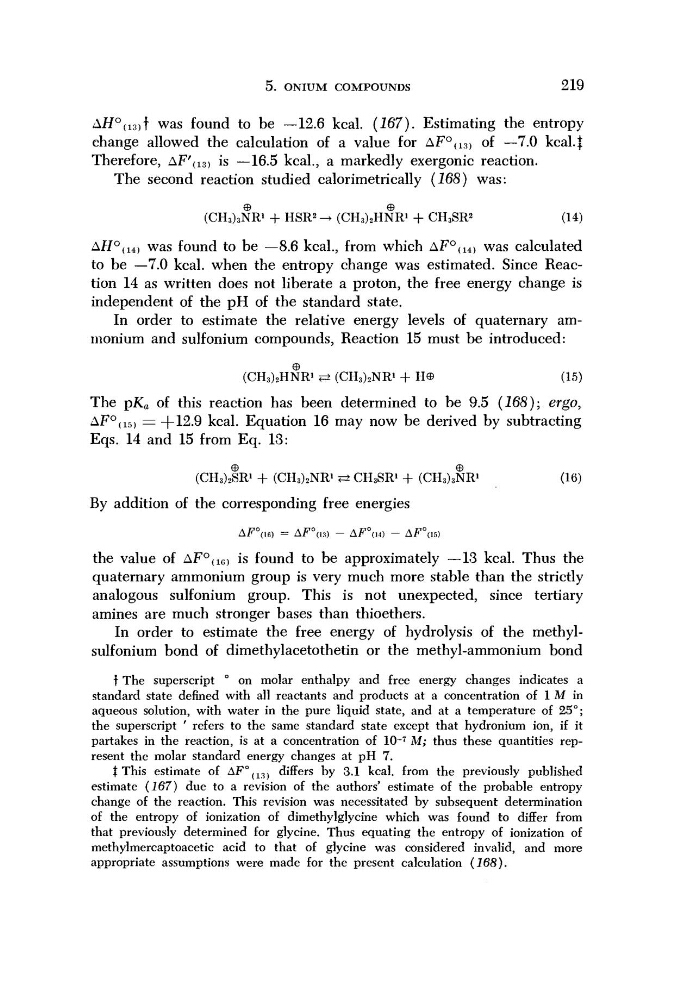
5. ONIUM COMPOUNDS
219
AiZ° ( i3)t was found to be —12.6 kcal. (167). Estimating the entropy
change allowed the calculation of a value for AF° (13) of —7.0 kcal.|
Therefore, AF' (13) is —16.5 kcal., a markedly exergonic reaction.
The second reaction studied calorimetrically (168) was:
(CH 3 ) 3 NR
1 + HSR
2 -> (CHg^HNR
1 + CH 3 SR
2
(14)
AH° (i4) was found to be —8.6 kcal., from which AF°( 14 ) was calculated
to be —7.0 kcal, when the entropy change was estimated. Since Reaction 14 as written does not liberate a proton, the free energy change is
independent of the pH of the standard state.
In order to estimate the relative energy levels of quaternary ammonium and sulfonium compounds, Reaction 15 must be introduced:
Θ
(CHa^HNR
1 «=> (CHjOaNR
1 + Ηθ
(15)
The pK a of this reaction has been determined to be 9.5 (168); ergo,
AF° ( I5) = +12.9 kcal. Equation 16 may now be derived by subtracting
Eqs. 14 and 15 from Eq. 13:
(CH 3 ) 2 SR
1 + (CH 3 ) 2 NRi <=± CHgSR
1 + (CH^NR
1
(16)
By addition of the corresponding free energies
Δ^°(16) = AF°(13) - AF°(14) - AF°(15)
the value of AF° (16) is found to be approximately —13 kcal. Thus the
quaternary ammonium group is very much more stable than the strictly
analogous sulfonium group. This is not unexpected, since tertiary
amines are much stronger bases than thioethers.
In order to estimate the free energy of hydrolysis of the methylsulfonium bond of dimethylacetothetin or the methyl-ammonium bond
f The superscript ° on molar enthalpy and free energy changes indicates a
standard state defined with all reactants and products at a concentration of 1 M in
aqueous solution, with water in the pure liquid state, and at a temperature of 25°;
the superscript ' refers to the same standard state except that hydronium ion, if it
partakes in the reaction, is at a concentration of ICH M; thus these quantities represent the molar standard energy changes at pH 7.
\ This estimate of AF° (13) differs by 3.1 kcal, from the previously published
estimate (167) due to a revision of the authors' estimate of the probable entropy
change of the reaction. This revision was necessitated by subsequent determination
of the entropy of ionization of dimethyl glycine which was found to differ from
that previously determined for glycine. Thus equating the entropy of ionization of
methylmercaptoacetic acid to that of glycine was considered invalid, and more
appropriate assumptions were made for the present calculation
(168).
219
AiZ° ( i3)t was found to be —12.6 kcal. (167). Estimating the entropy
change allowed the calculation of a value for AF° (13) of —7.0 kcal.|
Therefore, AF' (13) is —16.5 kcal., a markedly exergonic reaction.
The second reaction studied calorimetrically (168) was:
(CH 3 ) 3 NR
1 + HSR
2 -> (CHg^HNR
1 + CH 3 SR
2
(14)
AH° (i4) was found to be —8.6 kcal., from which AF°( 14 ) was calculated
to be —7.0 kcal, when the entropy change was estimated. Since Reaction 14 as written does not liberate a proton, the free energy change is
independent of the pH of the standard state.
In order to estimate the relative energy levels of quaternary ammonium and sulfonium compounds, Reaction 15 must be introduced:
Θ
(CHa^HNR
1 «=> (CHjOaNR
1 + Ηθ
(15)
The pK a of this reaction has been determined to be 9.5 (168); ergo,
AF° ( I5) = +12.9 kcal. Equation 16 may now be derived by subtracting
Eqs. 14 and 15 from Eq. 13:
(CH 3 ) 2 SR
1 + (CH 3 ) 2 NRi <=± CHgSR
1 + (CH^NR
1
(16)
By addition of the corresponding free energies
Δ^°(16) = AF°(13) - AF°(14) - AF°(15)
the value of AF° (16) is found to be approximately —13 kcal. Thus the
quaternary ammonium group is very much more stable than the strictly
analogous sulfonium group. This is not unexpected, since tertiary
amines are much stronger bases than thioethers.
In order to estimate the free energy of hydrolysis of the methylsulfonium bond of dimethylacetothetin or the methyl-ammonium bond
f The superscript ° on molar enthalpy and free energy changes indicates a
standard state defined with all reactants and products at a concentration of 1 M in
aqueous solution, with water in the pure liquid state, and at a temperature of 25°;
the superscript ' refers to the same standard state except that hydronium ion, if it
partakes in the reaction, is at a concentration of ICH M; thus these quantities represent the molar standard energy changes at pH 7.
\ This estimate of AF° (13) differs by 3.1 kcal, from the previously published
estimate (167) due to a revision of the authors' estimate of the probable entropy
change of the reaction. This revision was necessitated by subsequent determination
of the entropy of ionization of dimethyl glycine which was found to differ from
that previously determined for glycine. Thus equating the entropy of ionization of
methylmercaptoacetic acid to that of glycine was considered invalid, and more
appropriate assumptions were made for the present calculation
(168).