

5. ONIUM COMPOUNDS
209
fonium nucleoside; spectrophotometric analysis of this alkali-catalyzed
hydrolytic reaction and a study of its kinetics thus becomes possible.
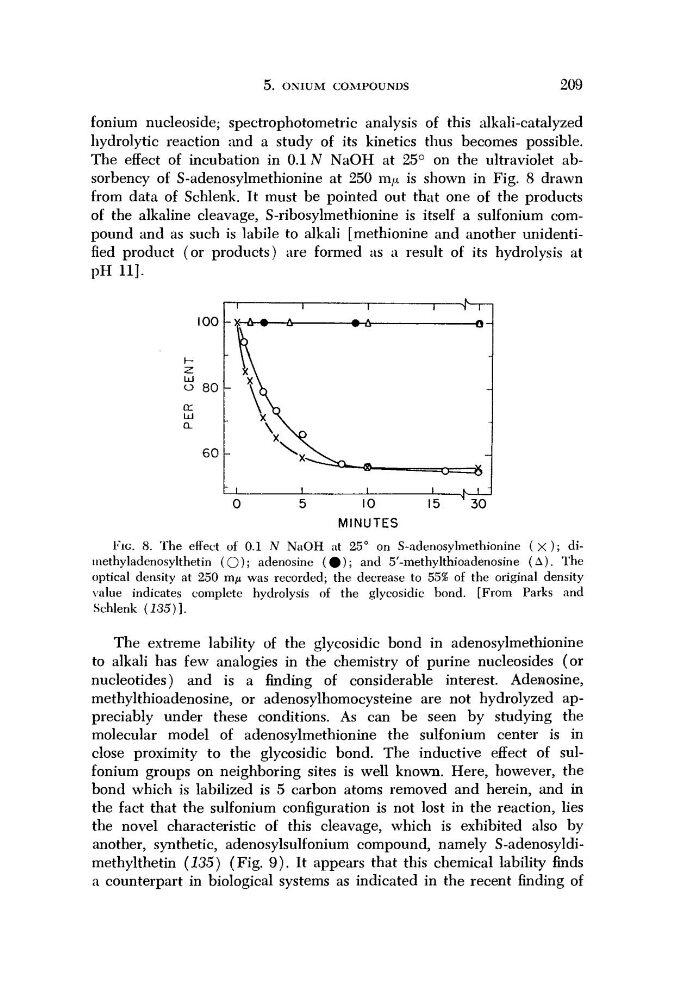
The effect of incubation in 0.1 N NaOH at 25° on the ultraviolet absorbency of S-adenosylmethionine at 250 m^ is shown in Fig. 8 drawn
from data of Schlenk. It must be pointed out that one of the products
of the alkaline cleavage, S-ribosylmethionine is itself a sulfonium compound and as such is labile to alkali [methionine and another unidentified product (or products) are formed as a result of its hydrolysis at
pH 11].
100
Ld
o 80
Q:
UJ
o_
60
0
5
10
15
30
MINUTES
FIG. 8. The effect of 0.1 N NaOH at 25° on S-adenosylmethionine (x); dimethyladenosylthetin (O); adenosine (·); and 5'-methylthioadenosine (Δ). The
optical density at 250 τημ was recorded; the decrease to 55% of the original density
value indicates complete hydrolysis of the glycosidic bond. [From Parks and
Schlenk (135)].
The extreme lability of the glycosidic bond in adenosylmethionine
to alkali has few analogies in the chemistry of purine nucleosides (or
nucleotides) and is a finding of considerable interest. Adenosine,
methylthioadenosine, or adenosylhomocysteine are not hydrolyzed appreciably under these conditions. As can be seen by studying the
molecular model of adenosylmethionine the sulfonium center is in
close proximity to the glycosidic bond. The inductive effect of sulfonium groups on neighboring sites is well known. Here, however, the
bond which is labilized is 5 carbon atoms removed and herein, and in
the fact that the sulfonium configuration is not lost in the reaction, lies
the novel characteristic of this cleavage, which is exhibited also by
another, synthetic, adenosylsulfonium compound, namely S-adenosyldimethylthetin (135) (Fig. 9). It appears that this chemical lability finds
a counterpart in biological systems as indicated in the recent finding of
209
fonium nucleoside; spectrophotometric analysis of this alkali-catalyzed
hydrolytic reaction and a study of its kinetics thus becomes possible.
The effect of incubation in 0.1 N NaOH at 25° on the ultraviolet absorbency of S-adenosylmethionine at 250 m^ is shown in Fig. 8 drawn
from data of Schlenk. It must be pointed out that one of the products
of the alkaline cleavage, S-ribosylmethionine is itself a sulfonium compound and as such is labile to alkali [methionine and another unidentified product (or products) are formed as a result of its hydrolysis at
pH 11].
100
Ld
o 80
Q:
UJ
o_
60
0
5
10
15
30
MINUTES
FIG. 8. The effect of 0.1 N NaOH at 25° on S-adenosylmethionine (x); dimethyladenosylthetin (O); adenosine (·); and 5'-methylthioadenosine (Δ). The
optical density at 250 τημ was recorded; the decrease to 55% of the original density
value indicates complete hydrolysis of the glycosidic bond. [From Parks and
Schlenk (135)].
The extreme lability of the glycosidic bond in adenosylmethionine
to alkali has few analogies in the chemistry of purine nucleosides (or
nucleotides) and is a finding of considerable interest. Adenosine,
methylthioadenosine, or adenosylhomocysteine are not hydrolyzed appreciably under these conditions. As can be seen by studying the
molecular model of adenosylmethionine the sulfonium center is in
close proximity to the glycosidic bond. The inductive effect of sulfonium groups on neighboring sites is well known. Here, however, the
bond which is labilized is 5 carbon atoms removed and herein, and in
the fact that the sulfonium configuration is not lost in the reaction, lies
the novel characteristic of this cleavage, which is exhibited also by
another, synthetic, adenosylsulfonium compound, namely S-adenosyldimethylthetin (135) (Fig. 9). It appears that this chemical lability finds
a counterpart in biological systems as indicated in the recent finding of