

196
G. L. CANTONI
mediate in biological sulfurylations (45).* Choline sulfate was first
found by Woolley and Peterson in cultures of Penicillium (46) and
more recently it has been described in a wide variety of other fungi
(47, 48) and in sea weeds (49).
2. Betaine and Homobetaine
Betaine is widely distributed in a variety of plant tissues and occurs
in relatively high concentration in some species of Leguminosae and
Graminacae and in evergreens. In these plants it is found in all tissues
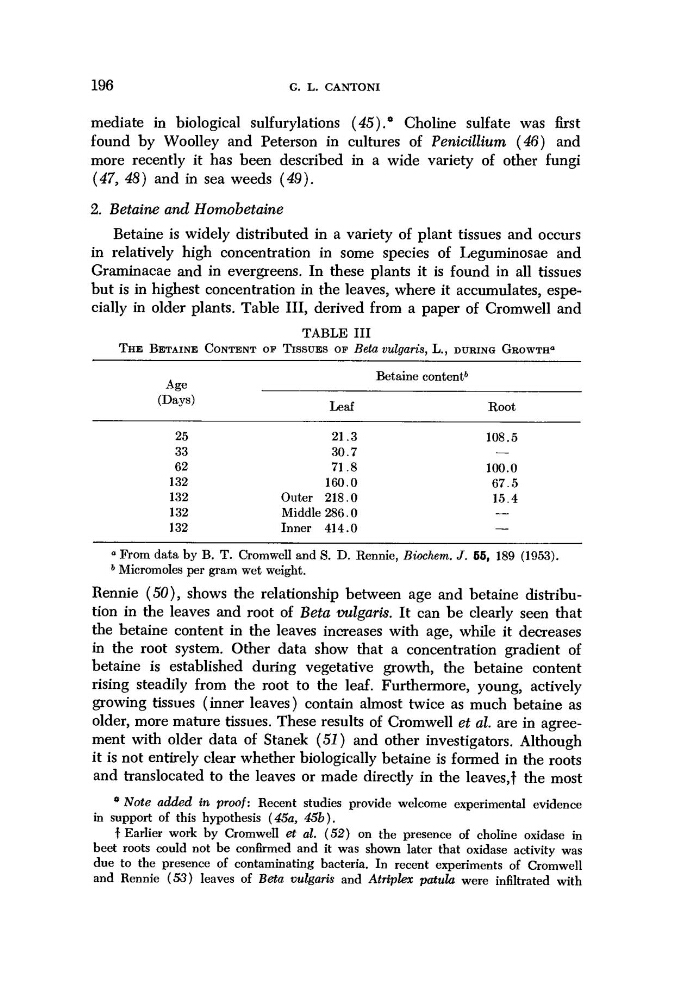
but is in highest concentration in the leaves, where it accumulates, especially in older plants. Table III, derived from a paper of Cromwell and
TABLE III
THE BETAINE CONTENT OP TISSUES OF Beta vulgaris, L., DURING GROWTH«
Betaine content
6
Age
V*^
Leaf
Root
25
21.3
108.5
33
30.7
—
62
71.8
100.0
132
160.0
67.5
132
Outer 218.0
15.4
132
Middle 286.0
—
132
Inner 414.0
—
a From data by B. T. Cromwell and S. D. Rennie, Biochem. J. 55, 189 (1953).
6 Micromoles per gram wet weight.
Rennie (50), shows the relationship between age and betaine distribution in the leaves and root of Beta vulgaris. It can be clearly seen that
the betaine content in the leaves increases with age, while it decreases
in the root system. Other data show that a concentration gradient of
betaine is established during vegetative growth, the betaine content
rising steadily from the root to the leaf. Furthermore, young, actively
growing tissues (inner leaves) contain almost twice as much betaine as
older, more mature tissues. These results of Cromwell et al. are in agreement with older data of Stanek (51) and other investigators. Although
it is not entirely clear whether biologically betaine is formed in the roots
and translocated to the leaves or made directly in the leaves, f the most
* Note added in proof-. Recent studies provide welcome experimental evidence
in support of this hypothesis (45a, 45b).
f Earlier work by Cromwell et al. (52) on the presence of choline oxidase in
beet roots could not be confirmed and it was shown later that oxidase activity was
due to the presence of contaminating bacteria. In recent experiments of Cromwell
and Rennie (53) leaves of Beta vulgaris and Atriplex patula were infiltrated with
G. L. CANTONI
mediate in biological sulfurylations (45).* Choline sulfate was first
found by Woolley and Peterson in cultures of Penicillium (46) and
more recently it has been described in a wide variety of other fungi
(47, 48) and in sea weeds (49).
2. Betaine and Homobetaine
Betaine is widely distributed in a variety of plant tissues and occurs
in relatively high concentration in some species of Leguminosae and
Graminacae and in evergreens. In these plants it is found in all tissues
but is in highest concentration in the leaves, where it accumulates, especially in older plants. Table III, derived from a paper of Cromwell and
TABLE III
THE BETAINE CONTENT OP TISSUES OF Beta vulgaris, L., DURING GROWTH«
Betaine content
6
Age
V*^
Leaf
Root
25
21.3
108.5
33
30.7
—
62
71.8
100.0
132
160.0
67.5
132
Outer 218.0
15.4
132
Middle 286.0
—
132
Inner 414.0
—
a From data by B. T. Cromwell and S. D. Rennie, Biochem. J. 55, 189 (1953).
6 Micromoles per gram wet weight.
Rennie (50), shows the relationship between age and betaine distribution in the leaves and root of Beta vulgaris. It can be clearly seen that
the betaine content in the leaves increases with age, while it decreases
in the root system. Other data show that a concentration gradient of
betaine is established during vegetative growth, the betaine content
rising steadily from the root to the leaf. Furthermore, young, actively
growing tissues (inner leaves) contain almost twice as much betaine as
older, more mature tissues. These results of Cromwell et al. are in agreement with older data of Stanek (51) and other investigators. Although
it is not entirely clear whether biologically betaine is formed in the roots
and translocated to the leaves or made directly in the leaves, f the most
* Note added in proof-. Recent studies provide welcome experimental evidence
in support of this hypothesis (45a, 45b).
f Earlier work by Cromwell et al. (52) on the presence of choline oxidase in
beet roots could not be confirmed and it was shown later that oxidase activity was
due to the presence of contaminating bacteria. In recent experiments of Cromwell
and Rennie (53) leaves of Beta vulgaris and Atriplex patula were infiltrated with