

5. ONIUM COMPOUNDS
195
from the point of view of comparative biochemistry, to indicate that a
number of other esters of choline have been identified in biological
material and found to be extremely active physiologically. Thus
Erspamer identified urocanylcholine (40) as the active agent in murexine and Whittaker isolated propionylcholine from mammalian spleen
(41) and β,β-dimethylacrylylcholine from Thais floridiana (42), the
Southern oyster drill.
Choline esters exhibit extraordinary pharmacological activity and
elicit a kaleidoscopic variety of physiological responses which span the
extremes of stimulation and inhibition. Powerful and specific enzymes
regulate their biosynthesis and, more significantly, their degradation.
Because of their biological lability, the natural existence of biologically
O
O
Adenine
T
T
-O—S—O—P—O—CH 2 O
i
I
o
-o
O
OH
I
o-p—oI
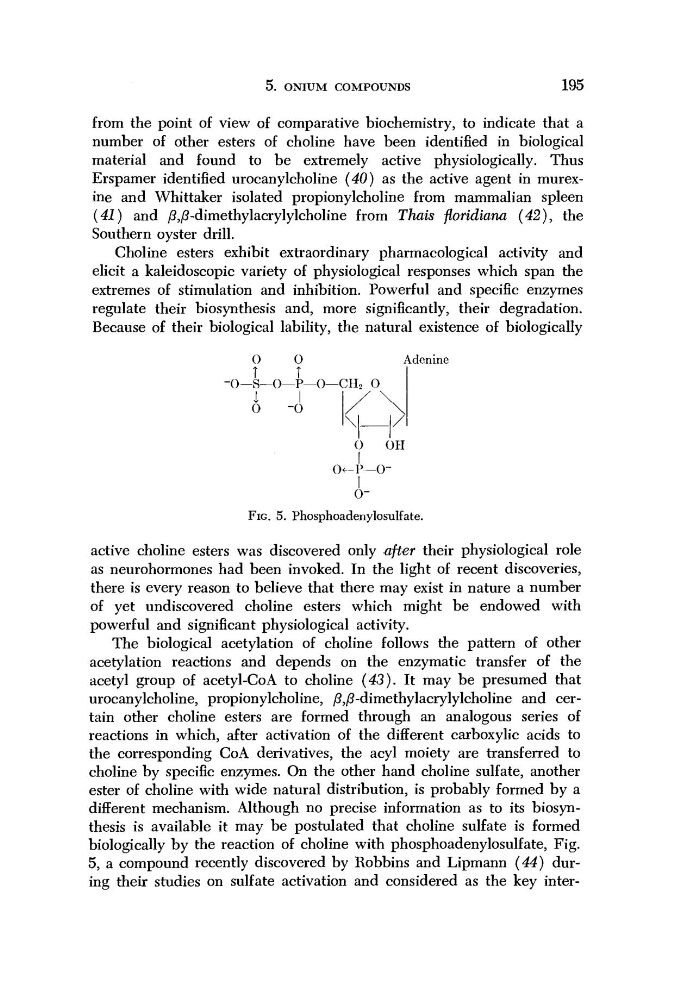
oFIG. 5. Phosphoadenylosulfate.
active choline esters was discovered only after their physiological role
as neurohormones had been invoked. In the light of recent discoveries,
there is every reason to believe that there may exist in nature a number
of yet undiscovered choline esters which might be endowed with
powerful and significant physiological activity.
The biological acetylation of choline follows the pattern of other
acetylation reactions and depends on the enzymatic transfer of the
acetyl group of acetyl-CoA to choline (43), It may be presumed that
urocanylcholine, propionylcholine, β,/^dimethylacrylylcholine and certain other choline esters are formed through an analogous series of
reactions in which, after activation of the different carboxylic acids to
the corresponding Co A derivatives, the acyl moiety are transferred to
choline by specific enzymes. On the other hand choline sulfate, another
ester of choline with wide natural distribution, is probably formed by a
different mechanism. Although no precise information as to its biosynthesis is available it may be postulated that choline sulfate is formed
biologically by the reaction of choline with phosphoadenylosulfate, Fig.
5, a compound recently discovered by Robbins and Lipmann (44) during their studies on sulfate activation and considered as the key inter-
195
from the point of view of comparative biochemistry, to indicate that a
number of other esters of choline have been identified in biological
material and found to be extremely active physiologically. Thus
Erspamer identified urocanylcholine (40) as the active agent in murexine and Whittaker isolated propionylcholine from mammalian spleen
(41) and β,β-dimethylacrylylcholine from Thais floridiana (42), the
Southern oyster drill.
Choline esters exhibit extraordinary pharmacological activity and
elicit a kaleidoscopic variety of physiological responses which span the
extremes of stimulation and inhibition. Powerful and specific enzymes
regulate their biosynthesis and, more significantly, their degradation.
Because of their biological lability, the natural existence of biologically
O
O
Adenine
T
T
-O—S—O—P—O—CH 2 O
i
I
o
-o
O
OH
I
o-p—oI
oFIG. 5. Phosphoadenylosulfate.
active choline esters was discovered only after their physiological role
as neurohormones had been invoked. In the light of recent discoveries,
there is every reason to believe that there may exist in nature a number
of yet undiscovered choline esters which might be endowed with
powerful and significant physiological activity.
The biological acetylation of choline follows the pattern of other
acetylation reactions and depends on the enzymatic transfer of the
acetyl group of acetyl-CoA to choline (43), It may be presumed that
urocanylcholine, propionylcholine, β,/^dimethylacrylylcholine and certain other choline esters are formed through an analogous series of
reactions in which, after activation of the different carboxylic acids to
the corresponding Co A derivatives, the acyl moiety are transferred to
choline by specific enzymes. On the other hand choline sulfate, another
ester of choline with wide natural distribution, is probably formed by a
different mechanism. Although no precise information as to its biosynthesis is available it may be postulated that choline sulfate is formed
biologically by the reaction of choline with phosphoadenylosulfate, Fig.
5, a compound recently discovered by Robbins and Lipmann (44) during their studies on sulfate activation and considered as the key inter-