

184
G. L. CANTONI
relatively few compounds about which more is known from the point
of view of enzymology and/or intermediary metabolism.
A. NATURAL DISTRIBUTION OF ONIUM COMPOUNDS
Listed in Table I are a variety of naturally occurring compounds
containing an onium pole. Although the list does not claim to be a complete one, an attempt has been made to include most of the known compounds where data are available. The distribution of the compounds
is also given in the table. In some cases, although the compound itself
may not have been isolated from natural sources, the enzymatic equipment for its formation has been identified, and it may be presumed then
that under suitable conditions of nutrition or of extraction the compound
itself might be found. Chemical formulas are given in Table II.
B. CONSIDERATIONS ON THE CHEMISTRY OF ONIUM COMPOUNDS*
The presence of an onium center renders a molecule susceptible to
the nucleophilic attack which is characteristic of compounds of this class.
These reactions may be divided broadly into three groups depending on
the point of attack of the nucleophilic reagent.
In the first class there is an attack at the α-carbon atom on the onium
pole with heterolytic elimination of the latter center as an uncharged
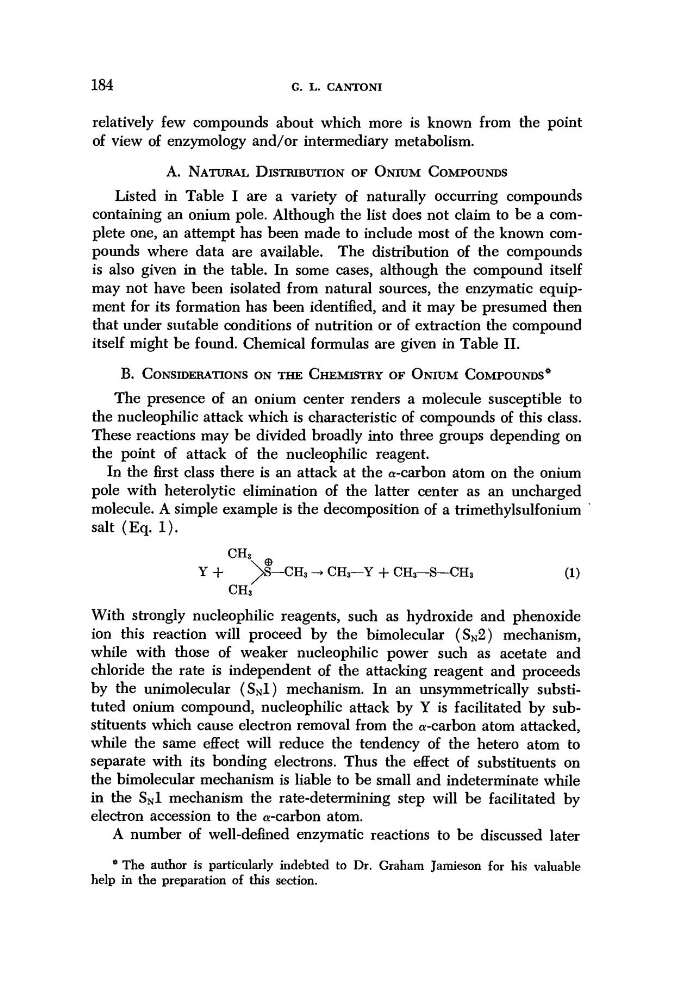
molecule. A simple example is the decomposition of a trimethylsulfonium
salt (Eq. 1).
CH 3
Y +
^>S—CH 3 -> CH 3 —Y + CH 3 —S—CH 3
(1)
CH 3
With strongly nucleophilic reagents, such as hydroxide and phenoxide
ion this reaction will proceed by the bimolecular (S N 2) mechanism,
while with those of weaker nucleophilic power such as acetate and
chloride the rate is independent of the attacking reagent and proceeds
by the unimolecular (S N 1) mechanism. In an unsymmetrically substituted onium compound, nucleophilic attack by Y is facilitated by substituents which cause electron removal from the α-carbon atom attacked,
while the same effect will reduce the tendency of the hetero atom to
separate with its bonding electrons. Thus the effect of substituents on
the bimolecular mechanism is liable to be small and indeterminate while
in the S N 1 mechanism the rate-determining step will be facilitated by
electron accession to the α-carbon atom.
A number of well-defined enzymatic reactions to be discussed later
* The author is particularly indebted to Dr. Graham Jamieson for his valuable
help in the preparation of this section.
G. L. CANTONI
relatively few compounds about which more is known from the point
of view of enzymology and/or intermediary metabolism.
A. NATURAL DISTRIBUTION OF ONIUM COMPOUNDS
Listed in Table I are a variety of naturally occurring compounds
containing an onium pole. Although the list does not claim to be a complete one, an attempt has been made to include most of the known compounds where data are available. The distribution of the compounds
is also given in the table. In some cases, although the compound itself
may not have been isolated from natural sources, the enzymatic equipment for its formation has been identified, and it may be presumed then
that under suitable conditions of nutrition or of extraction the compound
itself might be found. Chemical formulas are given in Table II.
B. CONSIDERATIONS ON THE CHEMISTRY OF ONIUM COMPOUNDS*
The presence of an onium center renders a molecule susceptible to
the nucleophilic attack which is characteristic of compounds of this class.
These reactions may be divided broadly into three groups depending on
the point of attack of the nucleophilic reagent.
In the first class there is an attack at the α-carbon atom on the onium
pole with heterolytic elimination of the latter center as an uncharged
molecule. A simple example is the decomposition of a trimethylsulfonium
salt (Eq. 1).
CH 3
Y +
^>S—CH 3 -> CH 3 —Y + CH 3 —S—CH 3
(1)
CH 3
With strongly nucleophilic reagents, such as hydroxide and phenoxide
ion this reaction will proceed by the bimolecular (S N 2) mechanism,
while with those of weaker nucleophilic power such as acetate and
chloride the rate is independent of the attacking reagent and proceeds
by the unimolecular (S N 1) mechanism. In an unsymmetrically substituted onium compound, nucleophilic attack by Y is facilitated by substituents which cause electron removal from the α-carbon atom attacked,
while the same effect will reduce the tendency of the hetero atom to
separate with its bonding electrons. Thus the effect of substituents on
the bimolecular mechanism is liable to be small and indeterminate while
in the S N 1 mechanism the rate-determining step will be facilitated by
electron accession to the α-carbon atom.
A number of well-defined enzymatic reactions to be discussed later
* The author is particularly indebted to Dr. Graham Jamieson for his valuable
help in the preparation of this section.