

4. ENERGY-RICH COMPOUNDS
137
the equilibrium lies far to the left. Propionate can also be phosphorylated in the acetokinase system, but only at a low rate compared
to acetate.
Acetyl phosphate is also synthesized from acetyl-CoA by the action
of the enzyme phosphotransacetylase {162, 187-191a), as shown in Reaction 45:
Acetyl-CoA + P z ;=± Acetyl phosphate + Co A
(45)
If Pi is replaced by arsenate, acetyl arsenate is formed, which then
undergoes spontaneous hydrolysis. The "arsenolysis" of acetyl phosphate, on the other hand, requires the formation of acetyl-CoA as an intermediate; this reaction has been used as an assay for CoA (189).
Propionyl-CoA will react more slowly than acetyl-CoA with phosphotransacetylase, whereas butyryl-CoA reacts only at a barely perceptible
rate. The CoA derivatives of formate, lactate, and the higher fatty
acids are completely inactive (189).
Acetyl phosphate may also be formed from the degradation of
pyruvate. In some systems, pyruvate oxidation yields acetyl lipoate or
acetyl-CoA [reviewed by Gunsalus et al. (192)]. The latter compound,
in the presence of Pi and phosphotransacetylase, can then give rise to
acetyl phosphate. However, the oxidation of pyruvate by L. delbrueckii
requires Pi, but not CoA (193), and acetyl phosphate appears to be
formed in the primary reaction. The term "phosphoroclastic reaction"
(177) should be reserved for systems of the latter type.
In mammalian tissues, acetyl phosphate can be formed by the oxidation of acetaldehyde by 3-phosphoglyceraldehyde dehydrogenase (194),
although the rate of this reaction is far lower than the usual oxidation
of 3-phosphoglyceraldehyde. 3-Phosphoglyceraldehyde dehydrogenase
also mediates the exchange of Pi into acetyl phosphate, the arsenolysis
and hydrolysis of acetyl phosphate, and a transfer of the acetyl radical
to CoA or glutathione (195-197). The formation of a thioester linkage
between the enzyme and the acyl group, followed by phosphorolysis or
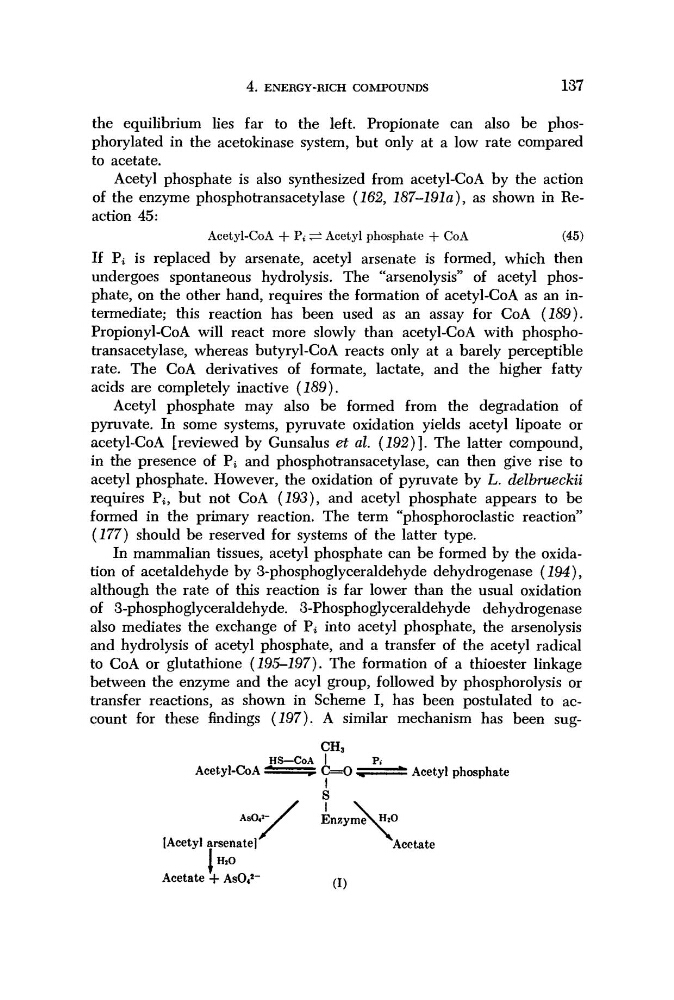
transfer reactions, as shown in Scheme I, has been postulated to account for these findings (197). A similar mechanism has been sugCH 3
HS—CoA |
P,
Acetyl-CoA
m C=0 »
* Acetyl phosphate
S
AsO«'-·/
EnzymeVHO
[Acetyl arsenate 1
Acetate
I Η,Ο
Acetate + As0 4
2
~
(I)
137
the equilibrium lies far to the left. Propionate can also be phosphorylated in the acetokinase system, but only at a low rate compared
to acetate.
Acetyl phosphate is also synthesized from acetyl-CoA by the action
of the enzyme phosphotransacetylase {162, 187-191a), as shown in Reaction 45:
Acetyl-CoA + P z ;=± Acetyl phosphate + Co A
(45)
If Pi is replaced by arsenate, acetyl arsenate is formed, which then
undergoes spontaneous hydrolysis. The "arsenolysis" of acetyl phosphate, on the other hand, requires the formation of acetyl-CoA as an intermediate; this reaction has been used as an assay for CoA (189).
Propionyl-CoA will react more slowly than acetyl-CoA with phosphotransacetylase, whereas butyryl-CoA reacts only at a barely perceptible
rate. The CoA derivatives of formate, lactate, and the higher fatty
acids are completely inactive (189).
Acetyl phosphate may also be formed from the degradation of
pyruvate. In some systems, pyruvate oxidation yields acetyl lipoate or
acetyl-CoA [reviewed by Gunsalus et al. (192)]. The latter compound,
in the presence of Pi and phosphotransacetylase, can then give rise to
acetyl phosphate. However, the oxidation of pyruvate by L. delbrueckii
requires Pi, but not CoA (193), and acetyl phosphate appears to be
formed in the primary reaction. The term "phosphoroclastic reaction"
(177) should be reserved for systems of the latter type.
In mammalian tissues, acetyl phosphate can be formed by the oxidation of acetaldehyde by 3-phosphoglyceraldehyde dehydrogenase (194),
although the rate of this reaction is far lower than the usual oxidation
of 3-phosphoglyceraldehyde. 3-Phosphoglyceraldehyde dehydrogenase
also mediates the exchange of Pi into acetyl phosphate, the arsenolysis
and hydrolysis of acetyl phosphate, and a transfer of the acetyl radical
to CoA or glutathione (195-197). The formation of a thioester linkage
between the enzyme and the acyl group, followed by phosphorolysis or
transfer reactions, as shown in Scheme I, has been postulated to account for these findings (197). A similar mechanism has been sugCH 3
HS—CoA |
P,
Acetyl-CoA
m C=0 »
* Acetyl phosphate
S
AsO«'-·/
EnzymeVHO
[Acetyl arsenate 1
Acetate
I Η,Ο
Acetate + As0 4
2
~
(I)