

136
F. M. HUENNEKENS AND H. R. WHITELEY
for the quantitative estimation of acetyl phosphate (179). A more accurate determination is based on the reaction of acetyl phosphate with
hydroxylamine at neutral pH (183); the resulting hydroxamic acid
gives a colored complex with Fe
3+ . The hydroxamates of acyl phos0
o
II
II
H3C-C-0-P-OH
I
OH
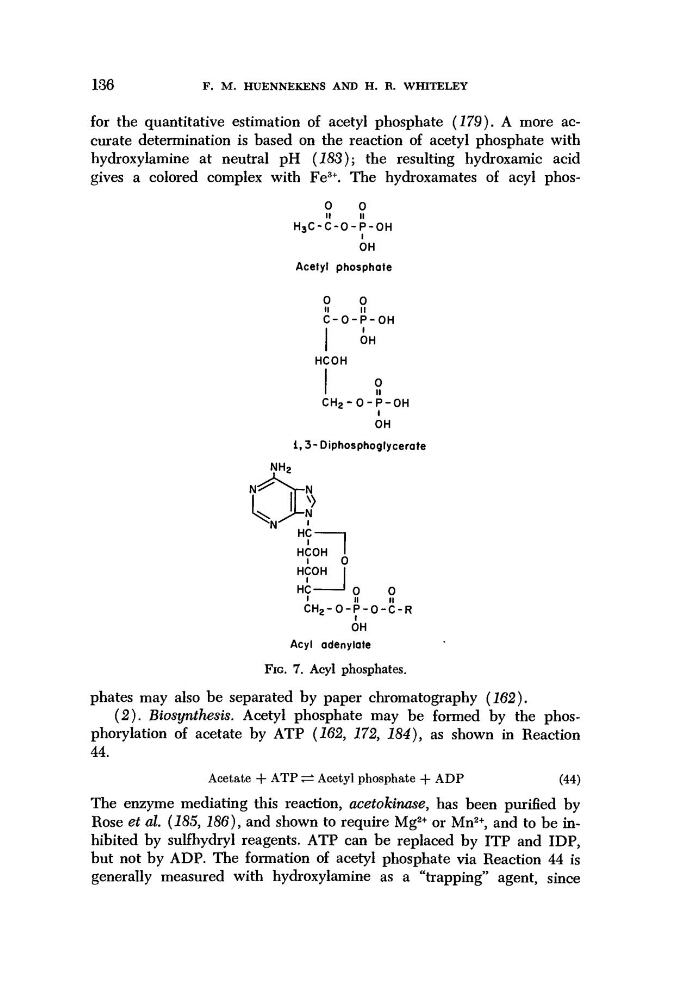
Acetyl phosphate
0
0
II
II
C-0-P-0H
OH
HC0H
0
I
11
CH 2 -0-P-0H
I
OH
i, 3- Diphosphoglycerate
NH 2
N^STN
HC0H
1
HC0H
HC
1 0
0
I
II
II
CH 2 -0-P-0-C-R
1
OH
Acyl adenylate
FIG. 7. Acyl phosphates.
phates may also be separated by paper chromatography (162).
(2). Biosynthesis. Acetyl phosphate may be formed by the phosphorylation of acetate by ATP (162, 172, 184), as shown in Reaction
44.
Acetate + ATP ^ Acetyl phosphate + ADP
(44)
The enzyme mediating this reaction, acetokinase, has been purified by
Rose et al. (185,186), and shown to require Mg
2+ or Mn
2+ , and to be inhibited by sulfhydryl reagents. ATP can be replaced by ITP and IDP,
but not by ADP. The formation of acetyl phosphate via Reaction 44 is
generally measured with hydroxylamine as a "trapping" agent, since
F. M. HUENNEKENS AND H. R. WHITELEY
for the quantitative estimation of acetyl phosphate (179). A more accurate determination is based on the reaction of acetyl phosphate with
hydroxylamine at neutral pH (183); the resulting hydroxamic acid
gives a colored complex with Fe
3+ . The hydroxamates of acyl phos0
o
II
II
H3C-C-0-P-OH
I
OH
Acetyl phosphate
0
0
II
II
C-0-P-0H
OH
HC0H
0
I
11
CH 2 -0-P-0H
I
OH
i, 3- Diphosphoglycerate
NH 2
N^STN
HC0H
1
HC0H
HC
1 0
0
I
II
II
CH 2 -0-P-0-C-R
1
OH
Acyl adenylate
FIG. 7. Acyl phosphates.
phates may also be separated by paper chromatography (162).
(2). Biosynthesis. Acetyl phosphate may be formed by the phosphorylation of acetate by ATP (162, 172, 184), as shown in Reaction
44.
Acetate + ATP ^ Acetyl phosphate + ADP
(44)
The enzyme mediating this reaction, acetokinase, has been purified by
Rose et al. (185,186), and shown to require Mg
2+ or Mn
2+ , and to be inhibited by sulfhydryl reagents. ATP can be replaced by ITP and IDP,
but not by ADP. The formation of acetyl phosphate via Reaction 44 is
generally measured with hydroxylamine as a "trapping" agent, since