

4. ENERGY-RICH COMPOUNDS
127
Another mode of synthesis of ATP is via transphosphorylation reactions, as typified by Eq. 33:
X-phosphate + ADP ;=± X + ATP
(33)
X-phosphate may be phosphocreatine or other N-phosphate compounds,
phosphoenolpyruvate, glyceryl and other acyl phosphates, or, as shown
in Reaction 23, other nucleoside triphosphates. These reactions involve
the transfer, rather than the net synthesis, of an "energy-rich" linkage,
and the equilibrium of Reaction 33 will depend, of course, upon the
relative AF° of hydrolysis values for X-phosphate and ATP (cf. Table
i).
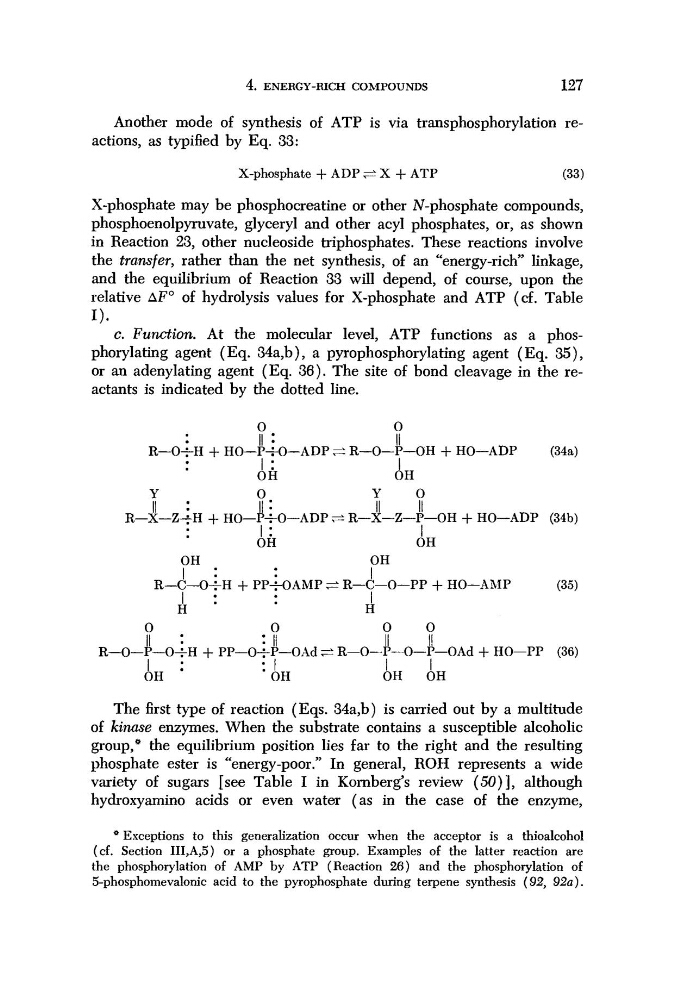
c. Function. At the molecular level, ATP functions as a phosphorylating agent (Eq. 34a,b), a pyrophosphorylating agent (Eq. 35),
or an adenylating agent (Eq. 36). The site of bond cleavage in the reactants is indicated by the dotted line.
O
O
R—O-MI + HO—P-H)—ADP ;=± R—0—P—OH + HO—ADP
(34a)
:
I :
I
OH
OH
Y
0 #
Y
O
R—X—Z4H + HO—P-i-O—ADP ;=± R—X—Z—P—OH + HO—ADP (34b)
:
I:
I
OH
OH
OH
OH
R—C—O
I
H
O
II
R—0—P—0in
H + PP-H3AMP ;=± R—C—O—PP + HO—AMP
(35)
:
I
H
O
O
O
H + PP—o4-P—OAd ;=± R—0—P—0—P—OAd + HO—PP (36)
: I
II
OH
OH
OH
The first type of reaction (Eqs. 34a,b) is carried out by a multitude
of kinase enzymes. When the substrate contains a susceptible alcoholic
group,* the equilibrium position lies far to the right and the resulting
phosphate ester is "energy-poor." In general, ROH represents a wide
variety of sugars [see Table I in Kornberg's review (50)], although
hydroxyamino acids or even water (as in the case of the enzyme,
* Exceptions to this generalization occur when the acceptor is a thioalcohol
(cf. Section III,A,5) or a phosphate group. Examples of the latter reaction are
the phosphorylation of AMP by ATP (Reaction 26) and the phosphorylation of
5-phosphomevalonic acid to the pyrophosphate during terpene synthesis (92 9 92a).
127
Another mode of synthesis of ATP is via transphosphorylation reactions, as typified by Eq. 33:
X-phosphate + ADP ;=± X + ATP
(33)
X-phosphate may be phosphocreatine or other N-phosphate compounds,
phosphoenolpyruvate, glyceryl and other acyl phosphates, or, as shown
in Reaction 23, other nucleoside triphosphates. These reactions involve
the transfer, rather than the net synthesis, of an "energy-rich" linkage,
and the equilibrium of Reaction 33 will depend, of course, upon the
relative AF° of hydrolysis values for X-phosphate and ATP (cf. Table
i).
c. Function. At the molecular level, ATP functions as a phosphorylating agent (Eq. 34a,b), a pyrophosphorylating agent (Eq. 35),
or an adenylating agent (Eq. 36). The site of bond cleavage in the reactants is indicated by the dotted line.
O
O
R—O-MI + HO—P-H)—ADP ;=± R—0—P—OH + HO—ADP
(34a)
:
I :
I
OH
OH
Y
0 #
Y
O
R—X—Z4H + HO—P-i-O—ADP ;=± R—X—Z—P—OH + HO—ADP (34b)
:
I:
I
OH
OH
OH
OH
R—C—O
I
H
O
II
R—0—P—0in
H + PP-H3AMP ;=± R—C—O—PP + HO—AMP
(35)
:
I
H
O
O
O
H + PP—o4-P—OAd ;=± R—0—P—0—P—OAd + HO—PP (36)
: I
II
OH
OH
OH
The first type of reaction (Eqs. 34a,b) is carried out by a multitude
of kinase enzymes. When the substrate contains a susceptible alcoholic
group,* the equilibrium position lies far to the right and the resulting
phosphate ester is "energy-poor." In general, ROH represents a wide
variety of sugars [see Table I in Kornberg's review (50)], although
hydroxyamino acids or even water (as in the case of the enzyme,
* Exceptions to this generalization occur when the acceptor is a thioalcohol
(cf. Section III,A,5) or a phosphate group. Examples of the latter reaction are
the phosphorylation of AMP by ATP (Reaction 26) and the phosphorylation of
5-phosphomevalonic acid to the pyrophosphate during terpene synthesis (92 9 92a).