

124
F. M. HUENNEKENS AND H. R. WHITELEY
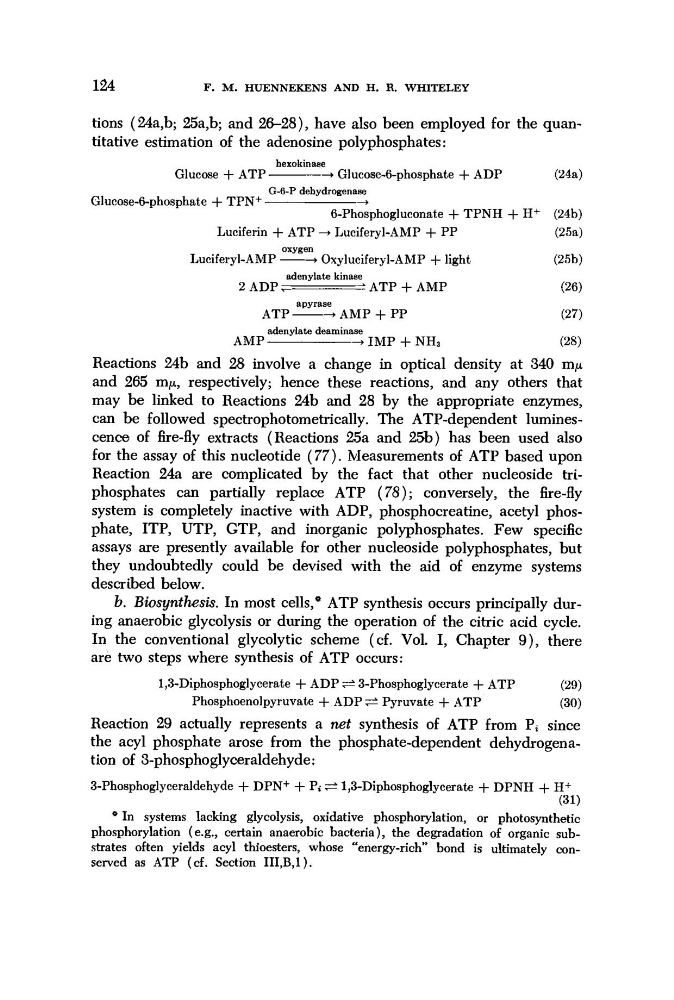
tions (24a,b; 25a,b; and 26-28), have also been employed for the quantitative estimation of the adenosine polyphosphates:
Glucose + ATP —*_^^ Glucose-6-phosphate + ADP
(24a)
G-6-P dehydrogenase
Glucose-6-phosphate + TPN+
►
6-Phosphogluconate + TPNH + H+ (24b)
Luciferin + ATP -> Luciferyl-AMP + PP
(25a)
oxygen
Luciferyl-AMP
> Oxyluciferyl-AMP + light
(25b)
adenylate kinase
2 ADP ^
=± ATP + AMP
(26)
apyrase
ATP
> AMP + PP
(27)
adenylate deaminase
AMP
► IMP + NH 3
(28)
Reactions 24b and 28 involve a change in optical density at 340 τημ
and 265 πΐμ, respectively; hence these reactions, and any others that
may be linked to Reactions 24b and 28 by the appropriate enzymes,
can be followed spectrophotometrically. The ATP-dependent luminescence of fire-fly extracts (Reactions 25a and 25b) has been used also
for the assay of this nucleotide (77). Measurements of ATP based upon
Reaction 24a are complicated by the fact that other nucleoside triphosphates can partially replace ATP (78); conversely, the fire-fly
system is completely inactive with ADP, phosphocreatine, acetyl phosphate, ITP, UTP, GTP, and inorganic polyphosphates. Few specific
assays are presently available for other nucleoside polyphosphates, but
they undoubtedly could be devised with the aid of enzyme systems
described below.
b. Biosynthesis. In most cells,* ATP synthesis occurs principally during anaerobic glycolysis or during the operation of the citric acid cycle.
In the conventional glycolytic scheme (cf. Vol. I, Chapter 9), there
are two steps where synthesis of ATP occurs:
1,3-Diphosphoglycerate + ADP ;=± 3-Phosphoglycerate + ATP
(29)
Phosphoenolpyruvate + ADP ;=± Pyruvate + ATP
(30)
Reaction 29 actually represents a net synthesis of ATP from Pi since
the acyl phosphate arose from the phosphate-dependent dehydrogenation of 3-phosphoglyceraldehyde:
3-Phosphoglyceraldehyde + DPN+ + P t ^± 1,3-Diphosphoglycerate + DPNH + H+
(31)
* In systems lacking glycolysis, oxidative phosphorylation, or photosynthetic
phosphorylation (e.g., certain anaerobic bacteria), the degradation of organic substrates often yields acyl thioesters, whose "energy-rich" bond is ultimately conserved as ATP (cf. Section ΙΙΙ,Β,Ι).
F. M. HUENNEKENS AND H. R. WHITELEY
tions (24a,b; 25a,b; and 26-28), have also been employed for the quantitative estimation of the adenosine polyphosphates:
Glucose + ATP —*_^^ Glucose-6-phosphate + ADP
(24a)
G-6-P dehydrogenase
Glucose-6-phosphate + TPN+
►
6-Phosphogluconate + TPNH + H+ (24b)
Luciferin + ATP -> Luciferyl-AMP + PP
(25a)
oxygen
Luciferyl-AMP
> Oxyluciferyl-AMP + light
(25b)
adenylate kinase
2 ADP ^
=± ATP + AMP
(26)
apyrase
ATP
> AMP + PP
(27)
adenylate deaminase
AMP
► IMP + NH 3
(28)
Reactions 24b and 28 involve a change in optical density at 340 τημ
and 265 πΐμ, respectively; hence these reactions, and any others that
may be linked to Reactions 24b and 28 by the appropriate enzymes,
can be followed spectrophotometrically. The ATP-dependent luminescence of fire-fly extracts (Reactions 25a and 25b) has been used also
for the assay of this nucleotide (77). Measurements of ATP based upon
Reaction 24a are complicated by the fact that other nucleoside triphosphates can partially replace ATP (78); conversely, the fire-fly
system is completely inactive with ADP, phosphocreatine, acetyl phosphate, ITP, UTP, GTP, and inorganic polyphosphates. Few specific
assays are presently available for other nucleoside polyphosphates, but
they undoubtedly could be devised with the aid of enzyme systems
described below.
b. Biosynthesis. In most cells,* ATP synthesis occurs principally during anaerobic glycolysis or during the operation of the citric acid cycle.
In the conventional glycolytic scheme (cf. Vol. I, Chapter 9), there
are two steps where synthesis of ATP occurs:
1,3-Diphosphoglycerate + ADP ;=± 3-Phosphoglycerate + ATP
(29)
Phosphoenolpyruvate + ADP ;=± Pyruvate + ATP
(30)
Reaction 29 actually represents a net synthesis of ATP from Pi since
the acyl phosphate arose from the phosphate-dependent dehydrogenation of 3-phosphoglyceraldehyde:
3-Phosphoglyceraldehyde + DPN+ + P t ^± 1,3-Diphosphoglycerate + DPNH + H+
(31)
* In systems lacking glycolysis, oxidative phosphorylation, or photosynthetic
phosphorylation (e.g., certain anaerobic bacteria), the degradation of organic substrates often yields acyl thioesters, whose "energy-rich" bond is ultimately conserved as ATP (cf. Section ΙΙΙ,Β,Ι).