

112
F. M. HUENNEKENS AND H. R. WHITELEY
carboxylate ion and the phosphate ion are both stabilized by resonance
to a greater degree than the carboxyl phosphate and will have, therefore, a lower energy than the latter compound. Thus, hydrolysis of
carboxyl phosphate would yield more energy than hydrolysis of an
alcohol phosphate, such as glucose-6-phosphate, since the alcohol produced in the latter reaction does not have multiple resonance forms.
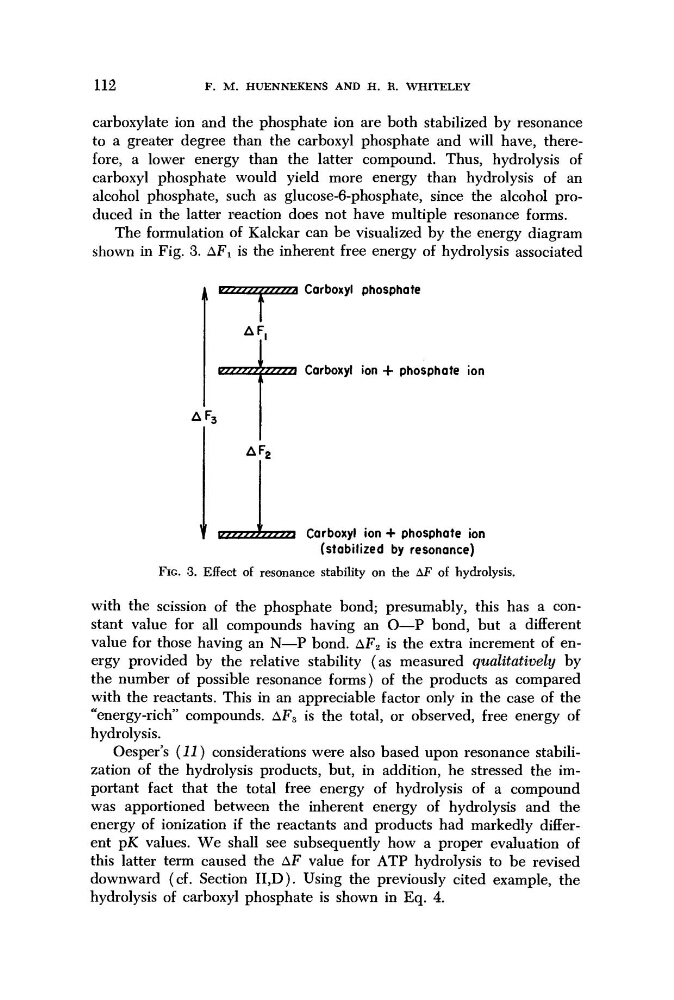
The formulation of Kalckar can be visualized by the energy diagram
shown in Fig. 3. AF X is the inherent free energy of hydrolysis associated
i ezzzzzzzzzzzza Carboxyl phosphate
I
ν/////η///ιη
Carboxyl ion + phosphate ion
T EZZZZZZZZZZZ2 Carboxyl ion + phosphate ion
(stabilized by resonance)
FIG. 3. Effect of resonance stability on the AF of hydrolysis.
with the scission of the phosphate bond; presumably, this has a constant value for all compounds having an O—P bond, but a different
value for those having an N—P bond. AF 2 is the extra increment of energy provided by the relative stability (as measured qualitatively by
the number of possible resonance forms) of the products as compared
with the reactants. This in an appreciable factor only in the case of the
"energy-rich" compounds. AF 3 is the total, or observed, free energy of
hydrolysis.
Oesper's (11) considerations were also based upon resonance stabilization of the hydrolysis products, but, in addition, he stressed the important fact that the total free energy of hydrolysis of a compound
was apportioned between the inherent energy of hydrolysis and the
energy of ionization if the reactants and products had markedly different pK values. We shall see subsequently how a proper evaluation of
this latter term caused the AF value for ATP hydrolysis to be revised
downward (cf. Section II,D). Using the previously cited example, the
hydrolysis of carboxyl phosphate is shown in Eq. 4.
F. M. HUENNEKENS AND H. R. WHITELEY
carboxylate ion and the phosphate ion are both stabilized by resonance
to a greater degree than the carboxyl phosphate and will have, therefore, a lower energy than the latter compound. Thus, hydrolysis of
carboxyl phosphate would yield more energy than hydrolysis of an
alcohol phosphate, such as glucose-6-phosphate, since the alcohol produced in the latter reaction does not have multiple resonance forms.
The formulation of Kalckar can be visualized by the energy diagram
shown in Fig. 3. AF X is the inherent free energy of hydrolysis associated
i ezzzzzzzzzzzza Carboxyl phosphate
I
ν/////η///ιη
Carboxyl ion + phosphate ion
T EZZZZZZZZZZZ2 Carboxyl ion + phosphate ion
(stabilized by resonance)
FIG. 3. Effect of resonance stability on the AF of hydrolysis.
with the scission of the phosphate bond; presumably, this has a constant value for all compounds having an O—P bond, but a different
value for those having an N—P bond. AF 2 is the extra increment of energy provided by the relative stability (as measured qualitatively by
the number of possible resonance forms) of the products as compared
with the reactants. This in an appreciable factor only in the case of the
"energy-rich" compounds. AF 3 is the total, or observed, free energy of
hydrolysis.
Oesper's (11) considerations were also based upon resonance stabilization of the hydrolysis products, but, in addition, he stressed the important fact that the total free energy of hydrolysis of a compound
was apportioned between the inherent energy of hydrolysis and the
energy of ionization if the reactants and products had markedly different pK values. We shall see subsequently how a proper evaluation of
this latter term caused the AF value for ATP hydrolysis to be revised
downward (cf. Section II,D). Using the previously cited example, the
hydrolysis of carboxyl phosphate is shown in Eq. 4.