

90
P. K. STUMPF AND G. A. BARBER
The ß-ketoacyl thiolase is an SH enzyme and Lynen (48) pictures its
action as follows:
RCH 2 COCH 2 CO-CoA + Enz—SH ;=± RCH 2 CO—S—Enz + CH3CO-C0A (25)
RCH 2 CO—S—Enz + CoA ^± RCH 2 CO-CoA + Enz—SH
(26)
The HS-Enz acts as the base reagent and leads the initial attack on
the ß-keto substrate. CoA appears at the end of the reaction to displace
the S-enzyme from the acyl-S-enzyme complex. Evidence suggests that
CoA is not the initial component involved in the cleavage reaction.
Thiolase has been found in a wide variety of mammalian organs (although low in brain), and in Clostridium kluyveri, C. saccharobutyricum, and C. butyrium (31).
In summary, five distinct steps are required to cleave acetyl-CoA
from a long-chain fatty acid. Two steps are oxidative; presumably the
electrons derived from these steps can be channeled into oxidative
phosphorylation sequence for a conservation of energy. However, the
primary extraction of energy is in the complete combustion of acetylCoA via the Krebs cycle. For most organisms the entire series of five
reactions takes place in the mitochondrial particle. There, presumably,
the enzymes are spatially arranged in a configuration adjacent to the
structures associated with the cytochrome systems and the site of oxidative phosphorylation. It is to be supposed that such an arrangement
constitutes a highly efficient system for the production and channeling
of high-energy bonds.
III. Non-Energy-Yielding Systems
Despite the prevalence of the classic /^-oxidative system that is so
beautifully geared to trap and conserve energy, in some plants there
are two systems that display highly specific reactions with long chain
fatty acids but do not appear to function in the channeling of the reaction into useful work. These are lipoxidase and fatty acid peroxidase.
A. LIPOXIDASE
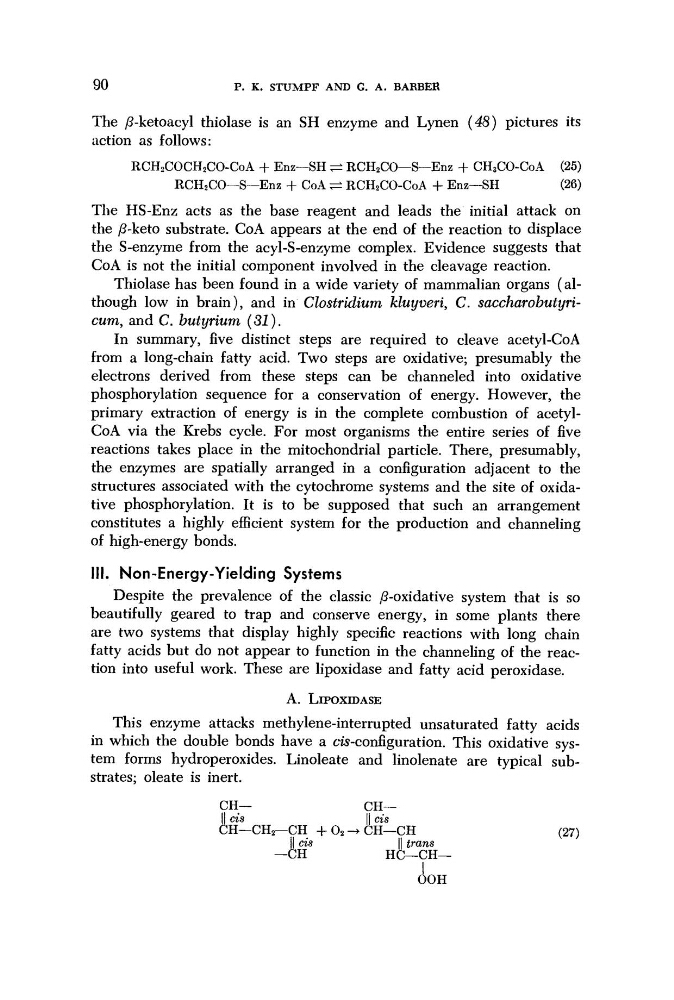
This enzyme attacks methylene-interrupted unsaturated fatty acids
in which the double bonds have a ds-configuration. This oxidative system forms hydroperoxides. Linoleate and linolenate are typical substrates; oleate is inert.
CH—
CH—
|| eis
|| eis
CH—CH 2 —CH +0 2 -*CH—CH
(27)
|| eis
|| trans
—CH
HC—CH—
OOH
P. K. STUMPF AND G. A. BARBER
The ß-ketoacyl thiolase is an SH enzyme and Lynen (48) pictures its
action as follows:
RCH 2 COCH 2 CO-CoA + Enz—SH ;=± RCH 2 CO—S—Enz + CH3CO-C0A (25)
RCH 2 CO—S—Enz + CoA ^± RCH 2 CO-CoA + Enz—SH
(26)
The HS-Enz acts as the base reagent and leads the initial attack on
the ß-keto substrate. CoA appears at the end of the reaction to displace
the S-enzyme from the acyl-S-enzyme complex. Evidence suggests that
CoA is not the initial component involved in the cleavage reaction.
Thiolase has been found in a wide variety of mammalian organs (although low in brain), and in Clostridium kluyveri, C. saccharobutyricum, and C. butyrium (31).
In summary, five distinct steps are required to cleave acetyl-CoA
from a long-chain fatty acid. Two steps are oxidative; presumably the
electrons derived from these steps can be channeled into oxidative
phosphorylation sequence for a conservation of energy. However, the
primary extraction of energy is in the complete combustion of acetylCoA via the Krebs cycle. For most organisms the entire series of five
reactions takes place in the mitochondrial particle. There, presumably,
the enzymes are spatially arranged in a configuration adjacent to the
structures associated with the cytochrome systems and the site of oxidative phosphorylation. It is to be supposed that such an arrangement
constitutes a highly efficient system for the production and channeling
of high-energy bonds.
III. Non-Energy-Yielding Systems
Despite the prevalence of the classic /^-oxidative system that is so
beautifully geared to trap and conserve energy, in some plants there
are two systems that display highly specific reactions with long chain
fatty acids but do not appear to function in the channeling of the reaction into useful work. These are lipoxidase and fatty acid peroxidase.
A. LIPOXIDASE
This enzyme attacks methylene-interrupted unsaturated fatty acids
in which the double bonds have a ds-configuration. This oxidative system forms hydroperoxides. Linoleate and linolenate are typical substrates; oleate is inert.
CH—
CH—
|| eis
|| eis
CH—CH 2 —CH +0 2 -*CH—CH
(27)
|| eis
|| trans
—CH
HC—CH—
OOH