

3. MECHANISMS FOR FATTY ACID OXIDATION
85
38), who has crystallized it from ox liver extracts. It has a very high
turnover number of 1.4 χ 10
6 moles of crotonyl-CoA per minute at 25°
for each mole of enzyme. In analyzing the substrate specificities of the
enzyme, Stern has shown that the substitution isomers such as ethylenic
thioesters with a methyl group in the a- or ^-positions greatly decrease
the reactivity. The positional isomer, 3-butenoyl-CoA, is hydrated although at a very slow rate (1.5% of the imrw-crotonyl-CoA derivative).
Stern claims that cis-crotonyl CoA is hydrated but at a rate one-third
that of the trans isomer. The eis isomer is first converted irreversibly
to the trans isomer. The trans isomer is then hydrated to L( + )-/3-hydroxyacyl-CoA. Wakil (39) presents strong evidence that crotonase
does not have any isomerase activity but does hydrate the eis isomer to
the D( — ) form and the trans to the L( + ) form. The 4-ethylenic
isomer of thioesters is not active. Acrylyl-CoA is hydrated to ß-hydroxypropionyl-CoA.
K , _ (L(+)-/3-hydroxybutyryl-CoA) _
A
"
(crotonyl-CoA)(H 2 0)
"
U8 X 1U
K! is independent of pH. If AF' = —RT In K' X 55.5 and the standard states of solutes is 1 M, then at pH 7.5 and 25° AF' is —730 cal. for
the formation of the ß-hydroxybutyryl-CoA.
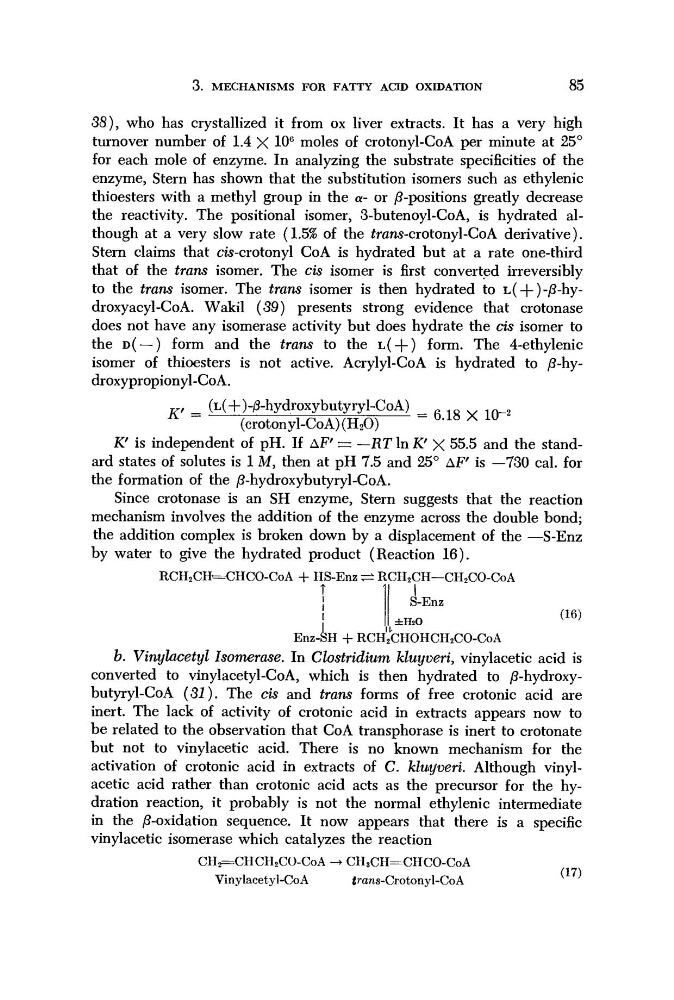
Since crotonase is an SH enzyme, Stern suggests that the reaction
mechanism involves the addition of the enzyme across the double bond;
the addition complex is broken down by a displacement of the —S-Enz
by water to give the hydrated product (Reaction 16).
RCH 2 CH-=CHCO-CoA + HS-Enz ^ RCH 2 CH—CH 2 CO-CoA
T
I
I
I
Enz-SH + RCH 2 CHOHCH 2 CO-CoA
±H 2 0
S-Enz
(16)
b. Vinylacetyl Isomerase. In Clostridium kluyveri, vinylacetic acid is
converted to vinylacetyl-CoA, which is then hydrated to ß-hydroxybutyryl-CoA (31). The eis and trans forms of free crotonic acid are
inert. The lack of activity of crotonic acid in extracts appears now to
be related to the observation that CoA transphorase is inert to crotonate
but not to vinylacetic acid. There is no known mechanism for the
activation of crotonic acid in extracts of C. kluyveri. Although vinylacetic acid rather than crotonic acid acts as the precursor for the hydration reaction, it probably is not the normal ethylenic intermediate
in the ^-oxidation sequence. It now appears that there is a specific
vinylacetic isomerase which catalyzes the reaction
CH^CHCHsCO-CoA -> CH 3 CH=CHCO-CoA
(17)
Vinylacety 1-Co A
t rans-Cr otonyl-Co A
85
38), who has crystallized it from ox liver extracts. It has a very high
turnover number of 1.4 χ 10
6 moles of crotonyl-CoA per minute at 25°
for each mole of enzyme. In analyzing the substrate specificities of the
enzyme, Stern has shown that the substitution isomers such as ethylenic
thioesters with a methyl group in the a- or ^-positions greatly decrease
the reactivity. The positional isomer, 3-butenoyl-CoA, is hydrated although at a very slow rate (1.5% of the imrw-crotonyl-CoA derivative).
Stern claims that cis-crotonyl CoA is hydrated but at a rate one-third
that of the trans isomer. The eis isomer is first converted irreversibly
to the trans isomer. The trans isomer is then hydrated to L( + )-/3-hydroxyacyl-CoA. Wakil (39) presents strong evidence that crotonase
does not have any isomerase activity but does hydrate the eis isomer to
the D( — ) form and the trans to the L( + ) form. The 4-ethylenic
isomer of thioesters is not active. Acrylyl-CoA is hydrated to ß-hydroxypropionyl-CoA.
K , _ (L(+)-/3-hydroxybutyryl-CoA) _
A
"
(crotonyl-CoA)(H 2 0)
"
U8 X 1U
K! is independent of pH. If AF' = —RT In K' X 55.5 and the standard states of solutes is 1 M, then at pH 7.5 and 25° AF' is —730 cal. for
the formation of the ß-hydroxybutyryl-CoA.
Since crotonase is an SH enzyme, Stern suggests that the reaction
mechanism involves the addition of the enzyme across the double bond;
the addition complex is broken down by a displacement of the —S-Enz
by water to give the hydrated product (Reaction 16).
RCH 2 CH-=CHCO-CoA + HS-Enz ^ RCH 2 CH—CH 2 CO-CoA
T
I
I
I
Enz-SH + RCH 2 CHOHCH 2 CO-CoA
±H 2 0
S-Enz
(16)
b. Vinylacetyl Isomerase. In Clostridium kluyveri, vinylacetic acid is
converted to vinylacetyl-CoA, which is then hydrated to ß-hydroxybutyryl-CoA (31). The eis and trans forms of free crotonic acid are
inert. The lack of activity of crotonic acid in extracts appears now to
be related to the observation that CoA transphorase is inert to crotonate
but not to vinylacetic acid. There is no known mechanism for the
activation of crotonic acid in extracts of C. kluyveri. Although vinylacetic acid rather than crotonic acid acts as the precursor for the hydration reaction, it probably is not the normal ethylenic intermediate
in the ^-oxidation sequence. It now appears that there is a specific
vinylacetic isomerase which catalyzes the reaction
CH^CHCHsCO-CoA -> CH 3 CH=CHCO-CoA
(17)
Vinylacety 1-Co A
t rans-Cr otonyl-Co A