

84
P. K. STUMPF AND G. A. BARBER
ductive steps, free reversibility can be demonstrated. Thus the ratio
Vsu
25 ° (phenazine methosulfate)
7 Fu (FMN · H
2 )
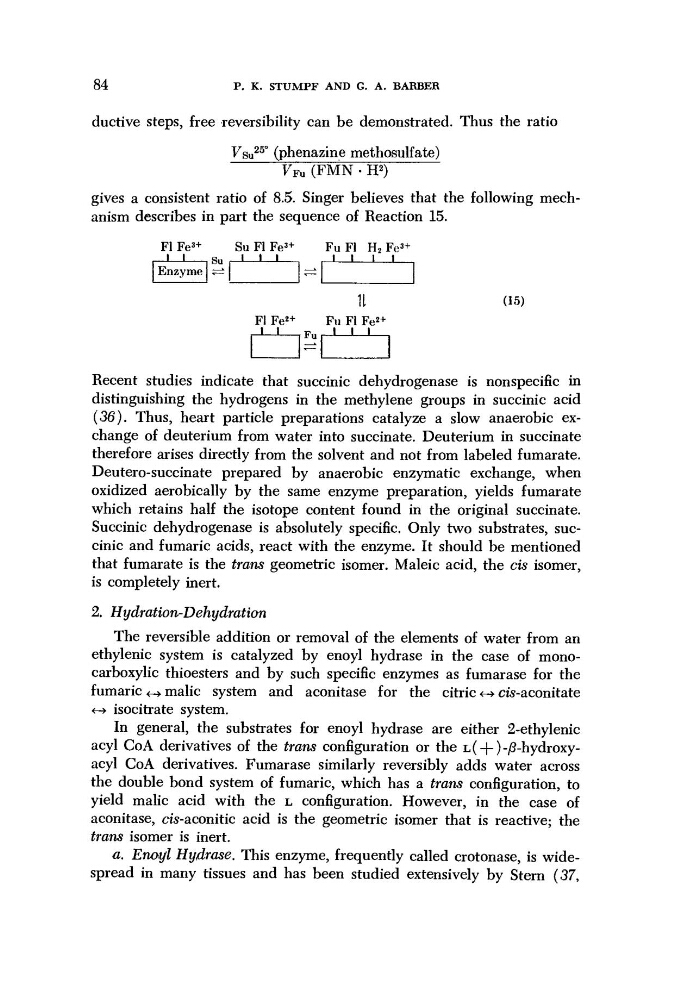
gives a consistent ratio of 8.5. Singer believes that the following mechanism describes in part the sequence of Reaction 15.
Fl Fe
3+
Su Fl Fe
3+
J_l
lSu
1 i ■
Enzyme
FuFl H 2 Fe
3+
_l I 1 I
Fl Fe
2+
J-J
Fu
11
Fu Fl Fe
2+
J
L_L
(15)
Recent studies indicate that succinic dehydrogenase is nonspecific in
distinguishing the hydrogens in the methylene groups in succinic acid
(36). Thus, heart particle preparations catalyze a slow anaerobic exchange of deuterium from water into succinate. Deuterium in succinate
therefore arises directly from the solvent and not from labeled fumarate.
Deutero-succinate prepared by anaerobic enzymatic exchange, when
oxidized aerobically by the same enzyme preparation, yields fumarate
which retains half the isotope content found in the original succinate.
Succinic dehydrogenase is absolutely specific. Only two substrates, succinic and fumaric acids, react with the enzyme. It should be mentioned
that fumarate is the trans geometric isomer. Maleic acid, the eis isomer,
is completely inert.
2. Hydration-Dehydration
The reversible addition or removal of the elements of water from an
ethylenic system is catalyzed by enoyl hydrase in the case of monocarboxylic thioesters and by such specific enzymes as fumarase for the
fumaric <-» malic system and aconitase for the citric <-> cis-aconitate
«-» isocitrate system.
In general, the substrates for enoyl hydrase are either 2-ethylenic
acyl CoA derivatives of the trans configuration or the L(-{-)-/?-hydroxyacyl CoA derivatives. Fumarase similarly reversibly adds water across
the double bond system of fumaric, which has a trans configuration, to
yield malic acid with the L configuration. However, in the case of
aconitase, m-aconitic acid is the geometric isomer that is reactive; the
trans isomer is inert.
a. Enoyl Hydrase. This enzyme, frequently called crotonase, is widespread in many tissues and has been studied extensively by Stern (37,
P. K. STUMPF AND G. A. BARBER
ductive steps, free reversibility can be demonstrated. Thus the ratio
Vsu
25 ° (phenazine methosulfate)
7 Fu (FMN · H
2 )
gives a consistent ratio of 8.5. Singer believes that the following mechanism describes in part the sequence of Reaction 15.
Fl Fe
3+
Su Fl Fe
3+
J_l
lSu
1 i ■
Enzyme
FuFl H 2 Fe
3+
_l I 1 I
Fl Fe
2+
J-J
Fu
11
Fu Fl Fe
2+
J
L_L
(15)
Recent studies indicate that succinic dehydrogenase is nonspecific in
distinguishing the hydrogens in the methylene groups in succinic acid
(36). Thus, heart particle preparations catalyze a slow anaerobic exchange of deuterium from water into succinate. Deuterium in succinate
therefore arises directly from the solvent and not from labeled fumarate.
Deutero-succinate prepared by anaerobic enzymatic exchange, when
oxidized aerobically by the same enzyme preparation, yields fumarate
which retains half the isotope content found in the original succinate.
Succinic dehydrogenase is absolutely specific. Only two substrates, succinic and fumaric acids, react with the enzyme. It should be mentioned
that fumarate is the trans geometric isomer. Maleic acid, the eis isomer,
is completely inert.
2. Hydration-Dehydration
The reversible addition or removal of the elements of water from an
ethylenic system is catalyzed by enoyl hydrase in the case of monocarboxylic thioesters and by such specific enzymes as fumarase for the
fumaric <-» malic system and aconitase for the citric <-> cis-aconitate
«-» isocitrate system.
In general, the substrates for enoyl hydrase are either 2-ethylenic
acyl CoA derivatives of the trans configuration or the L(-{-)-/?-hydroxyacyl CoA derivatives. Fumarase similarly reversibly adds water across
the double bond system of fumaric, which has a trans configuration, to
yield malic acid with the L configuration. However, in the case of
aconitase, m-aconitic acid is the geometric isomer that is reactive; the
trans isomer is inert.
a. Enoyl Hydrase. This enzyme, frequently called crotonase, is widespread in many tissues and has been studied extensively by Stern (37,