

302
LIONEL F. JAFFE
TABLE II
Gradients or Flows through Fucus Eggs
Starting time
Species"
Character
Direction
re deformation
Magnitude
(Refs.)
6
1 Plasmolysis
Rhizoid end first
5-12 hr before
Ff(l)
2 Electrical
Positive ions enter About same
10~
6
amp/cm
2
Ff(2)
current
rhizoid
2 hr before
10~
5
amp/cm
2
Pf(3)
3 Secrete rhizogen Rhizoid end first
At or before
If, Pf(4)
4 Take up vital
dyes
Rhizoid end first
After
Fe(5)
5 RNA
Highest at rhizoid
end
After
Fe(6)
6 Golgi apparatus Highest at
rhizoid end
After
Fv, Fs(7)
7 Wall precursor
vesicles
Highest at
rhizoid end
After
Fv,Fs(7)
° Ff = Fucus furcatus;
Pf = Pelvetia fastigiata;
Fe = Fucus evanescens; Fv =
Fucus vesiculosus; Fs = Fucus serratus.
b
Key
to references: (1) Reed and Whitaker, 1941; (2) Jaffe, 1966; (3) Jaffe, unpublished; (4) Neuscheler and Jaffe, unpublished; (5) Nakazawa, 1957; (6) Nakazawa,
1966; (7) Bouck, 1967.
perhaps 0-2 hours—before germination. The germination and centrifugation curves, although obtained with different batches of eggs, seem otherwise comparable. So they directly indicate polarizability by centrifugation until close to the time of germination. The photopolarization curve
is less comparable with the germination one since the latter was obtained
with eggs grown in the dark, and it is known that continuous light can
advance germination by about 4 hours (Whitaker, 1936). However, Fig.
7 shows the courses of photopolarizability and of germination of aliquots
of one batch of comparably treated eggs of Pelvetia fastigiata, Here the
retention of polarizability nearly until germination itself is directly
evident.
The tentative polarity induced by light is reversible by subsequent
counterillumination
(Whitaker, 1942; Bentrup, 1963). Moreover, the fall
in susceptibility to such a second light follows the same course as that to
a single stimulus (Bentrup, 1963). Flow polarization is likewise photoreversible (Bentrup and Jaffe, 1968), but centrifugal polarization is reported not to be so reversible (Knapp, 1931).
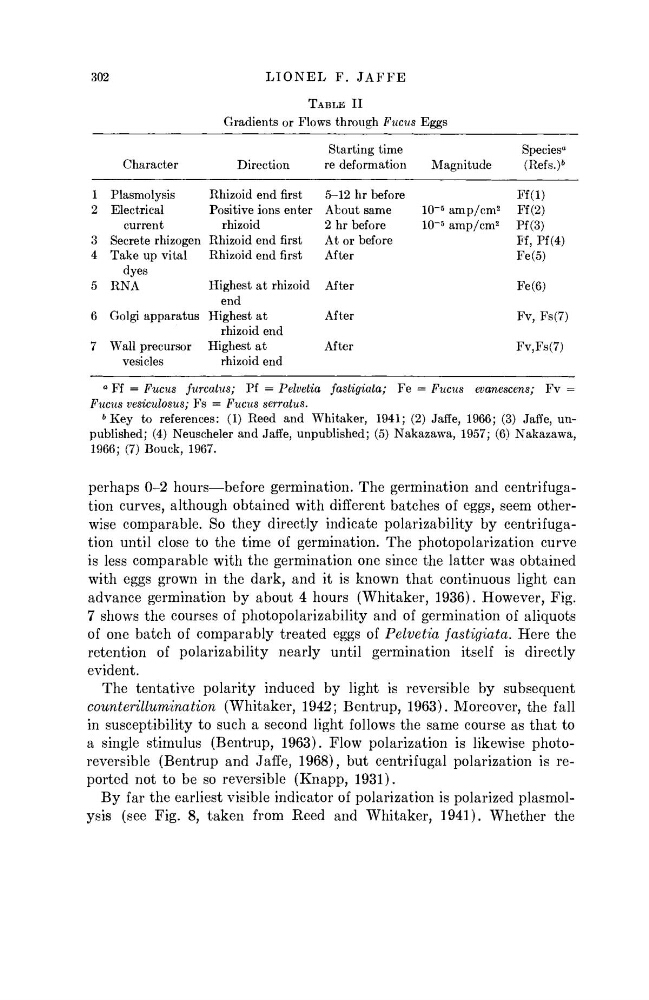
By far the earliest visible indicator of polarization is polarized plasmolysis (see Fig. 8, taken from Reed and Whitaker, 1941). Whether the
LIONEL F. JAFFE
TABLE II
Gradients or Flows through Fucus Eggs
Starting time
Species"
Character
Direction
re deformation
Magnitude
(Refs.)
6
1 Plasmolysis
Rhizoid end first
5-12 hr before
Ff(l)
2 Electrical
Positive ions enter About same
10~
6
amp/cm
2
Ff(2)
current
rhizoid
2 hr before
10~
5
amp/cm
2
Pf(3)
3 Secrete rhizogen Rhizoid end first
At or before
If, Pf(4)
4 Take up vital
dyes
Rhizoid end first
After
Fe(5)
5 RNA
Highest at rhizoid
end
After
Fe(6)
6 Golgi apparatus Highest at
rhizoid end
After
Fv, Fs(7)
7 Wall precursor
vesicles
Highest at
rhizoid end
After
Fv,Fs(7)
° Ff = Fucus furcatus;
Pf = Pelvetia fastigiata;
Fe = Fucus evanescens; Fv =
Fucus vesiculosus; Fs = Fucus serratus.
b
Key
to references: (1) Reed and Whitaker, 1941; (2) Jaffe, 1966; (3) Jaffe, unpublished; (4) Neuscheler and Jaffe, unpublished; (5) Nakazawa, 1957; (6) Nakazawa,
1966; (7) Bouck, 1967.
perhaps 0-2 hours—before germination. The germination and centrifugation curves, although obtained with different batches of eggs, seem otherwise comparable. So they directly indicate polarizability by centrifugation until close to the time of germination. The photopolarization curve
is less comparable with the germination one since the latter was obtained
with eggs grown in the dark, and it is known that continuous light can
advance germination by about 4 hours (Whitaker, 1936). However, Fig.
7 shows the courses of photopolarizability and of germination of aliquots
of one batch of comparably treated eggs of Pelvetia fastigiata, Here the
retention of polarizability nearly until germination itself is directly
evident.
The tentative polarity induced by light is reversible by subsequent
counterillumination
(Whitaker, 1942; Bentrup, 1963). Moreover, the fall
in susceptibility to such a second light follows the same course as that to
a single stimulus (Bentrup, 1963). Flow polarization is likewise photoreversible (Bentrup and Jaffe, 1968), but centrifugal polarization is reported not to be so reversible (Knapp, 1931).
By far the earliest visible indicator of polarization is polarized plasmolysis (see Fig. 8, taken from Reed and Whitaker, 1941). Whether the