

296
L I O N E L
F .
J A F F E
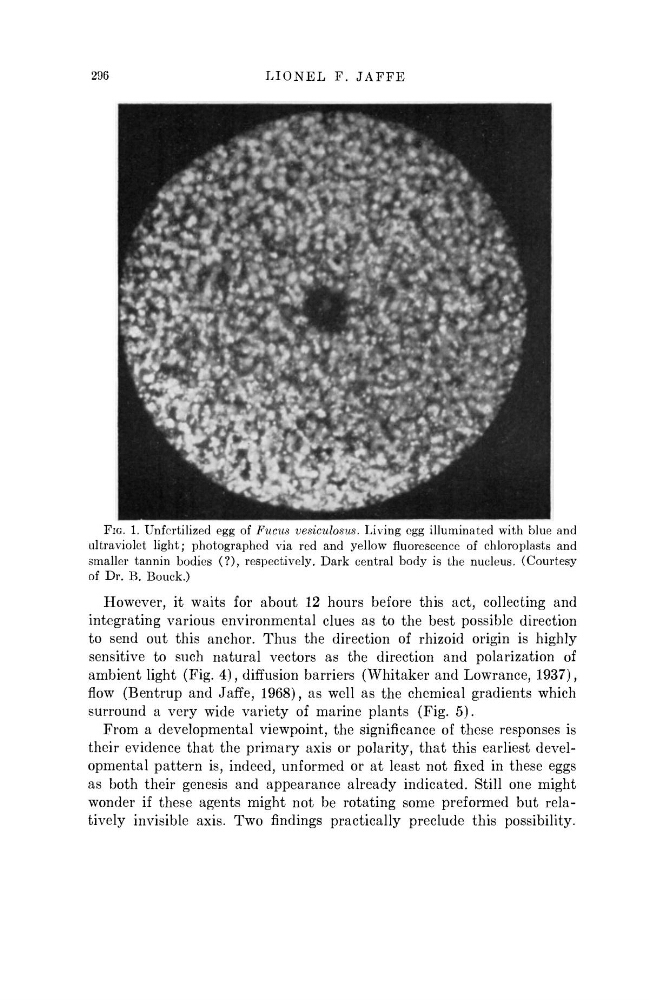
FIG. 1. Unfertilized egg of Fucus vesiculosus. Living egg illuminated with blue and
ultraviolet light; photographed via red and yellow fluorescence of chloroplasts and
smaller tannin bodies ( ? ) , respectively. Dark central body is the nucleus. (Courtesy
of Dr. B. Bouck.)
However, it waits for about 12 hours before this act, collecting and
integrating various environmental clues as to the best possible direction
to send out this anchor. Thus the direction of rhizoid origin is highly
sensitive to such natural vectors as the direction and polarization of
ambient light (Fig. 4 ) , diffusion barriers (Whitaker and Lowrance, 1937),
flow (Bentrup and Jaffe, 1968), as well as the chemical gradients which
surround a very wide variety of marine plants (Fig. 5 ) .
F r o m a developmental viewpoint, the significance of these responses is
their evidence that the primary axis or polarity, that this earliest developmental pattern is, indeed, unformed or at least not fixed in these eggs
as both their genesis and appearance already indicated. Still one might
wonder if these agents might not be rotating some preformed but relatively invisible axis. T w o findings practically preclude this possibility.
L I O N E L
F .
J A F F E
FIG. 1. Unfertilized egg of Fucus vesiculosus. Living egg illuminated with blue and
ultraviolet light; photographed via red and yellow fluorescence of chloroplasts and
smaller tannin bodies ( ? ) , respectively. Dark central body is the nucleus. (Courtesy
of Dr. B. Bouck.)
However, it waits for about 12 hours before this act, collecting and
integrating various environmental clues as to the best possible direction
to send out this anchor. Thus the direction of rhizoid origin is highly
sensitive to such natural vectors as the direction and polarization of
ambient light (Fig. 4 ) , diffusion barriers (Whitaker and Lowrance, 1937),
flow (Bentrup and Jaffe, 1968), as well as the chemical gradients which
surround a very wide variety of marine plants (Fig. 5 ) .
F r o m a developmental viewpoint, the significance of these responses is
their evidence that the primary axis or polarity, that this earliest developmental pattern is, indeed, unformed or at least not fixed in these eggs
as both their genesis and appearance already indicated. Still one might
wonder if these agents might not be rotating some preformed but relatively invisible axis. T w o findings practically preclude this possibility.