

B L A S T O G E N E S I S A N D M O R P H O G E N E S I S
1 8 9
All this is accomplished b y the same processes as in all embryonic
epigenesis. T h e differentiation of blastogenic cells, initially all alike,
is a function of their position in the whole organism according to the
principles of Driesch.
T h e statoblasts of phylactolaemates are slightly more complex. The
blastogenic cells there are of two kinds. T h e y subdivide ontogenesis. One
kind are the cyst precursors which are going to form the primordial
cystid and the organs of the young zooecium; the others are deutoblastic
cells. T h e y elaborate y o l k reserves which will be necessary for the
nutrition of the growing blastozooid. After they are empty, their inclusions entirely digested, they will form the coelomic layer covering the
organs.
T h e mass of mesoblastic cells of a bud of Clavelina is located in an
ectodermal lobe of the budding chamber. This chamber will be the
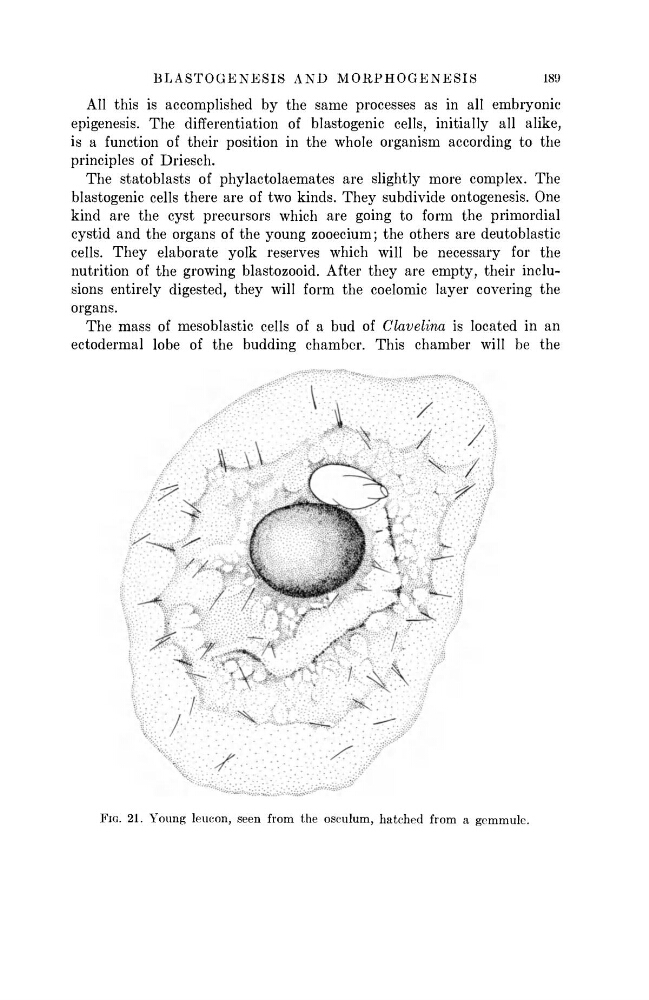
F I G . 2 1 . Young leucon, seen from the osculum, hatched from a gemmule.
1 8 9
All this is accomplished b y the same processes as in all embryonic
epigenesis. T h e differentiation of blastogenic cells, initially all alike,
is a function of their position in the whole organism according to the
principles of Driesch.
T h e statoblasts of phylactolaemates are slightly more complex. The
blastogenic cells there are of two kinds. T h e y subdivide ontogenesis. One
kind are the cyst precursors which are going to form the primordial
cystid and the organs of the young zooecium; the others are deutoblastic
cells. T h e y elaborate y o l k reserves which will be necessary for the
nutrition of the growing blastozooid. After they are empty, their inclusions entirely digested, they will form the coelomic layer covering the
organs.
T h e mass of mesoblastic cells of a bud of Clavelina is located in an
ectodermal lobe of the budding chamber. This chamber will be the
F I G . 2 1 . Young leucon, seen from the osculum, hatched from a gemmule.