

142
HERMAN DENIS
18c compared with b). The difference between both series of values is
maximum during gastrulation and tends to decrease in later development. Considerable discrepancy also exists between the data of Figs,
lib and 17. In gastrulae, about 40% of
3 2
P-labeled RNA is DNA-like,
but only 10% of this RNA hybridizes readily with DNA. A simple
interpretation of the observed discrepancy would be that the early
embryo synthesizes some mRNA molecules in such a high number of
copies that these cannot hybridize with DNA, even when the latter is
present in large excess in the incubation mixture.
TABLE I
Amount of Hybridizable RNA Present in Embryos of Different Stages
Labeled
hybridizable
Stage
Type of labeling
RNA (m M g)
12 (gastrula)
32p
12
1 4
C, 11 hr
13
26-28 (tail bud)
32p
34
1 4
C, 11 hr
24
39 (swimming tadpole)
32p
78
1 4
C, 11 hr
42
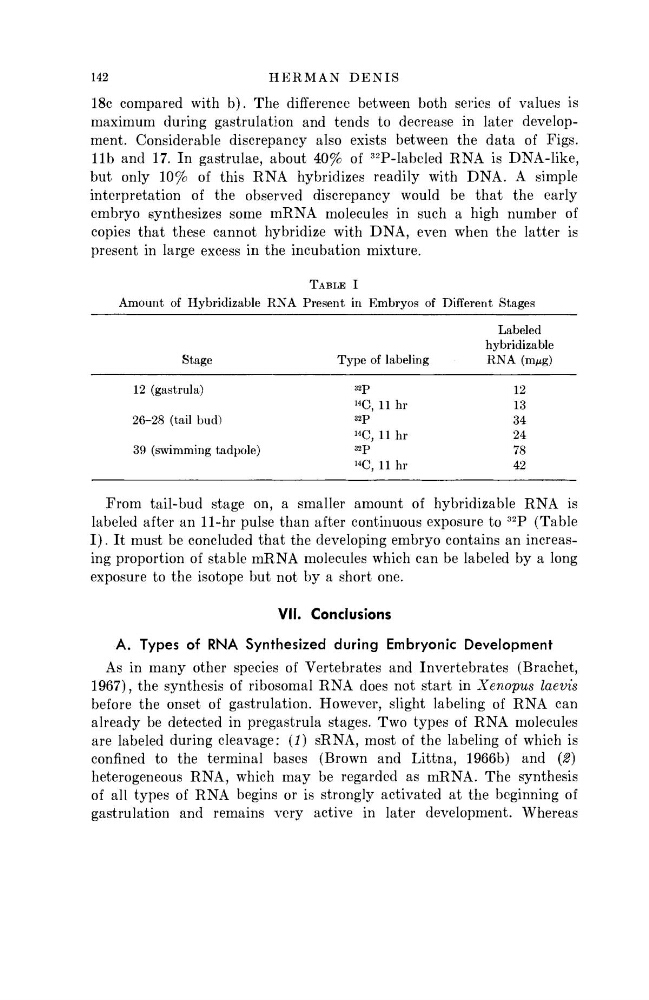
From tail-bud stage on, a smaller amount of hybridizable RNA is
labeled after an 11-hr pulse than after continuous exposure to
3 2
P (Table
I). It must be concluded that the developing embryo contains an increasing proportion of stable mRNA molecules which can be labeled by a long
exposure to the isotope but not by a short one.
VII. Conclusions
A. Types of RNA Synthesized during Embryonic Development
As in many other species of Vertebrates and Invertebrates (Brachet,
1967), the synthesis of ribosomal RNA does not start in Xenopus
laevis
before the onset of gastrulation. However, slight labeling of RNA can
already be detected in pregastrula stages. Two types of RNA molecules
are labeled during cleavage: (1) sRNA, most of the labeling of which is
confined to the terminal bases (Brown and Littna, 1966b) and (2)
heterogeneous RNA, which may be regarded as mRNA. The synthesis
of all types of RNA begins or is strongly activated at the beginning of
gastrulation and remains very active in later development. Whereas
HERMAN DENIS
18c compared with b). The difference between both series of values is
maximum during gastrulation and tends to decrease in later development. Considerable discrepancy also exists between the data of Figs,
lib and 17. In gastrulae, about 40% of
3 2
P-labeled RNA is DNA-like,
but only 10% of this RNA hybridizes readily with DNA. A simple
interpretation of the observed discrepancy would be that the early
embryo synthesizes some mRNA molecules in such a high number of
copies that these cannot hybridize with DNA, even when the latter is
present in large excess in the incubation mixture.
TABLE I
Amount of Hybridizable RNA Present in Embryos of Different Stages
Labeled
hybridizable
Stage
Type of labeling
RNA (m M g)
12 (gastrula)
32p
12
1 4
C, 11 hr
13
26-28 (tail bud)
32p
34
1 4
C, 11 hr
24
39 (swimming tadpole)
32p
78
1 4
C, 11 hr
42
From tail-bud stage on, a smaller amount of hybridizable RNA is
labeled after an 11-hr pulse than after continuous exposure to
3 2
P (Table
I). It must be concluded that the developing embryo contains an increasing proportion of stable mRNA molecules which can be labeled by a long
exposure to the isotope but not by a short one.
VII. Conclusions
A. Types of RNA Synthesized during Embryonic Development
As in many other species of Vertebrates and Invertebrates (Brachet,
1967), the synthesis of ribosomal RNA does not start in Xenopus
laevis
before the onset of gastrulation. However, slight labeling of RNA can
already be detected in pregastrula stages. Two types of RNA molecules
are labeled during cleavage: (1) sRNA, most of the labeling of which is
confined to the terminal bases (Brown and Littna, 1966b) and (2)
heterogeneous RNA, which may be regarded as mRNA. The synthesis
of all types of RNA begins or is strongly activated at the beginning of
gastrulation and remains very active in later development. Whereas