

ROLE OF mRNA IN EMBRYONIC DEVELOPMENT
141
after Sephadex filtration contains only rRNA and DNA-like RNA
(dRNA). The G + C content of this fraction increases during embryonic
development. This indicates that the front peak contains an increasing
proportion of rRNA. From the G + C content of the unretarded peak, one
can deduce the proportion of rRNA and dRNA present in this fraction,
since the G + C content of dRNA and of rRNA is known (40% and 60%
of G + C, respectively; Brown and Littna, 1964b). With these data,
Brown and Littna could calculate the amount of dRNA synthesized by
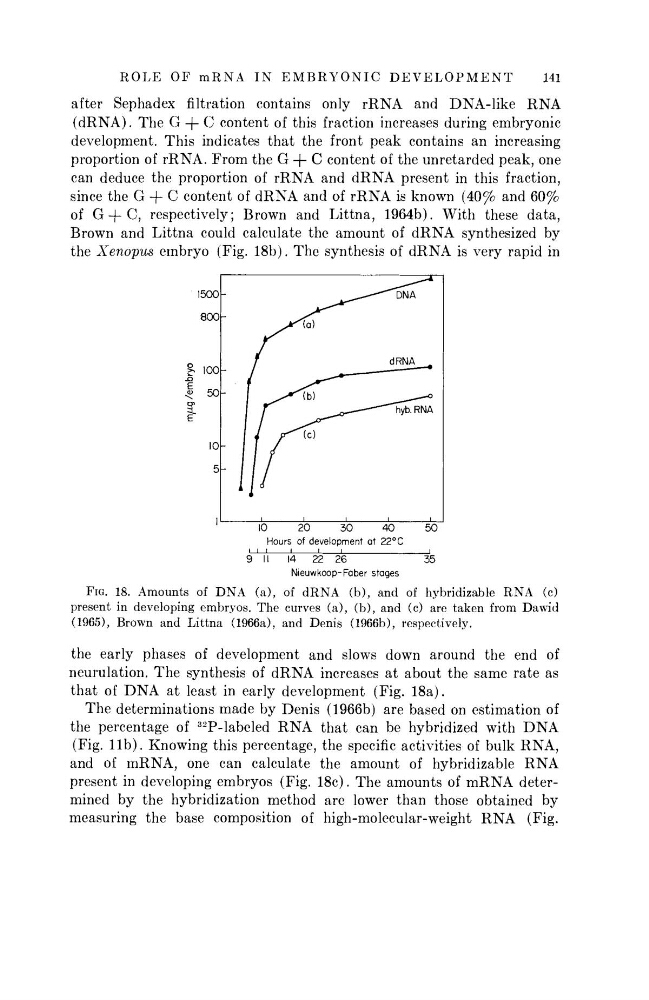
the Xenopus embryo (Fig. 18b). The synthesis of dRNA is very rapid in
500 -
—"DNA
800
100
50
dRNA^
^^hyb^RNA
10
5
i
i
i
i
i
10
20
30
40
50
Hours of development at 22°C
ST^H
14
22
26
35
Nieuwkoop-Faber stages
FIG. 18. Amounts of DNA (a), of dRNA (b), and of hybridizable RNA (c)
present in developing embryos. The curves (a), (b), and (c) are taken from Dawid
(1965), Brown and Littna (1966a), and Denis (1966b), respectively.
the early phases of development and slows down around the end of
neurulation. The synthesis of dRNA increases at about the same rate as
that of DNA at least in early development (Fig. 18a).
The determinations made by Denis (1966b) are based on estimation of
the percentage of
3 2
P-labeled RNA that can be hybridized with DNA
(Fig. lib). Knowing this percentage, the specific activities of bulk RNA,
and of mRNA, one can calculate the amount of hybridizable RNA
present in developing embryos (Fig. 18c). The amounts of mRNA determined by the hybridization method are lower than those obtained by
measuring the base composition of high-molecular-weight RNA (Fig.
m/xg /embryo
141
after Sephadex filtration contains only rRNA and DNA-like RNA
(dRNA). The G + C content of this fraction increases during embryonic
development. This indicates that the front peak contains an increasing
proportion of rRNA. From the G + C content of the unretarded peak, one
can deduce the proportion of rRNA and dRNA present in this fraction,
since the G + C content of dRNA and of rRNA is known (40% and 60%
of G + C, respectively; Brown and Littna, 1964b). With these data,
Brown and Littna could calculate the amount of dRNA synthesized by
the Xenopus embryo (Fig. 18b). The synthesis of dRNA is very rapid in
500 -
—"DNA
800
100
50
dRNA^
^^hyb^RNA
10
5
i
i
i
i
i
10
20
30
40
50
Hours of development at 22°C
ST^H
14
22
26
35
Nieuwkoop-Faber stages
FIG. 18. Amounts of DNA (a), of dRNA (b), and of hybridizable RNA (c)
present in developing embryos. The curves (a), (b), and (c) are taken from Dawid
(1965), Brown and Littna (1966a), and Denis (1966b), respectively.
the early phases of development and slows down around the end of
neurulation. The synthesis of dRNA increases at about the same rate as
that of DNA at least in early development (Fig. 18a).
The determinations made by Denis (1966b) are based on estimation of
the percentage of
3 2
P-labeled RNA that can be hybridized with DNA
(Fig. lib). Knowing this percentage, the specific activities of bulk RNA,
and of mRNA, one can calculate the amount of hybridizable RNA
present in developing embryos (Fig. 18c). The amounts of mRNA determined by the hybridization method are lower than those obtained by
measuring the base composition of high-molecular-weight RNA (Fig.
m/xg /embryo