

D E V E L O P M E N T S I N S E X U A L O R G A N O G E N E S I S
307
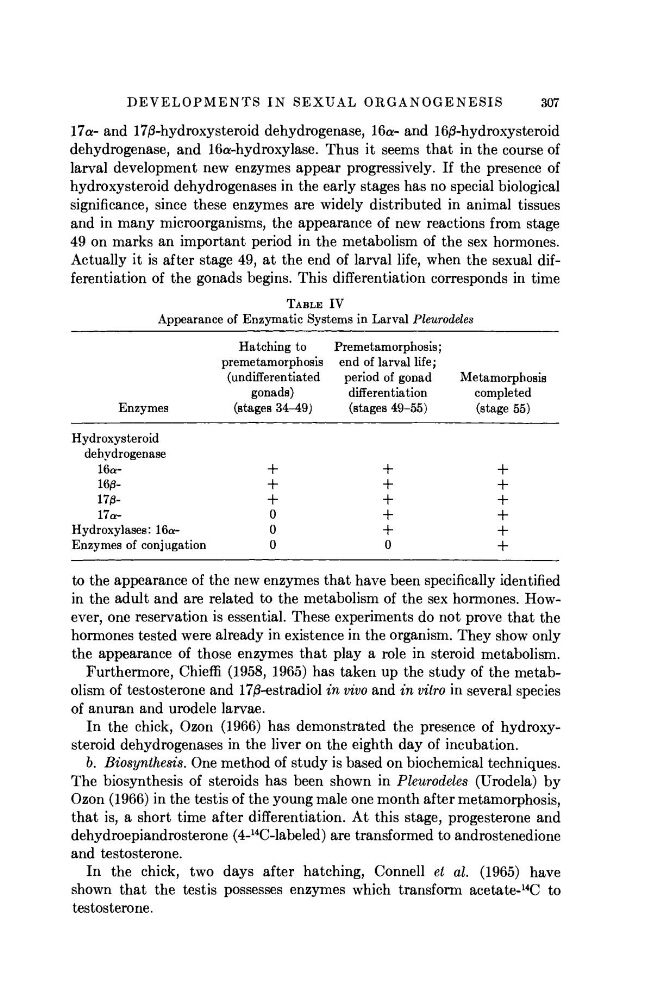
17a- and 17/3-hydroxysteroid dehydrogenase, 16a- and 16ß-hydroxysteroid
dehydrogenase, and 16a-hydroxylase. Thus it seems that in the course of
larval development new enzymes appear progressively. If the presence of
hydroxysteroid dehydrogenases in the early stages has no special biological
significance, since these enzymes are widely distributed in animal tissues
and in many microorganisms, the appearance of new reactions from stage
49 on marks an important period in the metabolism of the sex hormones.
Actually it is after stage 49, at the end of larval life, when the sexual differentiation of the gonads begins. This differentiation corresponds in time
TABLE IV
Appearance of Enzymatic Systems in Larval Pleurodeles
Enzymes
Hydroxysteroid
dehydrogenase
17aHydroxylases: 16aEnzymes of conjugation
Hatching to
premetamorphosis
(undifferentiated
gonads)
(stages 34-49)
+
+
+ 0
0
0
Premetamorphosis ;
end of larval life;
period of gonad
differentiation
(stages 49-55)
+
+
+
+
+
0
Metamorphosis
completed
(stage 55)
+
+
+
+
+
+
to the appearance of the new enzymes that have been specifically identified
in the adult and are related to the metabolism of the sex hormones. However, one reservation is essential. These experiments do not prove that the
hormones tested were already in existence in the organism. They show only
the appearance of those enzymes that play a role in steroid metabolism.
Furthermore, Chieffi (1958, 1965) has taken up the study of the metabolism of testosterone and 170-estradiol in vivo and in vitro in several species
of anuran and urodele larvae.
In the chick, Ozon (1966) has demonstrated the presence of hydroxysteroid dehydrogenases in the liver on the eighth day of incubation.
b. Biosynthesis. One method of study is based on biochemical techniques.
The biosynthesis of steroids has been shown in Pleurodeles (Urodela) by
Ozon (1966) in the testis of the young male one month after metamorphosis,
that is, a short time after differentiation. At this stage, progesterone and
dehydroepiandrosterone (414
C-labeled) are transformed to androstenedione
and testosterone.
In the chick, two days after hatching, Connell et al. (1965) have
shown that the testis possesses enzymes which transform acetate14
C to
testosterone.
307
17a- and 17/3-hydroxysteroid dehydrogenase, 16a- and 16ß-hydroxysteroid
dehydrogenase, and 16a-hydroxylase. Thus it seems that in the course of
larval development new enzymes appear progressively. If the presence of
hydroxysteroid dehydrogenases in the early stages has no special biological
significance, since these enzymes are widely distributed in animal tissues
and in many microorganisms, the appearance of new reactions from stage
49 on marks an important period in the metabolism of the sex hormones.
Actually it is after stage 49, at the end of larval life, when the sexual differentiation of the gonads begins. This differentiation corresponds in time
TABLE IV
Appearance of Enzymatic Systems in Larval Pleurodeles
Enzymes
Hydroxysteroid
dehydrogenase
17aHydroxylases: 16aEnzymes of conjugation
Hatching to
premetamorphosis
(undifferentiated
gonads)
(stages 34-49)
+
+
+ 0
0
0
Premetamorphosis ;
end of larval life;
period of gonad
differentiation
(stages 49-55)
+
+
+
+
+
0
Metamorphosis
completed
(stage 55)
+
+
+
+
+
+
to the appearance of the new enzymes that have been specifically identified
in the adult and are related to the metabolism of the sex hormones. However, one reservation is essential. These experiments do not prove that the
hormones tested were already in existence in the organism. They show only
the appearance of those enzymes that play a role in steroid metabolism.
Furthermore, Chieffi (1958, 1965) has taken up the study of the metabolism of testosterone and 170-estradiol in vivo and in vitro in several species
of anuran and urodele larvae.
In the chick, Ozon (1966) has demonstrated the presence of hydroxysteroid dehydrogenases in the liver on the eighth day of incubation.
b. Biosynthesis. One method of study is based on biochemical techniques.
The biosynthesis of steroids has been shown in Pleurodeles (Urodela) by
Ozon (1966) in the testis of the young male one month after metamorphosis,
that is, a short time after differentiation. At this stage, progesterone and
dehydroepiandrosterone (414
C-labeled) are transformed to androstenedione
and testosterone.
In the chick, two days after hatching, Connell et al. (1965) have
shown that the testis possesses enzymes which transform acetate14
C to
testosterone.