

282
L. G A L L I E N
be pointed out that this is the only known case of a haploid vertebrate
reaching adulthood.
In these combinations the haploid individuals, obtained by thermal
shocking of the eggs, were androhaploids. Usually in the cf 2n X cf n pairs,
both parabionts develop testes, but in the haploid, spermatogenesis is
interrupted at the primary spermatocyte stage; bivalents cannot be formed.
Thus the haploids are sterile (Fig. 13).
In the Ç 2n X c? n pairs the results are variable and are related to the
level of general development of the haploid. It may inhibit ovarian differentiation in varying degrees. Most often, in this combination (Ç 2n X
d
71
n), the sex of the gonads in the two partners differentiates quite normally : the diploid has ovaries with mature pigmented oocytes, the haploid
has two testes developed, but with spermatogenesis interrupted (Fig. 14).
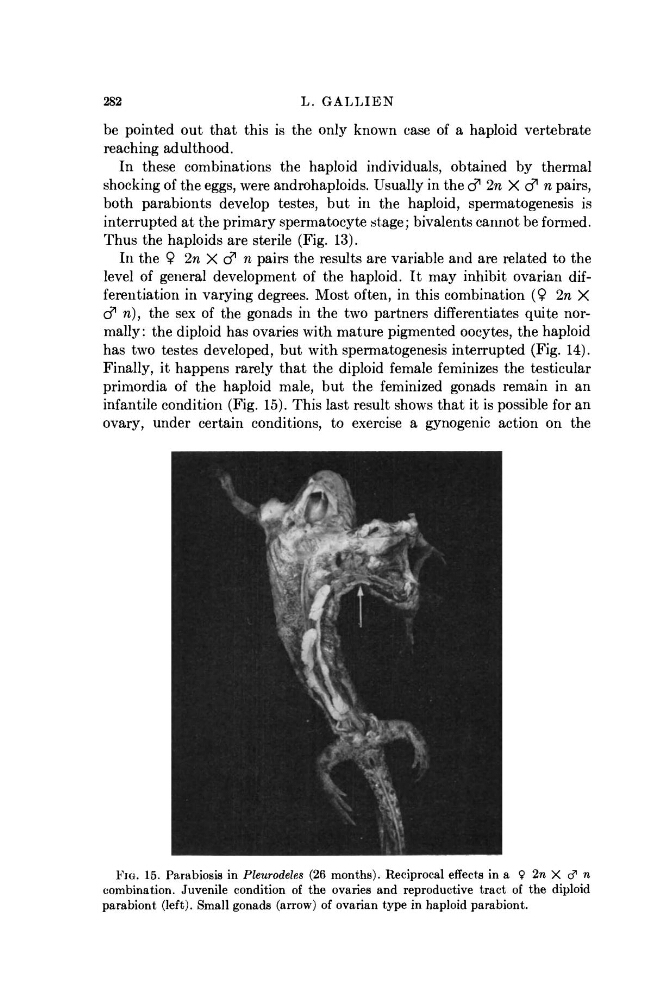
Finally, it happens rarely that the diploid female feminizes the testicular
primordia of the haploid male, but the feminized gonads remain in an
infantile condition (Fig. 15). This last result shows that it is possible for an
ovary, under certain conditions, to exercise a gynogenic action on the
FIG. 15. Parabiosis in Pleurodeles (26 months). Reciprocal effects in a 9 2n X cT n
combination. Juvenile condition of the ovaries and reproductive tract of the diploid
parabiont (left). Small gonads (arrow) of ovarian type in haploid parabiont.
L. G A L L I E N
be pointed out that this is the only known case of a haploid vertebrate
reaching adulthood.
In these combinations the haploid individuals, obtained by thermal
shocking of the eggs, were androhaploids. Usually in the cf 2n X cf n pairs,
both parabionts develop testes, but in the haploid, spermatogenesis is
interrupted at the primary spermatocyte stage; bivalents cannot be formed.
Thus the haploids are sterile (Fig. 13).
In the Ç 2n X c? n pairs the results are variable and are related to the
level of general development of the haploid. It may inhibit ovarian differentiation in varying degrees. Most often, in this combination (Ç 2n X
d
71
n), the sex of the gonads in the two partners differentiates quite normally : the diploid has ovaries with mature pigmented oocytes, the haploid
has two testes developed, but with spermatogenesis interrupted (Fig. 14).
Finally, it happens rarely that the diploid female feminizes the testicular
primordia of the haploid male, but the feminized gonads remain in an
infantile condition (Fig. 15). This last result shows that it is possible for an
ovary, under certain conditions, to exercise a gynogenic action on the
FIG. 15. Parabiosis in Pleurodeles (26 months). Reciprocal effects in a 9 2n X cT n
combination. Juvenile condition of the ovaries and reproductive tract of the diploid
parabiont (left). Small gonads (arrow) of ovarian type in haploid parabiont.