

D E V E L O P M E N T S I N SEXUAL O R G A N O G E N E S I S
263
The condition of gametocyte formation is reversible. A culture that has
been maintained at 8°C, then transferred to 18°C, stops manifesting a
sexual condition and begins budding again. As soon as the gametic phase is
terminated the interstitial cells no longer become germ cells. They resume
their somatic functions, forming cnidoblasts especially. Thus interstitial
cells pass from a somatic to a germinal condition reversibly.
1. Induction of Sexuality in an Asexual Strain of H. fusca
In a culture of H. fusca maintained at 8°C, gametogenesis is established.
If culturing is continued under these conditions, the interstitial cells are
exhausted and the hydras atrophy and die. However, a few of them survive
and become reconstituted. These individuals will be able to bud, but they
have definitely lost the capacity to begin gametogenesis, even if, after
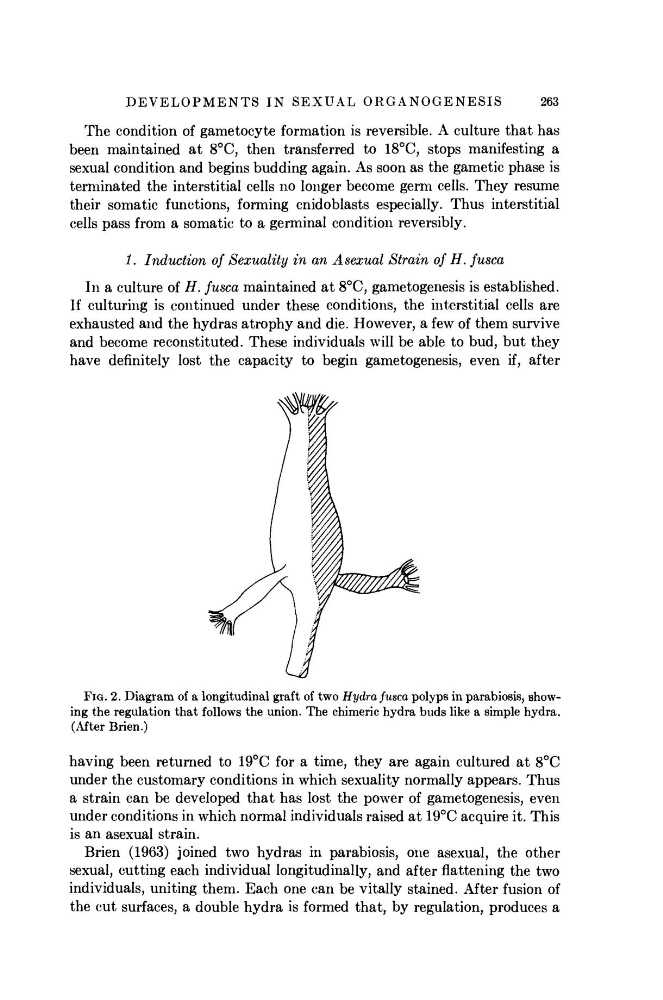
FIG. 2. Diagram of a longitudinal graft of two Hydra fusca polyps in parabiosis, showing the regulation that follows the union. The chimeric hydra buds like a simple hydra.
(After Brien.)
having been returned to 19°C for a time, they are again cultured at 8°C
under the customary conditions in which sexuality normally appears. Thus
a strain can be developed that has lost the power of gametogenesis, even
under conditions in which normal individuals raised at 19°C acquire it. This
is an asexual strain.
Brien (1963) joined two hydras in parabiosis, one asexual, the other
sexual, cutting each individual longitudinally, and after flattening the two
individuals, uniting them. Each one can be vitally stained. After fusion of
the cut surfaces, a double hydra is formed that, by regulation, produces a
263
The condition of gametocyte formation is reversible. A culture that has
been maintained at 8°C, then transferred to 18°C, stops manifesting a
sexual condition and begins budding again. As soon as the gametic phase is
terminated the interstitial cells no longer become germ cells. They resume
their somatic functions, forming cnidoblasts especially. Thus interstitial
cells pass from a somatic to a germinal condition reversibly.
1. Induction of Sexuality in an Asexual Strain of H. fusca
In a culture of H. fusca maintained at 8°C, gametogenesis is established.
If culturing is continued under these conditions, the interstitial cells are
exhausted and the hydras atrophy and die. However, a few of them survive
and become reconstituted. These individuals will be able to bud, but they
have definitely lost the capacity to begin gametogenesis, even if, after
FIG. 2. Diagram of a longitudinal graft of two Hydra fusca polyps in parabiosis, showing the regulation that follows the union. The chimeric hydra buds like a simple hydra.
(After Brien.)
having been returned to 19°C for a time, they are again cultured at 8°C
under the customary conditions in which sexuality normally appears. Thus
a strain can be developed that has lost the power of gametogenesis, even
under conditions in which normal individuals raised at 19°C acquire it. This
is an asexual strain.
Brien (1963) joined two hydras in parabiosis, one asexual, the other
sexual, cutting each individual longitudinally, and after flattening the two
individuals, uniting them. Each one can be vitally stained. After fusion of
the cut surfaces, a double hydra is formed that, by regulation, produces a