

262
L. G A L L I E N
1951, 1955) have shown that in H. fusca, used here as an example of this
type of phenomenon, the animal does not possess a line of previously determined germ cells.
If a clonal culture of hydra is maintained at a temperature above 16°C,
approximately 18°-19°C, an individual that is isolated and well fed forms
buds indefinitely. These buds themselves continue to bud without ever,
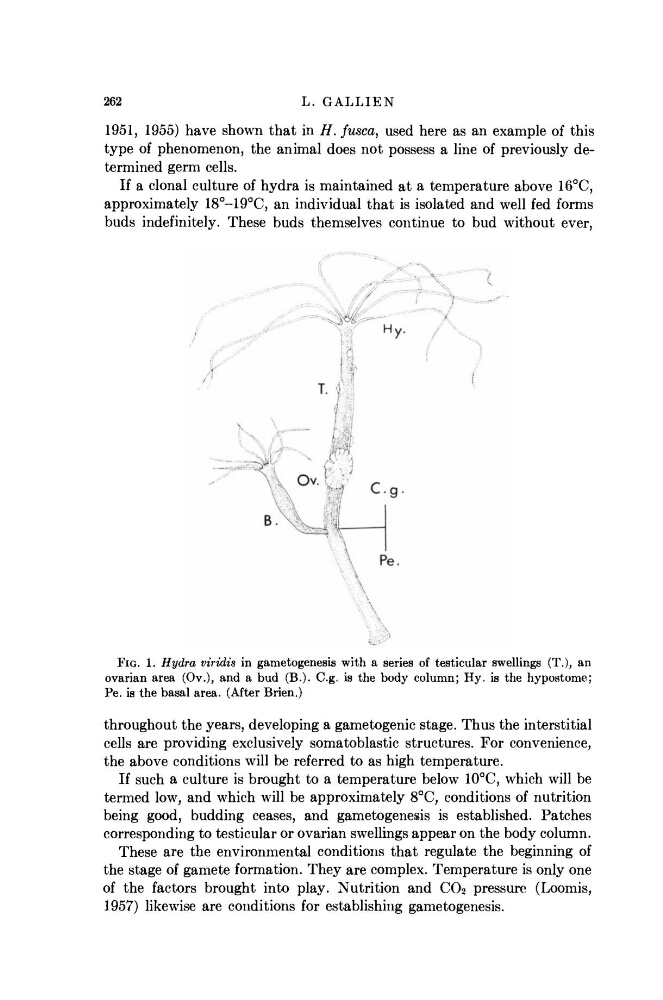
FIG. 1. Hydra viridis in gametogenesis with a series of testicular swellings (T.), an
ovarian area (Ov.), and a bud (B.). C.g. is the body column; Hy. is the hypostome;
Pe. is the basal area. (After Brien.)
throughout the years, developing a gametogenic stage. Thus the interstitial
cells are providing exclusively somatoblastic structures. For convenience,
the above conditions will be referred to as high temperature.
If such a culture is brought to a temperature below 10°C, which will be
termed low, and which will be approximately 8°C, conditions of nutrition
being good, budding ceases, and gametogenesis is established. Patches
corresponding to testicular or ovarian swellings appear on the body column.
These are the environmental conditions that regulate the beginning of
the stage of gamete formation. They are complex. Temperature is only one
of the factors brought into play. Nutrition and C0 2 pressure (Loomis,
1957) likewise are conditions for establishing gametogenesis.
L. G A L L I E N
1951, 1955) have shown that in H. fusca, used here as an example of this
type of phenomenon, the animal does not possess a line of previously determined germ cells.
If a clonal culture of hydra is maintained at a temperature above 16°C,
approximately 18°-19°C, an individual that is isolated and well fed forms
buds indefinitely. These buds themselves continue to bud without ever,
FIG. 1. Hydra viridis in gametogenesis with a series of testicular swellings (T.), an
ovarian area (Ov.), and a bud (B.). C.g. is the body column; Hy. is the hypostome;
Pe. is the basal area. (After Brien.)
throughout the years, developing a gametogenic stage. Thus the interstitial
cells are providing exclusively somatoblastic structures. For convenience,
the above conditions will be referred to as high temperature.
If such a culture is brought to a temperature below 10°C, which will be
termed low, and which will be approximately 8°C, conditions of nutrition
being good, budding ceases, and gametogenesis is established. Patches
corresponding to testicular or ovarian swellings appear on the body column.
These are the environmental conditions that regulate the beginning of
the stage of gamete formation. They are complex. Temperature is only one
of the factors brought into play. Nutrition and C0 2 pressure (Loomis,
1957) likewise are conditions for establishing gametogenesis.