

U L T R A S T R U C T U R E OF T H E A M P H I B I A N EGG
185
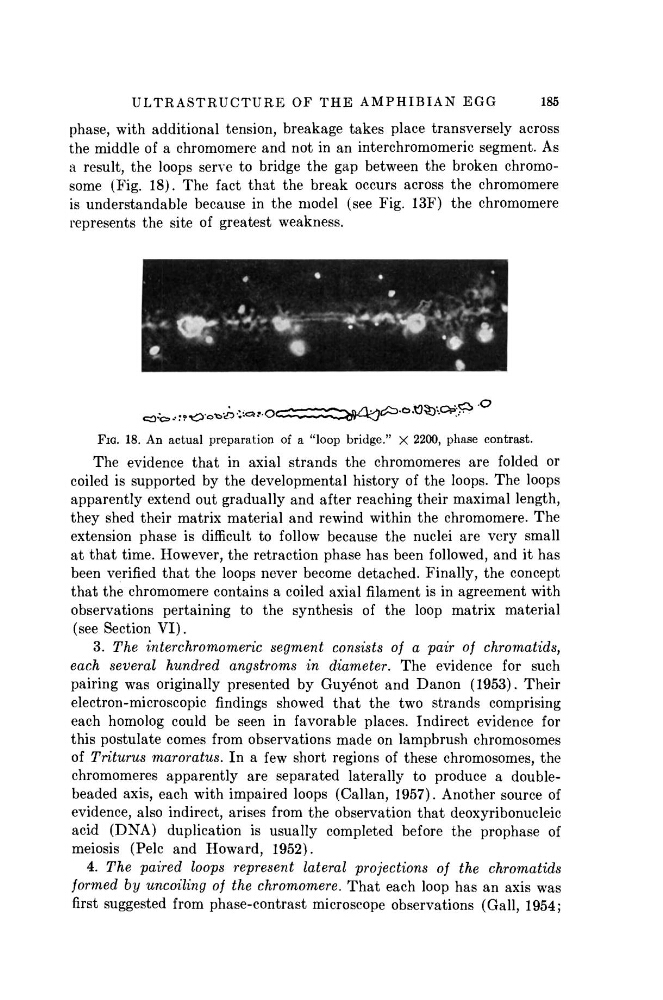
phase, with additional tension, breakage takes place transversely across
the middle of a chromomere and not in an interchromomeric segment. As
a result, the loops serve to bridge the gap between the broken chromosome (Fig. 18). The fact that the break occurs across the chromomere
is understandable because in the model (see Fig. 13F) the chromomere
represents the site of greatest weakness.
c ^ , : ? o o ^ : ^
o
FIG. 18. An actual preparation of a "loop bridge." X 2200, phase contrast.
The evidence that in axial strands the chromomeres are folded or
coiled is supported by the developmental history of the loops. The loops
apparently extend out gradually and after reaching their maximal length,
they shed their matrix material and rewind within the chromomere. The
extension phase is difficult to follow because the nuclei are very small
at that time. However, the retraction phase has been followed, and it has
been verified that the loops never become detached. Finally, the concept
that the chromomere contains a coiled axial filament is in agreement with
observations pertaining to the synthesis of the loop matrix material
(see Section VI).
3. The interchromomeric segment consists of a pair of chromatids,
each several hundred angstroms in diameter. The evidence for such
pairing was originally presented by Guyénot and Danon (1953). Their
electron-microscopic findings showed that the two strands comprising
each homolog could be seen in favorable places. Indirect evidence for
this postulate comes from observations made on lampbrush chromosomes
of Triturus maroratus. In a few short regions of these chromosomes, the
chromomeres apparently are separated laterally to produce a doublebeaded axis, each with impaired loops (Callan, 1957). Another source of
evidence, also indirect, arises from the observation that deoxyribonucleic
acid (DNA) duplication is usually completed before the prophase of
meiosis (Pelc and Howard, 1952).
4. The paired loops represent lateral projections of the chromatids
formed by uncoiling of the chromomere. That each loop has an axis was
first suggested from phase-contrast microscope observations (Gall, 1954;
185
phase, with additional tension, breakage takes place transversely across
the middle of a chromomere and not in an interchromomeric segment. As
a result, the loops serve to bridge the gap between the broken chromosome (Fig. 18). The fact that the break occurs across the chromomere
is understandable because in the model (see Fig. 13F) the chromomere
represents the site of greatest weakness.
c ^ , : ? o o ^ : ^
o
FIG. 18. An actual preparation of a "loop bridge." X 2200, phase contrast.
The evidence that in axial strands the chromomeres are folded or
coiled is supported by the developmental history of the loops. The loops
apparently extend out gradually and after reaching their maximal length,
they shed their matrix material and rewind within the chromomere. The
extension phase is difficult to follow because the nuclei are very small
at that time. However, the retraction phase has been followed, and it has
been verified that the loops never become detached. Finally, the concept
that the chromomere contains a coiled axial filament is in agreement with
observations pertaining to the synthesis of the loop matrix material
(see Section VI).
3. The interchromomeric segment consists of a pair of chromatids,
each several hundred angstroms in diameter. The evidence for such
pairing was originally presented by Guyénot and Danon (1953). Their
electron-microscopic findings showed that the two strands comprising
each homolog could be seen in favorable places. Indirect evidence for
this postulate comes from observations made on lampbrush chromosomes
of Triturus maroratus. In a few short regions of these chromosomes, the
chromomeres apparently are separated laterally to produce a doublebeaded axis, each with impaired loops (Callan, 1957). Another source of
evidence, also indirect, arises from the observation that deoxyribonucleic
acid (DNA) duplication is usually completed before the prophase of
meiosis (Pelc and Howard, 1952).
4. The paired loops represent lateral projections of the chromatids
formed by uncoiling of the chromomere. That each loop has an axis was
first suggested from phase-contrast microscope observations (Gall, 1954;