

182
SAUL WISCHNITZER
optics on an inverted microscope system, Gall (1954) exploited the
technique of nuclear isolation introduced earlier by Duryee. Gall was
able to characterize each of the chromosomes belonging to Triturus
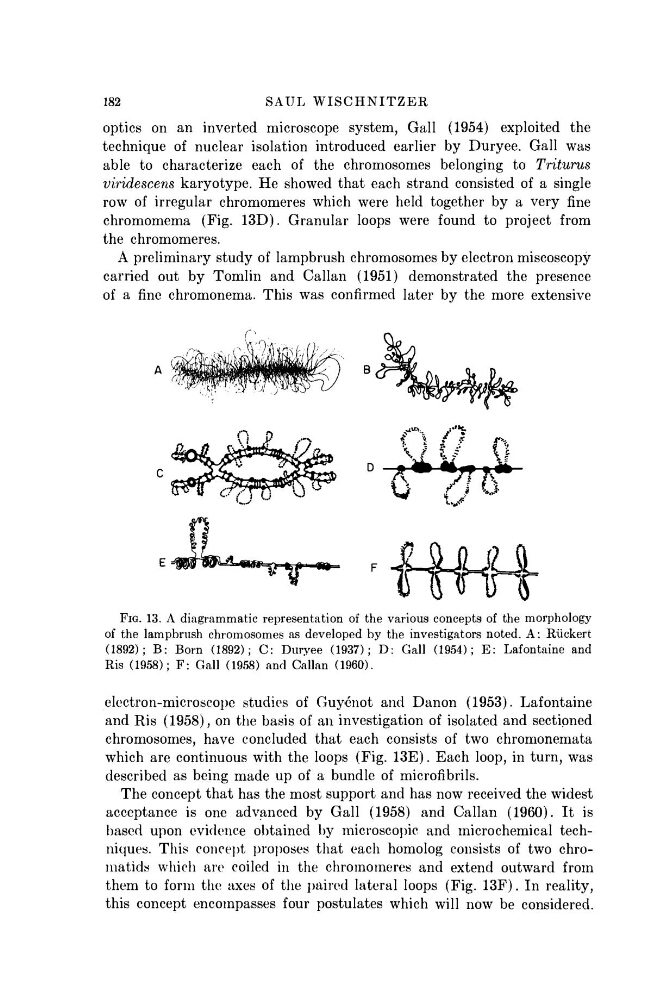
viridescens karyotype. He showed that each strand consisted of a single
row of irregular chromomeres which were held together by a very fine
chromomema (Fig. 13D). Granular loops were found to project from
the chromomeres.
A preliminary study of lampbrush chromosomes by electron miscoscopy
carried out by Tomlin and Callan (1951) demonstrated the presence
of a fine chromonema. This was confirmed later by the more extensive
FIG. 13. A diagrammatic representation of the various concepts of the morphology
of the lampbrush chromosomes as developed by the investigators noted. A: Riickert
(1892); B: Born (1892); C: Duryee (1937); D: Gall (1954); E: Lafontaine and
Ris (1958); F: Gall (1958) and Callan (1960).
electron-microscope studies of Guyénot and Danon (1953). Lafontaine
and Ris (1958), on the basis of an investigation of isolated and sectioned
chromosomes, have concluded that each consists of two chromonemata
which are continuous with the loops (Fig. 13E). Each loop, in turn, was
described as being made up of a bundle of microfibrils.
The concept that has the most support and has now received the widest
acceptance is one advanced by Gall (1958) and Callan (1960). It is
based upon evidence obtained by microscopic and microchemical techniques. This concept proposes that each homolog consists of two chromatids which are coiled in the chromomeres and extend outward from
them to form the axes of the paired lateral loops (Fig. 13F). In reality,
this concept encompasses four postulates which will now be considered.
SAUL WISCHNITZER
optics on an inverted microscope system, Gall (1954) exploited the
technique of nuclear isolation introduced earlier by Duryee. Gall was
able to characterize each of the chromosomes belonging to Triturus
viridescens karyotype. He showed that each strand consisted of a single
row of irregular chromomeres which were held together by a very fine
chromomema (Fig. 13D). Granular loops were found to project from
the chromomeres.
A preliminary study of lampbrush chromosomes by electron miscoscopy
carried out by Tomlin and Callan (1951) demonstrated the presence
of a fine chromonema. This was confirmed later by the more extensive
FIG. 13. A diagrammatic representation of the various concepts of the morphology
of the lampbrush chromosomes as developed by the investigators noted. A: Riickert
(1892); B: Born (1892); C: Duryee (1937); D: Gall (1954); E: Lafontaine and
Ris (1958); F: Gall (1958) and Callan (1960).
electron-microscope studies of Guyénot and Danon (1953). Lafontaine
and Ris (1958), on the basis of an investigation of isolated and sectioned
chromosomes, have concluded that each consists of two chromonemata
which are continuous with the loops (Fig. 13E). Each loop, in turn, was
described as being made up of a bundle of microfibrils.
The concept that has the most support and has now received the widest
acceptance is one advanced by Gall (1958) and Callan (1960). It is
based upon evidence obtained by microscopic and microchemical techniques. This concept proposes that each homolog consists of two chromatids which are coiled in the chromomeres and extend outward from
them to form the axes of the paired lateral loops (Fig. 13F). In reality,
this concept encompasses four postulates which will now be considered.