

174
SAUL WISCHNITZER
exist in vivo and thus represent an increase in nuclear surface area in
response to existing physiological needs.
As early as 1950, Callan and Tomlin described the bilamellar composition of the isolated nuclear envelope. However, they, and subsequently others, mistook the annuli or ring-shaped structures seen on the
surface of shadow-cast preparations for artifacts. The basic organization
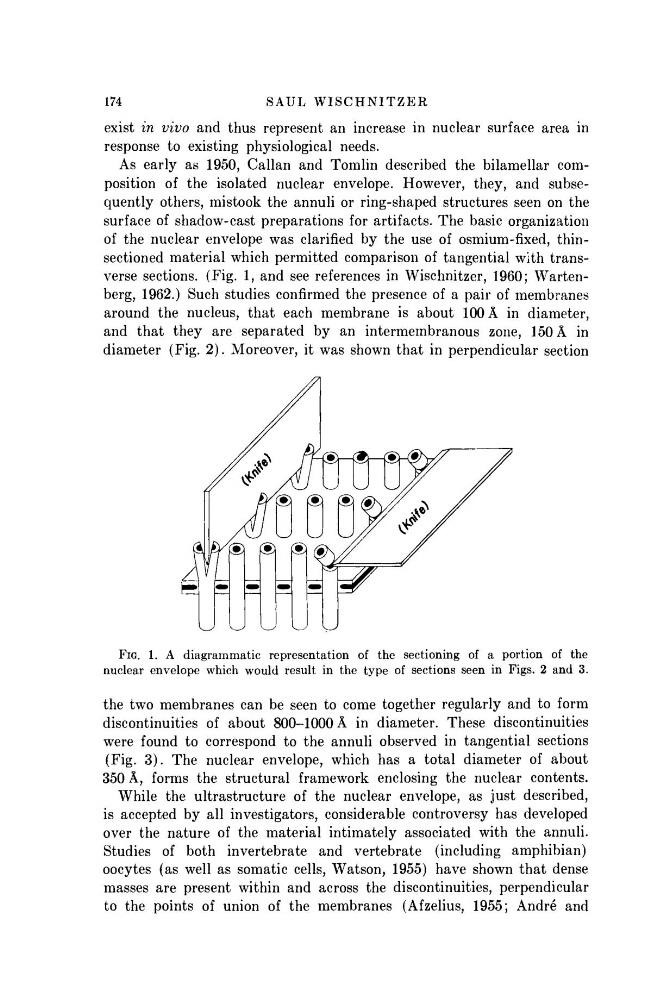
of the nuclear envelope was clarified by the use of osmium-fixed, thinsectioned material which permitted comparison of tangential with transverse sections. (Fig. 1, and see references in Wischnitzer, 1960; Wartenberg, 1962.) Such studies confirmed the presence of a pair of membranes
around the nucleus, that each membrane is about 100 Â in diameter,
and that they are separated by an intermembranous zone, 150 Ä in
diameter (Fig. 2). Moreover, it was shown that in perpendicular section
FIG. 1. A diagrammatic representation of the sectioning of a portion of the
nuclear envelope which would result in the type of sections seen in Figs. 2 and 3.
the two membranes can be seen to come together regularly and to form
discontinuities of about 800-1000 Â in diameter. These discontinuities
were found to correspond to the annuli observed in tangential sections
(Fig. 3). The nuclear envelope, which has a total diameter of about
350 Â, forms the structural framework enclosing the nuclear contents.
While the ultrastructure of the nuclear envelope, as just described,
is accepted by all investigators, considerable controversy has developed
over the nature of the material intimately associated with the annuli.
Studies of both invertebrate and vertebrate (including amphibian)
oocytes (as well as somatic cells, Watson, 1955) have shown that dense
masses are present within and across the discontinuities, perpendicular
to the points of union of the membranes (Afzelius, 1955; André and
SAUL WISCHNITZER
exist in vivo and thus represent an increase in nuclear surface area in
response to existing physiological needs.
As early as 1950, Callan and Tomlin described the bilamellar composition of the isolated nuclear envelope. However, they, and subsequently others, mistook the annuli or ring-shaped structures seen on the
surface of shadow-cast preparations for artifacts. The basic organization
of the nuclear envelope was clarified by the use of osmium-fixed, thinsectioned material which permitted comparison of tangential with transverse sections. (Fig. 1, and see references in Wischnitzer, 1960; Wartenberg, 1962.) Such studies confirmed the presence of a pair of membranes
around the nucleus, that each membrane is about 100 Â in diameter,
and that they are separated by an intermembranous zone, 150 Ä in
diameter (Fig. 2). Moreover, it was shown that in perpendicular section
FIG. 1. A diagrammatic representation of the sectioning of a portion of the
nuclear envelope which would result in the type of sections seen in Figs. 2 and 3.
the two membranes can be seen to come together regularly and to form
discontinuities of about 800-1000 Â in diameter. These discontinuities
were found to correspond to the annuli observed in tangential sections
(Fig. 3). The nuclear envelope, which has a total diameter of about
350 Â, forms the structural framework enclosing the nuclear contents.
While the ultrastructure of the nuclear envelope, as just described,
is accepted by all investigators, considerable controversy has developed
over the nature of the material intimately associated with the annuli.
Studies of both invertebrate and vertebrate (including amphibian)
oocytes (as well as somatic cells, Watson, 1955) have shown that dense
masses are present within and across the discontinuities, perpendicular
to the points of union of the membranes (Afzelius, 1955; André and