

HETEROBLASTIC D E V E L O P M E N T IN PLANTS
145
forms (Fig. 7), but higher concentrations of mannitol led to the development of stunted water forms (Allsopp, 1955). In another experiment,
sporelings in 4% glucose media had the usual characteristics of land
forms, while sporelings in 4% sucrose were all water forms. The importance of water restriction in the development of land forms was
shown clearly by experiments in which sporelings supported at the surface of a 2% glucose medium, either by the presence in the medium
of a loose packing of cotton wool or 0.75% agar, developed as land
forms, whereas sporelings submerged in the same liquid medium developed as water forms.
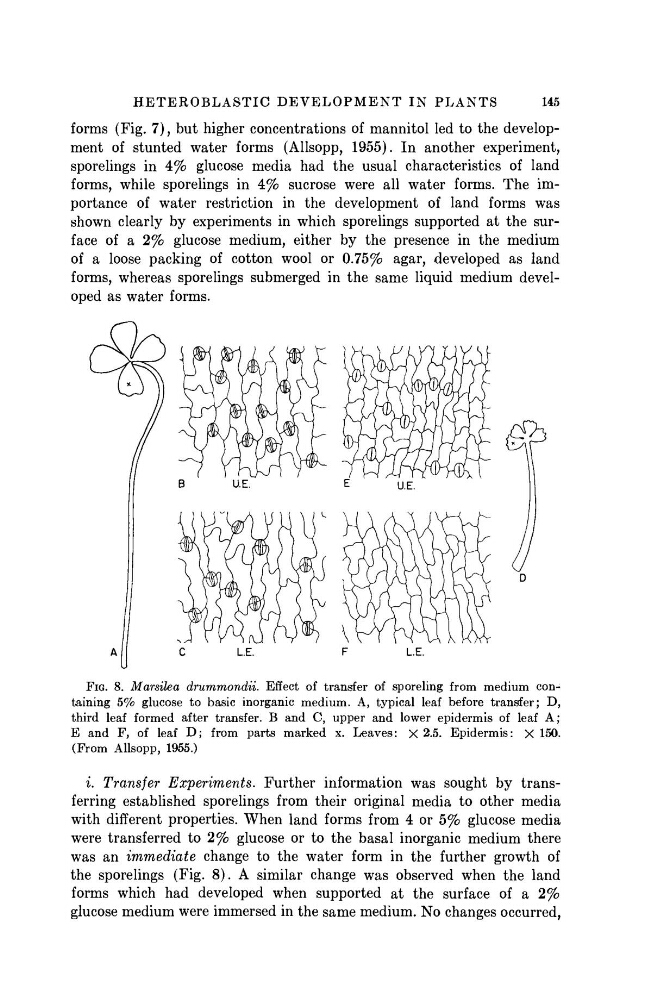
FIG. 8. Marsiha drummondii. Effect of transfer of sporeling from medium containing 5% glucose to basic inorganic medium. A, typical leaf before transfer; D,
third leaf formed after transfer. B and C, upper and lower epidermis of leaf A;
E and F, of leaf D; from parts marked x. Leaves: X 2.5. Epidermis: X 150.
(From Allsopp, 1955.)
i. Transfer Experiments. Further information was sought by transferring established sporelings from their original media to other media
with different properties. When land forms from 4 or 5% glucose media
were transferred to 2% glucose or to the basal inorganic medium there
was an immediate change to the water form in the further growth of
the sporelings (Fig. 8). A similar change was observed when the land
forms which had developed when supported at the surface of a 2%
glucose medium were immersed in the same medium. No changes occurred,
145
forms (Fig. 7), but higher concentrations of mannitol led to the development of stunted water forms (Allsopp, 1955). In another experiment,
sporelings in 4% glucose media had the usual characteristics of land
forms, while sporelings in 4% sucrose were all water forms. The importance of water restriction in the development of land forms was
shown clearly by experiments in which sporelings supported at the surface of a 2% glucose medium, either by the presence in the medium
of a loose packing of cotton wool or 0.75% agar, developed as land
forms, whereas sporelings submerged in the same liquid medium developed as water forms.
FIG. 8. Marsiha drummondii. Effect of transfer of sporeling from medium containing 5% glucose to basic inorganic medium. A, typical leaf before transfer; D,
third leaf formed after transfer. B and C, upper and lower epidermis of leaf A;
E and F, of leaf D; from parts marked x. Leaves: X 2.5. Epidermis: X 150.
(From Allsopp, 1955.)
i. Transfer Experiments. Further information was sought by transferring established sporelings from their original media to other media
with different properties. When land forms from 4 or 5% glucose media
were transferred to 2% glucose or to the basal inorganic medium there
was an immediate change to the water form in the further growth of
the sporelings (Fig. 8). A similar change was observed when the land
forms which had developed when supported at the surface of a 2%
glucose medium were immersed in the same medium. No changes occurred,