

144
A. ALLSOPP
including anatomical details as well as external morphology, (Allsopp,
1953b, 1954a). Thus, the water forms from a 2% glucose medium had
elongated internodes, thick relatively unbranched roots, and leaves of
characteristic shape, with the lamina expanded in the plane of the petiole,
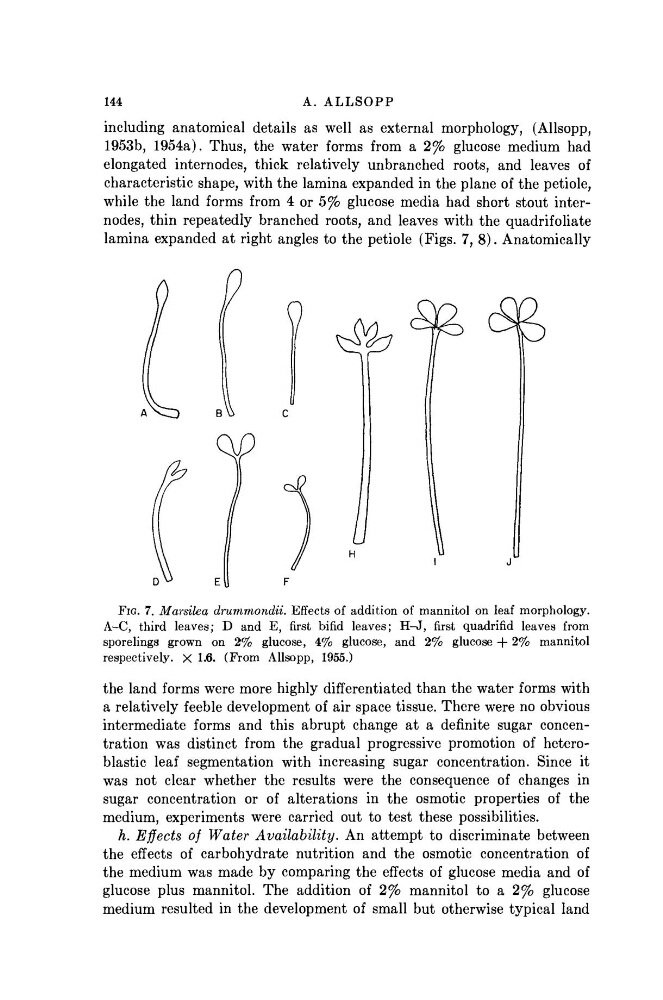
while the land forms from 4 or 5% glucose media had short stout internodes, thin repeatedly branched roots, and leaves with the quadrifoliate
lamina expanded at right angles to the petiole (Figs. 7, 8). Anatomically
FIG. 7. Marsilea drummondii. Effects of addition of mannitol on leaf morphology.
A-C, third leaves; D and E, first bifid leaves; H-J, first quadrifid leaves from
spore lings grown on 2% glucose, 4% glucose, and 2% glucose + 2% mannitol
respectively. X 1.6. (From Allsopp, 1955.)
the land forms were more highly differentiated than the water forms with
a relatively feeble development of air space tissue. There were no obvious
intermediate forms and this abrupt change at a definite sugar concentration was distinct from the gradual progressive promotion of heteroblastic leaf segmentation with increasing sugar concentration. Since it
was not clear whether the results were the consequence of changes in
sugar concentration or of alterations in the osmotic properties of the
medium, experiments were carried out to test these possibilities.
h. Effects of Water Availability. An attempt to discriminate between
the effects of carbohydrate nutrition and the osmotic concentration of
the medium was made by comparing the effects of glucose media and of
glucose plus mannitol. The addition of 2% mannitol to a 2% glucose
medium resulted in the development of small but otherwise typical land
A. ALLSOPP
including anatomical details as well as external morphology, (Allsopp,
1953b, 1954a). Thus, the water forms from a 2% glucose medium had
elongated internodes, thick relatively unbranched roots, and leaves of
characteristic shape, with the lamina expanded in the plane of the petiole,
while the land forms from 4 or 5% glucose media had short stout internodes, thin repeatedly branched roots, and leaves with the quadrifoliate
lamina expanded at right angles to the petiole (Figs. 7, 8). Anatomically
FIG. 7. Marsilea drummondii. Effects of addition of mannitol on leaf morphology.
A-C, third leaves; D and E, first bifid leaves; H-J, first quadrifid leaves from
spore lings grown on 2% glucose, 4% glucose, and 2% glucose + 2% mannitol
respectively. X 1.6. (From Allsopp, 1955.)
the land forms were more highly differentiated than the water forms with
a relatively feeble development of air space tissue. There were no obvious
intermediate forms and this abrupt change at a definite sugar concentration was distinct from the gradual progressive promotion of heteroblastic leaf segmentation with increasing sugar concentration. Since it
was not clear whether the results were the consequence of changes in
sugar concentration or of alterations in the osmotic properties of the
medium, experiments were carried out to test these possibilities.
h. Effects of Water Availability. An attempt to discriminate between
the effects of carbohydrate nutrition and the osmotic concentration of
the medium was made by comparing the effects of glucose media and of
glucose plus mannitol. The addition of 2% mannitol to a 2% glucose
medium resulted in the development of small but otherwise typical land