

140
A. A L L S O P P
b. The Effects of Carbohydrate Nutrition. In experiments on the
effects of changes in the organic carbon supply (Allsopp, 1953b), it was
found at the outset that the leaf sequence is not rigidly determined,
with a definite number of leaves of each type, but on the contrary is
readily modified by changes both in the nature and concentration of the
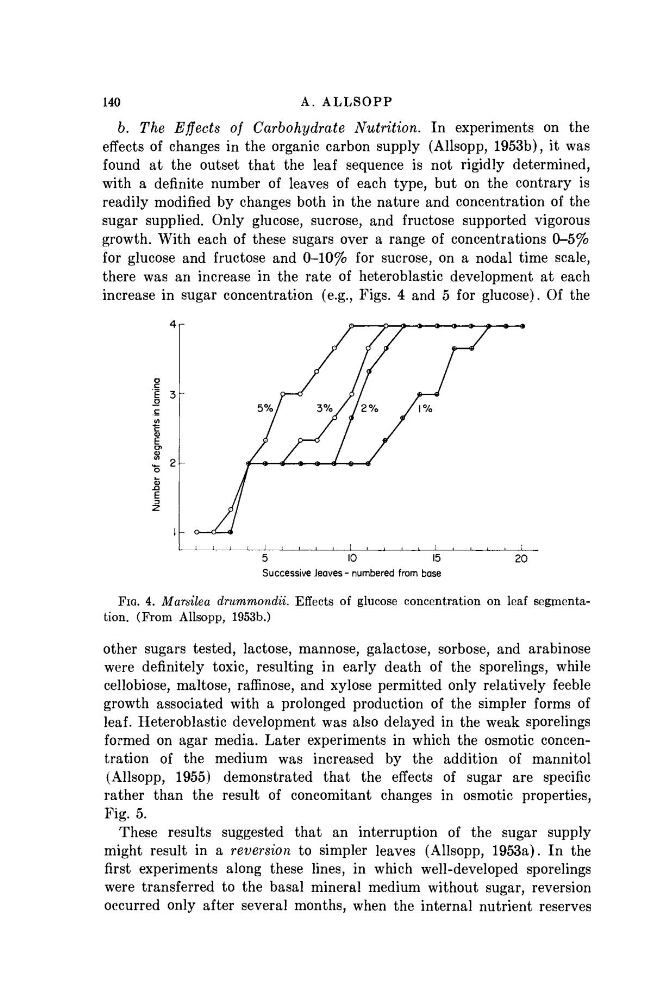
sugar supplied. Only glucose, sucrose, and fructose supported vigorous
growth. With each of these sugars over a range of concentrations 0-5%
for glucose and fructose and 0-10% for sucrose, on a nodal time scale,
there was an increase in the rate of heteroblastic development at each
increase in sugar concentration (e.g., Figs. 4 and 5 for glucose). Of the
4
σ
ç
E
V)
"c
I
E
a
I
5
10
15
2 0
Successive Jeaves - numbered from base
FIG. 4. Marsilea drummondii. Effects of glucose concentration on leaf segmentation. (From Allsopp, 1953b.)
other sugars tested, lactose, mannose, galactose, sorbose, and arabinose
were definitely toxic, resulting in early death of the sporelings, while
cellobiose, maltose, raffinose, and xylose permitted only relatively feeble
growth associated with a prolonged production of the simpler forms of
leaf. Heteroblastic development was also delayed in the weak sporelings
formed on agar media. Later experiments in which the osmotic concentration of the medium was increased by the addition of mannitol
(Allsopp, 1955) demonstrated that the effects of sugar are specific
rather than the result of concomitant changes in osmotic properties,
Fig. 5.
These results suggested that an interruption of the sugar supply
might result in a reversion to simpler leaves (Allsopp, 1953a). In the
first experiments along these lines, in which well-developed sporelings
were transferred to the basal mineral medium without sugar, reversion
occurred only after several months, when the internal nutrient reserves
A. A L L S O P P
b. The Effects of Carbohydrate Nutrition. In experiments on the
effects of changes in the organic carbon supply (Allsopp, 1953b), it was
found at the outset that the leaf sequence is not rigidly determined,
with a definite number of leaves of each type, but on the contrary is
readily modified by changes both in the nature and concentration of the
sugar supplied. Only glucose, sucrose, and fructose supported vigorous
growth. With each of these sugars over a range of concentrations 0-5%
for glucose and fructose and 0-10% for sucrose, on a nodal time scale,
there was an increase in the rate of heteroblastic development at each
increase in sugar concentration (e.g., Figs. 4 and 5 for glucose). Of the
4
σ
ç
E
V)
"c
I
E
a
I
5
10
15
2 0
Successive Jeaves - numbered from base
FIG. 4. Marsilea drummondii. Effects of glucose concentration on leaf segmentation. (From Allsopp, 1953b.)
other sugars tested, lactose, mannose, galactose, sorbose, and arabinose
were definitely toxic, resulting in early death of the sporelings, while
cellobiose, maltose, raffinose, and xylose permitted only relatively feeble
growth associated with a prolonged production of the simpler forms of
leaf. Heteroblastic development was also delayed in the weak sporelings
formed on agar media. Later experiments in which the osmotic concentration of the medium was increased by the addition of mannitol
(Allsopp, 1955) demonstrated that the effects of sugar are specific
rather than the result of concomitant changes in osmotic properties,
Fig. 5.
These results suggested that an interruption of the sugar supply
might result in a reversion to simpler leaves (Allsopp, 1953a). In the
first experiments along these lines, in which well-developed sporelings
were transferred to the basal mineral medium without sugar, reversion
occurred only after several months, when the internal nutrient reserves