

EMBRYONIC HEMOGLOBIN SYNTHESIS
99
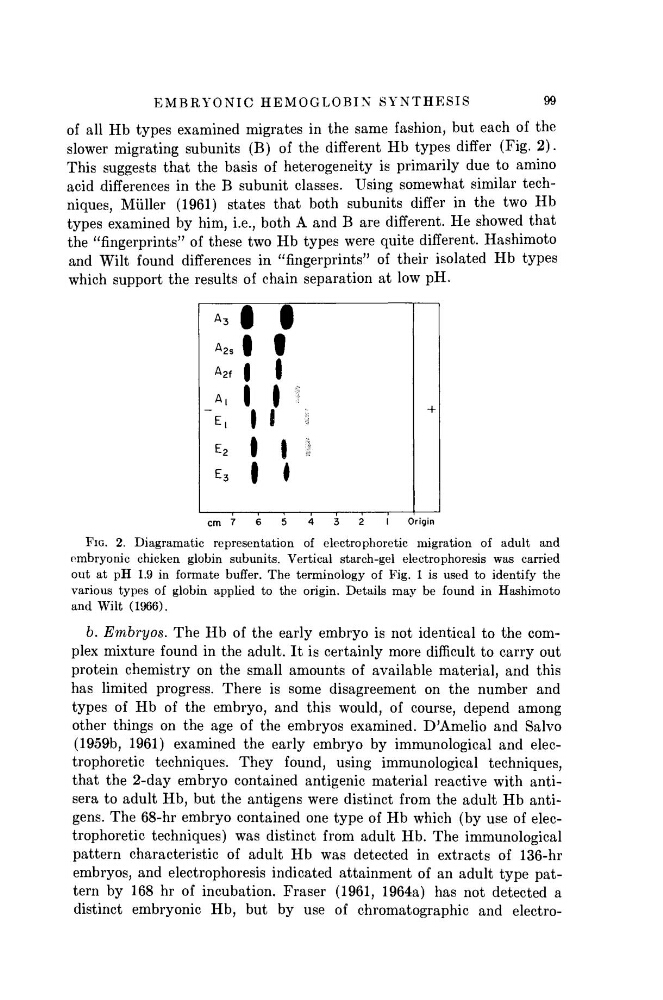
of all Hb types examined migrates in the same fashion, but each of the
slower migrating subunits (B) of the different Hb types differ (Fig. 2).
This suggests that the basis of heterogeneity is primarily due to amino
acid differences in the B subunit classes. Using somewhat similar techniques, Müller (1961) states that both subunits differ in the two Hb
types examined by him, i.e., both A and B are different. He showed that
the "fingerprints" of these two Hb types were quite different. Hashimoto
and Wilt found differences in "fingerprints" of their isolated Hb types
which support the results of chain separation at low pH.
pri~i
1
• 1
A« |
·
A l l
l"E, 1 I
■:
^ I «
* | I
+
n
1
1
1
1
1
r
cm 7
6
5
4
3
2
I
Origin
FIG. 2. Diagramatic representation of electrophoretic migration of adult and
embryonic chicken globin subunits. Vertical starch-gel electrophoresis was carried
out at pH 1.9 in formate buffer. The terminology of Fig. 1 is used to identify the
various types of globin applied to the origin. Details may be found in Hashimoto
and Wilt (1966).
b. Embryos. The Hb of the early embryo is not identical to the complex mixture found in the adult. It is certainly more difficult to carry out
protein chemistry on the small amounts of available material, and this
has limited progress. There is some disagreement on the number and
types of Hb of the embryo, and this would, of course, depend among
other things on the age of the embryos examined. D'Amelio and Salvo
(1959b, 1961) examined the early embryo by immunological and electrophoretic techniques. They found, using immunological techniques,
that the 2-day embryo contained antigenic material reactive with antisera to adult Hb, but the antigens were distinct from the adult Hb antigens. The 68-hr embryo contained one type of Hb which (by use of electrophoretic techniques) was distinct from adult Hb. The immunological
pattern characteristic of adult Hb was detected in extracts of 136-hr
embryos, and electrophoresis indicated attainment of an adult type pattern by 168 hr of incubation. Fraser (1961, 1964a) has not detected a
distinct embryonic Hb, but by use of Chromatographie and electro-
99
of all Hb types examined migrates in the same fashion, but each of the
slower migrating subunits (B) of the different Hb types differ (Fig. 2).
This suggests that the basis of heterogeneity is primarily due to amino
acid differences in the B subunit classes. Using somewhat similar techniques, Müller (1961) states that both subunits differ in the two Hb
types examined by him, i.e., both A and B are different. He showed that
the "fingerprints" of these two Hb types were quite different. Hashimoto
and Wilt found differences in "fingerprints" of their isolated Hb types
which support the results of chain separation at low pH.
pri~i
1
• 1
A« |
·
A l l
l"E, 1 I
■:
^ I «
* | I
+
n
1
1
1
1
1
r
cm 7
6
5
4
3
2
I
Origin
FIG. 2. Diagramatic representation of electrophoretic migration of adult and
embryonic chicken globin subunits. Vertical starch-gel electrophoresis was carried
out at pH 1.9 in formate buffer. The terminology of Fig. 1 is used to identify the
various types of globin applied to the origin. Details may be found in Hashimoto
and Wilt (1966).
b. Embryos. The Hb of the early embryo is not identical to the complex mixture found in the adult. It is certainly more difficult to carry out
protein chemistry on the small amounts of available material, and this
has limited progress. There is some disagreement on the number and
types of Hb of the embryo, and this would, of course, depend among
other things on the age of the embryos examined. D'Amelio and Salvo
(1959b, 1961) examined the early embryo by immunological and electrophoretic techniques. They found, using immunological techniques,
that the 2-day embryo contained antigenic material reactive with antisera to adult Hb, but the antigens were distinct from the adult Hb antigens. The 68-hr embryo contained one type of Hb which (by use of electrophoretic techniques) was distinct from adult Hb. The immunological
pattern characteristic of adult Hb was detected in extracts of 136-hr
embryos, and electrophoresis indicated attainment of an adult type pattern by 168 hr of incubation. Fraser (1961, 1964a) has not detected a
distinct embryonic Hb, but by use of Chromatographie and electro-