

98
FRED H. WILT
from red cell hemolysates of adult ducks by starch-gel electrophoresis.
The whole question of immunological specificity may now be reopened
in the light of new findings on the extent and nature of the heterogeneity.
Matsuda and Takei (1963) showed 3 distinct components could be
obtained by chromatography on carboxymethyl cellulose (CMC). More
recently Marchis-Mouren and Lipmann (1965) found 5 Chromatographie
components, and Schall and Turba (1963) detected 5 components after
starch-gel electrophoresis. Hashimoto and Wilt (1966) explored this
question using a variety of high resolution techniques, taking particular
care to control aggregation and carrying out all experiments on the
cyanomethemoglobin derivative in buffers containing cyanide. They
found that this precaution was essential to obtain reproducible results.
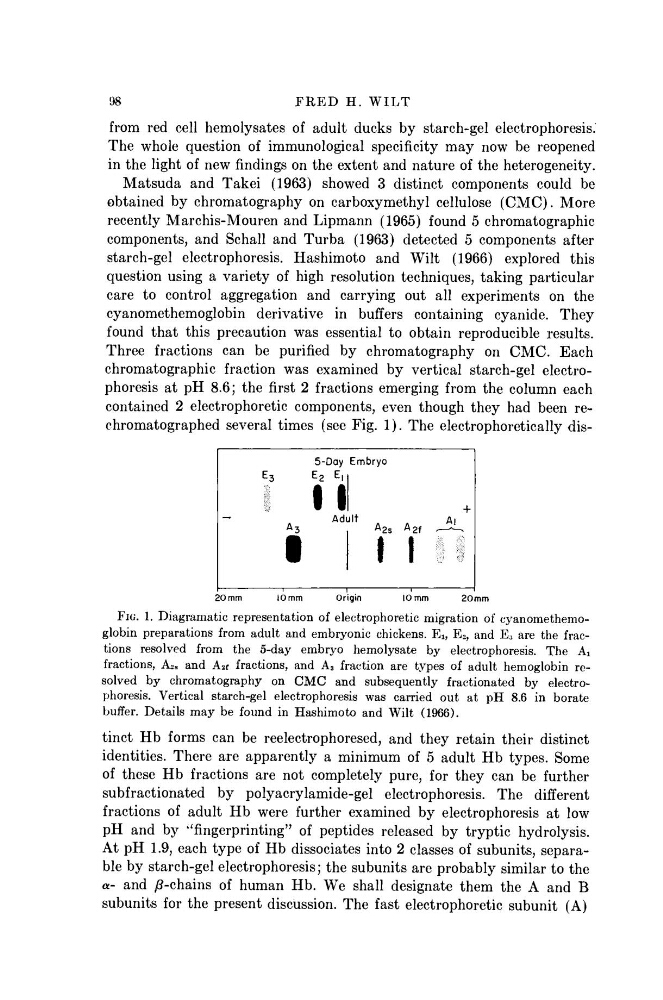
Three fractions can be purified by chromatography on CMC. Each
Chromatographie fraction was examined by vertical starch-gel electrophoresis at pH 8.6; the first 2 fractions emerging from the column each
contained 2 electrophoretic components, even though they had been rechromatographed several times (see Fig. 1). The electrophoretically dis-"
5-Day Embryo
E3
E2 E,
II
Adult
A 3
.
A2s A2f
•
t 1
+
A|
|
!
|
!
|
20mm
10mm
Origin
10mm
20mm
FIG. 1. Diagramatic representation of electrophoretic migration of cyanomethemoglobin preparations from adult and embryonic chickens. Ei, E 2 , and E a are the fractions resolved from the 5-day embryo hemolysate by electrophoresis. The Ai
fractions, A2S and A 2 f fractions, and A 3 fraction are types of adult hemoglobin resolved by chromatography on CMC and subsequently fractionated by electrophoresis. Vertical starch-gel electrophoresis was carried out at pH 8.6 in borate
buffer. Details may be found in Hashimoto and Wilt (1966).
tinct Hb forms can be reelectrophoresed, and they retain their distinct
identities. There are apparently a minimum of 5 adult Hb types. Some
of these Hb fractions are not completely pure, for they can be further
subfractionated by polyacrylamide-gel electrophoresis. The different
fractions of adult Hb were further examined by electrophoresis at low
pH and by "fingerprinting" of peptides released by tryptic hydrolysis.
At pH 1.9, each type of Hb dissociates into 2 classes of subunits, separable by starch-gel electrophoresis ; the subunits are probably similar to the
a- and ^-chains of human Hb. We shall designate them the A and B
subunits for the present discussion. The fast electrophoretic subunit (A)
FRED H. WILT
from red cell hemolysates of adult ducks by starch-gel electrophoresis.
The whole question of immunological specificity may now be reopened
in the light of new findings on the extent and nature of the heterogeneity.
Matsuda and Takei (1963) showed 3 distinct components could be
obtained by chromatography on carboxymethyl cellulose (CMC). More
recently Marchis-Mouren and Lipmann (1965) found 5 Chromatographie
components, and Schall and Turba (1963) detected 5 components after
starch-gel electrophoresis. Hashimoto and Wilt (1966) explored this
question using a variety of high resolution techniques, taking particular
care to control aggregation and carrying out all experiments on the
cyanomethemoglobin derivative in buffers containing cyanide. They
found that this precaution was essential to obtain reproducible results.
Three fractions can be purified by chromatography on CMC. Each
Chromatographie fraction was examined by vertical starch-gel electrophoresis at pH 8.6; the first 2 fractions emerging from the column each
contained 2 electrophoretic components, even though they had been rechromatographed several times (see Fig. 1). The electrophoretically dis-"
5-Day Embryo
E3
E2 E,
II
Adult
A 3
.
A2s A2f
•
t 1
+
A|
|
!
|
!
|
20mm
10mm
Origin
10mm
20mm
FIG. 1. Diagramatic representation of electrophoretic migration of cyanomethemoglobin preparations from adult and embryonic chickens. Ei, E 2 , and E a are the fractions resolved from the 5-day embryo hemolysate by electrophoresis. The Ai
fractions, A2S and A 2 f fractions, and A 3 fraction are types of adult hemoglobin resolved by chromatography on CMC and subsequently fractionated by electrophoresis. Vertical starch-gel electrophoresis was carried out at pH 8.6 in borate
buffer. Details may be found in Hashimoto and Wilt (1966).
tinct Hb forms can be reelectrophoresed, and they retain their distinct
identities. There are apparently a minimum of 5 adult Hb types. Some
of these Hb fractions are not completely pure, for they can be further
subfractionated by polyacrylamide-gel electrophoresis. The different
fractions of adult Hb were further examined by electrophoresis at low
pH and by "fingerprinting" of peptides released by tryptic hydrolysis.
At pH 1.9, each type of Hb dissociates into 2 classes of subunits, separable by starch-gel electrophoresis ; the subunits are probably similar to the
a- and ^-chains of human Hb. We shall designate them the A and B
subunits for the present discussion. The fast electrophoretic subunit (A)