

II.
THE EMBRYOLOGY
OF ASCIDIANS
87
reassuming its normal spherical shape; the granule, of course, followed
all the deformations of the egg's surface but, at the end, it was not
found, as expected, on the animal pole, but rather displaced from it
(Figs. 50 to 52). When a large granule was put on the animal pole, at
fertilization it was broken in two or more pieces; the pieces, at the end,
were found to be distant from each other, and from the animal pole
(Figs. 53 to 55).
56
57
58
59
60
61
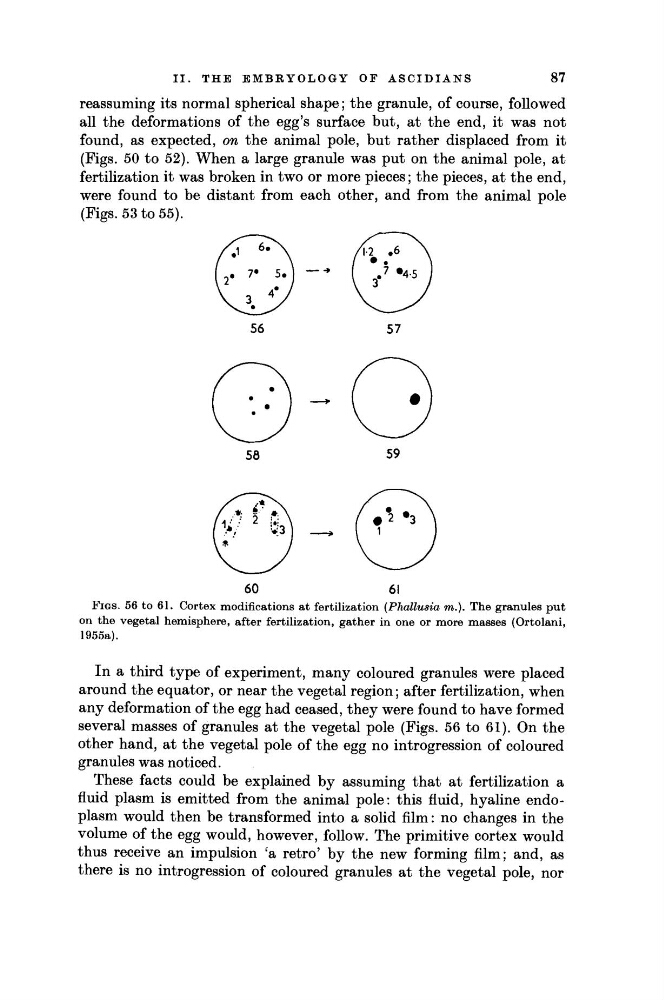
FIGS. 56 to 61. Cortex modifications at fertilization (Phallusia ra.). The granules put
on the vegetal hemisphere, after fertilization, gather in one or more masses (Ortolani,
1955a).
In a third type of experiment, many coloured granules were placed
around the equator, or near the vegetal region; after fertilization, when
any deformation of the egg had ceased, they were found to have formed
several masses of granules at the vegetal pole (Figs. 56 to 61). On the
other hand, at the vegetal pole of the egg no introgression of coloured
granules was noticed.
These facts could be explained by assuming that at fertilization a
fluid plasm is emitted from the animal pole: this fluid, hyaline endoplasm would then be transformed into a solid film: no changes in the
volume of the egg would, however, follow. The primitive cortex would
thus receive an impulsion 'a retro' by the new forming film; and, as
there is no introgression of coloured granules at the vegetal pole, nor
THE EMBRYOLOGY
OF ASCIDIANS
87
reassuming its normal spherical shape; the granule, of course, followed
all the deformations of the egg's surface but, at the end, it was not
found, as expected, on the animal pole, but rather displaced from it
(Figs. 50 to 52). When a large granule was put on the animal pole, at
fertilization it was broken in two or more pieces; the pieces, at the end,
were found to be distant from each other, and from the animal pole
(Figs. 53 to 55).
56
57
58
59
60
61
FIGS. 56 to 61. Cortex modifications at fertilization (Phallusia ra.). The granules put
on the vegetal hemisphere, after fertilization, gather in one or more masses (Ortolani,
1955a).
In a third type of experiment, many coloured granules were placed
around the equator, or near the vegetal region; after fertilization, when
any deformation of the egg had ceased, they were found to have formed
several masses of granules at the vegetal pole (Figs. 56 to 61). On the
other hand, at the vegetal pole of the egg no introgression of coloured
granules was noticed.
These facts could be explained by assuming that at fertilization a
fluid plasm is emitted from the animal pole: this fluid, hyaline endoplasm would then be transformed into a solid film: no changes in the
volume of the egg would, however, follow. The primitive cortex would
thus receive an impulsion 'a retro' by the new forming film; and, as
there is no introgression of coloured granules at the vegetal pole, nor