

I X .
D E V E L O P M E N T O F T H E T E L E O S T E A N E G G
423
ever, certain parallels can be drawn. In the two cases the cortex of
the cleaved egg can be divided into a superior portion, the animal
portion, which remains in a surface position, and an inferior portion, the
marginal and sub-blastoporal portion. In Amphibia, the latter is
invaginated inside the egg; in Teleosts, it disappears: the marginal
section is broken up during ingression (see Section IV, B) and the
equivalent of the sub-blastoporal portion undergoes destruction, since it
cannot be invaginated (see Section IV, A, 2).
The faculty of autonomous spreading of the enveloping layer (see
Section IV, A, 1) is found in the cells of the animal zone in Amphibia
(Holtfreter, 1943b, c).
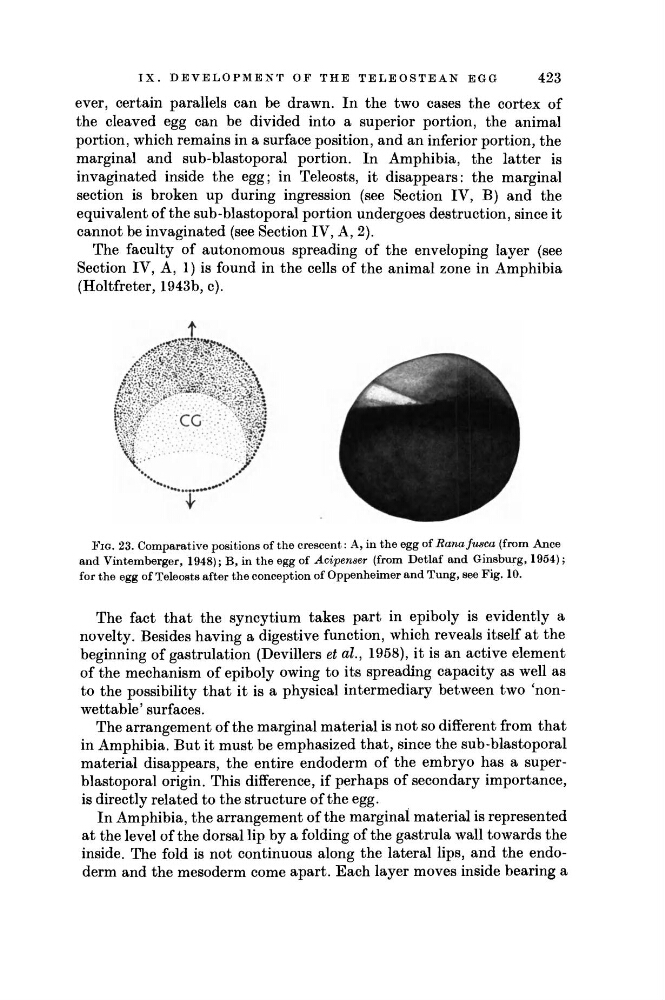
F I G . 23. Comparative positions of the crescent: A, in the egg of Rana fusca (from Anee
and Vintemberger, 1948); B, in the egg of Acipenser (from Detlaf and Ginsburg, 1954);
for the egg of Teleosts after the conception of Oppenheimer and Tung, see Fig. 10.
The fact that the syncytium takes part in epiboly is evidently a
novelty. Besides having a digestive function, which reveals itself at the
beginning of gastrulation (Devillers et ah, 1958), it is an active element
of the mechanism of epiboly owing to its spreading capacity as well as
to the possibility that it is a physical intermediary between two 'nonwettable' surfaces.
The arrangement of the marginal material is not so different from that
in Amphibia. But it must be emphasized that, since the sub-blastoporal
material disappears, the entire endoderm of the embryo has a superblastoporal origin. This difference, if perhaps of secondary importance,
is directly related to the structure of the egg.
In Amphibia, the arrangement of the marginal material is represented
at the level of the dorsal lip by a folding of the gastrula wall towards the
inside. The fold is not continuous along the lateral lips, and the endoderm and the mesoderm come apart. Each layer moves inside bearing a
A
Β
D E V E L O P M E N T O F T H E T E L E O S T E A N E G G
423
ever, certain parallels can be drawn. In the two cases the cortex of
the cleaved egg can be divided into a superior portion, the animal
portion, which remains in a surface position, and an inferior portion, the
marginal and sub-blastoporal portion. In Amphibia, the latter is
invaginated inside the egg; in Teleosts, it disappears: the marginal
section is broken up during ingression (see Section IV, B) and the
equivalent of the sub-blastoporal portion undergoes destruction, since it
cannot be invaginated (see Section IV, A, 2).
The faculty of autonomous spreading of the enveloping layer (see
Section IV, A, 1) is found in the cells of the animal zone in Amphibia
(Holtfreter, 1943b, c).
F I G . 23. Comparative positions of the crescent: A, in the egg of Rana fusca (from Anee
and Vintemberger, 1948); B, in the egg of Acipenser (from Detlaf and Ginsburg, 1954);
for the egg of Teleosts after the conception of Oppenheimer and Tung, see Fig. 10.
The fact that the syncytium takes part in epiboly is evidently a
novelty. Besides having a digestive function, which reveals itself at the
beginning of gastrulation (Devillers et ah, 1958), it is an active element
of the mechanism of epiboly owing to its spreading capacity as well as
to the possibility that it is a physical intermediary between two 'nonwettable' surfaces.
The arrangement of the marginal material is not so different from that
in Amphibia. But it must be emphasized that, since the sub-blastoporal
material disappears, the entire endoderm of the embryo has a superblastoporal origin. This difference, if perhaps of secondary importance,
is directly related to the structure of the egg.
In Amphibia, the arrangement of the marginal material is represented
at the level of the dorsal lip by a folding of the gastrula wall towards the
inside. The fold is not continuous along the lateral lips, and the endoderm and the mesoderm come apart. Each layer moves inside bearing a
A
Β