

IX. DEVELOPMENT OF THE TELEOSTEAN EGG
411
little to the whole blastodisc. On the other hand, Trinkaus (1951) indicates that there is in Fundulus a uniform distribution of movements in
the early stages.
If we make composite germs (Devillers, 1951c) by associating either
two ventral, or two dorsal halves (see Section III, B, 2, a) we note that
after 3 to 4 days the diameter of the first is at least equal to that of
controls, while that of the second is smaller by about a third.
When gastrulation draws to an end and nearly all the marginal
material is invaginated, it is probable that epiboly then progresses at the
same speed all around the disc.
2. Part Played by the Perivitelline Pellicle
During the advance of the germinal border towards the vegetative
pole, the perivitelline pellicle becomes thicker and opaque. In the very
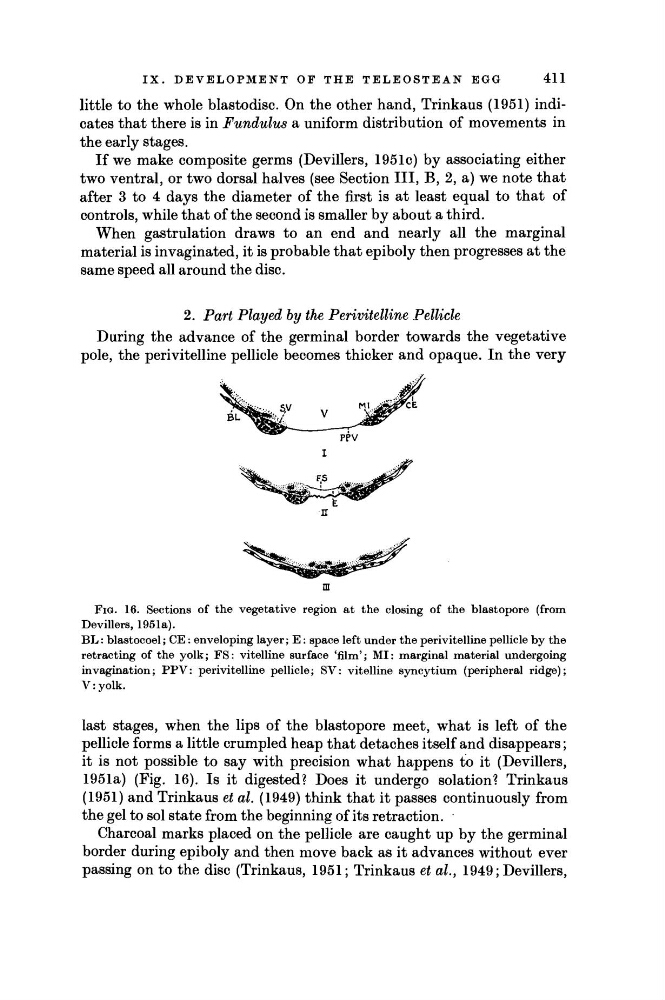
FIG. 16. Sections of the vegetative region at the closing of the blastopore (from
Devillers, 1951a).
BL: blastocoel; CE: enveloping layer; Ε: space left under the perivitelline pellicle by the
retracting of the yolk; FS: vitelline surface 'film'; MI: marginal material undergoing
invagination; PPV: perivitelline pellicle; SV: vitelline syncytium (peripheral ridge);
V:yolk.
last stages, when the lips of the blastopore meet, what is left of the
pellicle forms a little crumpled heap that detaches itself and disappears;
it is not possible to say with precision what happens to it (Devillers,
1951a) (Fig. 16). Is it digested? Does it undergo solation? Trinkaus
(1951) and Trinkaus et al. (1949) think that it passes continuously from
the gel to sol state from the beginning of its retraction.
Charcoal marks placed on the pellicle are caught up by the germinal
border during epiboly and then move back as it advances without ever
passing on to the disc (Trinkaus, 1951; Trinkaus et al., 1949; Devillers,
411
little to the whole blastodisc. On the other hand, Trinkaus (1951) indicates that there is in Fundulus a uniform distribution of movements in
the early stages.
If we make composite germs (Devillers, 1951c) by associating either
two ventral, or two dorsal halves (see Section III, B, 2, a) we note that
after 3 to 4 days the diameter of the first is at least equal to that of
controls, while that of the second is smaller by about a third.
When gastrulation draws to an end and nearly all the marginal
material is invaginated, it is probable that epiboly then progresses at the
same speed all around the disc.
2. Part Played by the Perivitelline Pellicle
During the advance of the germinal border towards the vegetative
pole, the perivitelline pellicle becomes thicker and opaque. In the very
FIG. 16. Sections of the vegetative region at the closing of the blastopore (from
Devillers, 1951a).
BL: blastocoel; CE: enveloping layer; Ε: space left under the perivitelline pellicle by the
retracting of the yolk; FS: vitelline surface 'film'; MI: marginal material undergoing
invagination; PPV: perivitelline pellicle; SV: vitelline syncytium (peripheral ridge);
V:yolk.
last stages, when the lips of the blastopore meet, what is left of the
pellicle forms a little crumpled heap that detaches itself and disappears;
it is not possible to say with precision what happens to it (Devillers,
1951a) (Fig. 16). Is it digested? Does it undergo solation? Trinkaus
(1951) and Trinkaus et al. (1949) think that it passes continuously from
the gel to sol state from the beginning of its retraction.
Charcoal marks placed on the pellicle are caught up by the germinal
border during epiboly and then move back as it advances without ever
passing on to the disc (Trinkaus, 1951; Trinkaus et al., 1949; Devillers,