

382
CH. D Ε VILLERS
forms a halo (the periblast) around the germ which will slowly move
towards the blastodisc during premorphogenesis. This migration comes
to an end later in Salmo (Fig. 2) than in Carassius.
In the activated egg, as yet undivided, the cytoplasm is continuous.
We can distinguish however the germ proper and the periblast. To
this distinction corresponds the division of the cortex into a germinal
portion and a peri vitelline portion (peri vitelline pellicle) the latter
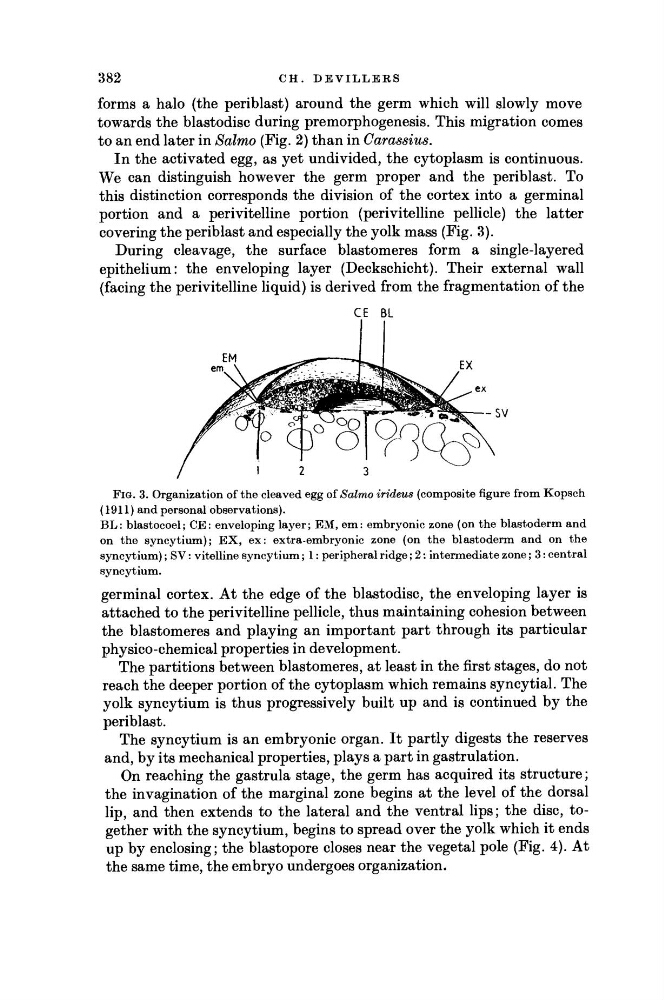
covering the periblast and especially the yolk mass (Fig. 3).
During cleavage, the surface blastomeres form a single-layered
epithelium: the enveloping layer (Deckschicht). Their external wall
(facing the perivitelline liquid) is derived from the fragmentation of the
FIG. 3. Organization of the cleaved egg of Salmo irideus (composite figure from Kopsch
(1911) and personal observations).
BL: blastocoel; CE: enveloping layer; EM, em: embryonic zone (on the blastoderm and
on the syncytium); EX, ex: extra-embryonic zone (on the blastoderm and on the
syncytium); SV: vitelline syncytium; 1: peripheral ridge; 2: intermediate zone; 3: central
syncytium.
germinal cortex. At the edge of the blastodisc, the enveloping layer is
attached to the perivitelline pellicle, thus maintaining cohesion between
the blastomeres and playing an important part through its particular
physico-chemical properties in development.
The partitions between blastomeres, at least in the first stages, do not
reach the deeper portion of the cytoplasm which remains syncytial. The
yolk syncytium is thus progressively built up and is continued by the
periblast.
The syncytium is an embryonic organ. It partly digests the reserves
and, by its mechanical properties, plays a part in gastrulation.
On reaching the gastrula stage, the germ has acquired its structure;
the invagination of the marginal zone begins at the level of the dorsal
lip, and then extends to the lateral and the ventral lips; the disc, together with the syncytium, begins to spread over the yolk which it ends
up by enclosing; the blastopore closes near the vegetal pole (Fig. 4). At
the same time, the embryo undergoes organization.
CE BL
EM
— SV
CH. D Ε VILLERS
forms a halo (the periblast) around the germ which will slowly move
towards the blastodisc during premorphogenesis. This migration comes
to an end later in Salmo (Fig. 2) than in Carassius.
In the activated egg, as yet undivided, the cytoplasm is continuous.
We can distinguish however the germ proper and the periblast. To
this distinction corresponds the division of the cortex into a germinal
portion and a peri vitelline portion (peri vitelline pellicle) the latter
covering the periblast and especially the yolk mass (Fig. 3).
During cleavage, the surface blastomeres form a single-layered
epithelium: the enveloping layer (Deckschicht). Their external wall
(facing the perivitelline liquid) is derived from the fragmentation of the
FIG. 3. Organization of the cleaved egg of Salmo irideus (composite figure from Kopsch
(1911) and personal observations).
BL: blastocoel; CE: enveloping layer; EM, em: embryonic zone (on the blastoderm and
on the syncytium); EX, ex: extra-embryonic zone (on the blastoderm and on the
syncytium); SV: vitelline syncytium; 1: peripheral ridge; 2: intermediate zone; 3: central
syncytium.
germinal cortex. At the edge of the blastodisc, the enveloping layer is
attached to the perivitelline pellicle, thus maintaining cohesion between
the blastomeres and playing an important part through its particular
physico-chemical properties in development.
The partitions between blastomeres, at least in the first stages, do not
reach the deeper portion of the cytoplasm which remains syncytial. The
yolk syncytium is thus progressively built up and is continued by the
periblast.
The syncytium is an embryonic organ. It partly digests the reserves
and, by its mechanical properties, plays a part in gastrulation.
On reaching the gastrula stage, the germ has acquired its structure;
the invagination of the marginal zone begins at the level of the dorsal
lip, and then extends to the lateral and the ventral lips; the disc, together with the syncytium, begins to spread over the yolk which it ends
up by enclosing; the blastopore closes near the vegetal pole (Fig. 4). At
the same time, the embryo undergoes organization.
CE BL
EM
— SV