

V I .
D I F F E R E N T I A T I O N O F V E R T E B R A T E P I G M E N T C E L L S
279
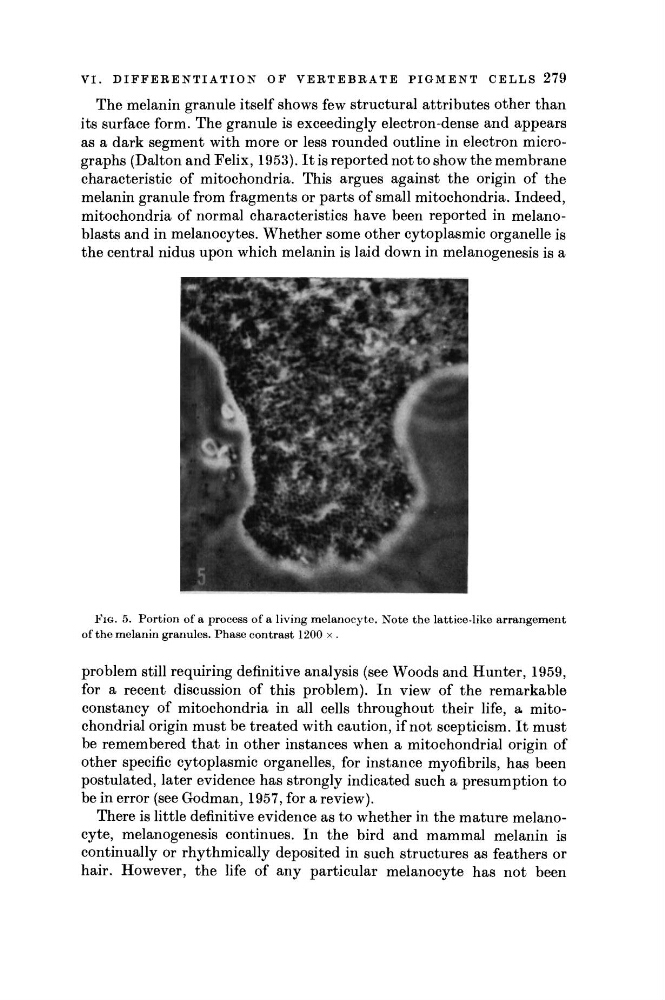
F I G . 5. Portion of a process of a living melanocyte. N o t e the lattice-like arrangement
of the melanin granules. Phase contrast 1200 χ .
problem still requiring definitive analysis (see Woods and Hunter, 1959,
for a recent discussion of this problem). In view of the remarkable
constancy of mitochondria in all cells throughout their life, a mitochondrial origin must be treated with caution, if not scepticism. It must
be remembered that in other instances when a mitochondrial origin of
other specific cytoplasmic organelles, for instance myofibrils, has been
postulated, later evidence has strongly indicated such a presumption to
be in error (see Godman, 1957, for a review).
There is little definitive evidence as to whether in the mature melanocyte, melanogenesis continues. In the bird and mammal melanin is
continually or rhythmically deposited in such structures as feathers or
hair. However, the life of any particular melanocyte has not been
The melanin granule itself shows few structural attributes other than
its surface form. The granule is exceedingly electron-dense and appears
as a dark segment with more or less rounded outline in electron micrographs (Dalton and Felix, 1953). It is reported not to show the membrane
characteristic of mitochondria. This argues against the origin of the
melanin granule from fragments or parts of small mitochondria. Indeed,
mitochondria of normal characteristics have been reported in melanoblasts and in melanocytes. Whether some other cytoplasmic organelle is
the central nidus upon which melanin is laid down in melanogenesis is a
D I F F E R E N T I A T I O N O F V E R T E B R A T E P I G M E N T C E L L S
279
F I G . 5. Portion of a process of a living melanocyte. N o t e the lattice-like arrangement
of the melanin granules. Phase contrast 1200 χ .
problem still requiring definitive analysis (see Woods and Hunter, 1959,
for a recent discussion of this problem). In view of the remarkable
constancy of mitochondria in all cells throughout their life, a mitochondrial origin must be treated with caution, if not scepticism. It must
be remembered that in other instances when a mitochondrial origin of
other specific cytoplasmic organelles, for instance myofibrils, has been
postulated, later evidence has strongly indicated such a presumption to
be in error (see Godman, 1957, for a review).
There is little definitive evidence as to whether in the mature melanocyte, melanogenesis continues. In the bird and mammal melanin is
continually or rhythmically deposited in such structures as feathers or
hair. However, the life of any particular melanocyte has not been
The melanin granule itself shows few structural attributes other than
its surface form. The granule is exceedingly electron-dense and appears
as a dark segment with more or less rounded outline in electron micrographs (Dalton and Felix, 1953). It is reported not to show the membrane
characteristic of mitochondria. This argues against the origin of the
melanin granule from fragments or parts of small mitochondria. Indeed,
mitochondria of normal characteristics have been reported in melanoblasts and in melanocytes. Whether some other cytoplasmic organelle is
the central nidus upon which melanin is laid down in melanogenesis is a