

174
F.
Ε.
LEHMANN
reaction curves which always appear during this period. The values of
catheptic activity are regularly related to the same amount of dry
matter and are therefore comparable. There appeared three distinct levels
of activity, a very high one for the kidney, a medium one for spleen and
liver and a low one for muscle (Fig. 12). There also exist for some organs
distinct sexual differences: catheptic activity in spleen and kidney is
higher in females than in males. Furthermore there exists a striking
parallel between phago- or lysosomes and catheptic activity for the different
0-7
0-6
j 0-5
υ
c
£ 0-3
t
0-2
ο·ι
(
0
0-05
0-1
0-15
0-2
Cysteine concn. —•
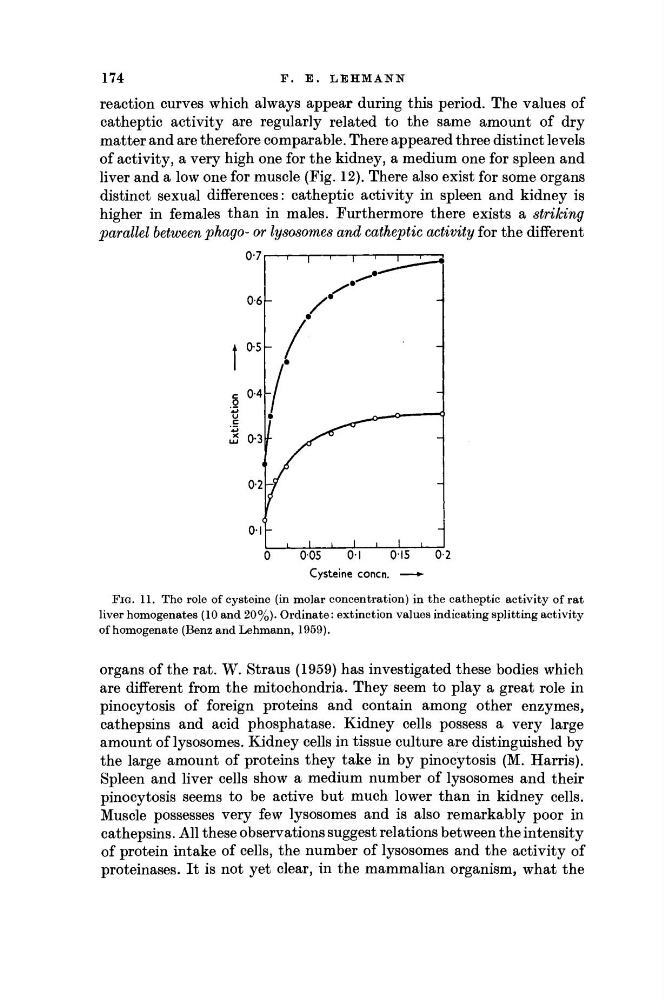
FIG. 11. The role of cysteine (in molar concentration) in the catheptic activity of rat
liver homogenates (10 and 20%). Ordinate: extinction values indicating splitting activity
of homogenate (Benz and Lehmann, 1959).
organs of the rat. W. Straus (1959) has investigated these bodies which
are different from the mitochondria. They seem to play a great role in
pinocytosis of foreign proteins and contain among other enzymes,
cathepsins and acid phosphatase. Kidney cells possess a very large
amount of lysosomes. Kidney cells in tissue culture are distinguished by
the large amount of proteins they take in by pinocytosis (M. Harris).
Spleen and liver cells show a medium number of lysosomes and their
pinocytosis seems to be active but much lower than in kidney cells.
Muscle possesses very few lysosomes and is also remarkably poor in
cathepsins. All these observations suggest relations between the intensity
of protein intake of cells, the number of lysosomes and the activity of
proteinases. It is not yet clear, in the mammalian organism, what the
F.
Ε.
LEHMANN
reaction curves which always appear during this period. The values of
catheptic activity are regularly related to the same amount of dry
matter and are therefore comparable. There appeared three distinct levels
of activity, a very high one for the kidney, a medium one for spleen and
liver and a low one for muscle (Fig. 12). There also exist for some organs
distinct sexual differences: catheptic activity in spleen and kidney is
higher in females than in males. Furthermore there exists a striking
parallel between phago- or lysosomes and catheptic activity for the different
0-7
0-6
j 0-5
υ
c
£ 0-3
t
0-2
ο·ι
(
0
0-05
0-1
0-15
0-2
Cysteine concn. —•
FIG. 11. The role of cysteine (in molar concentration) in the catheptic activity of rat
liver homogenates (10 and 20%). Ordinate: extinction values indicating splitting activity
of homogenate (Benz and Lehmann, 1959).
organs of the rat. W. Straus (1959) has investigated these bodies which
are different from the mitochondria. They seem to play a great role in
pinocytosis of foreign proteins and contain among other enzymes,
cathepsins and acid phosphatase. Kidney cells possess a very large
amount of lysosomes. Kidney cells in tissue culture are distinguished by
the large amount of proteins they take in by pinocytosis (M. Harris).
Spleen and liver cells show a medium number of lysosomes and their
pinocytosis seems to be active but much lower than in kidney cells.
Muscle possesses very few lysosomes and is also remarkably poor in
cathepsins. All these observations suggest relations between the intensity
of protein intake of cells, the number of lysosomes and the activity of
proteinases. It is not yet clear, in the mammalian organism, what the