

170
Γ. Ε.
LEHMANN
pounds might differ very much. Our morphological and histological
findings all support this conclusion. Furthermore it appeared that
different periods of the regeneration processes were most sensitive to
aminoketone E 9 and colchicine. This might be connected also with a
different biochemical reactivity of the regenerating tissues. In the case
of E 9 the morphostatic effect might be closely correlated with the
cathepsin activating influence of E 9 . Inhibition of growth and modification of cathepsin seem to be in this case closely connected.
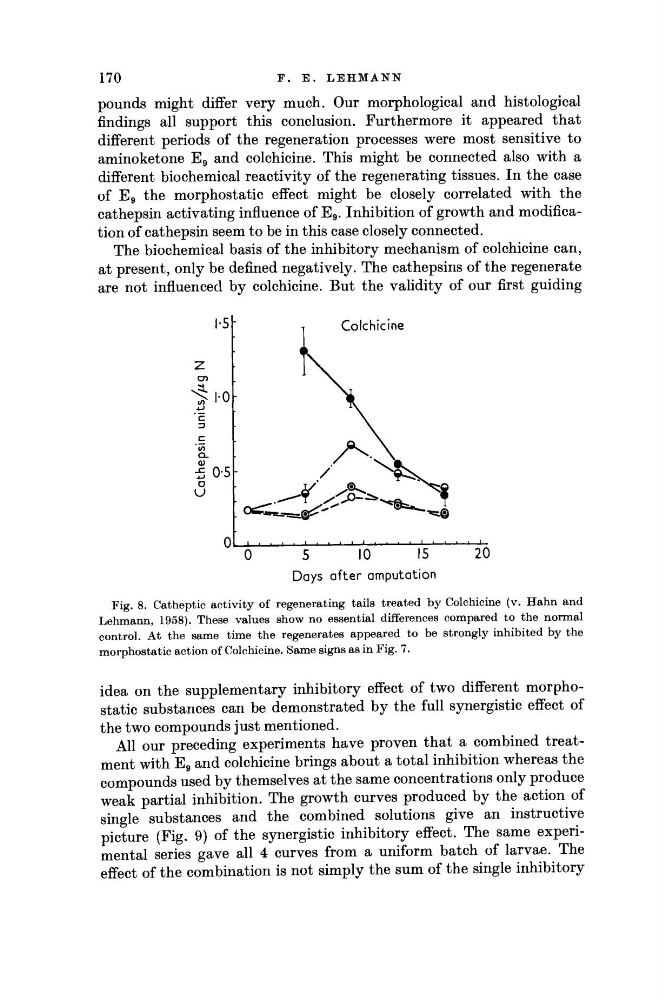
The biochemical basis of the inhibitory mechanism of colchicine can,
at present, only be defined negatively. The cathepsins of the regenerate
are not influenced by colchicine. But the validity of our first guiding
Fig. 8. Catheptic activity of regenerating tails treated by Colchicine (v. Hahn and
Lehmann, 1958). These values show no essential differences compared to the normal
control. At the same time the regenerates appeared to be strongly inhibited by the
morphostatic action of Colchicine. Same signs as in Fig. 7.
idea on the supplementary inhibitory effect of two different morphostatic substances can be demonstrated by the full synergistic effect of
the two compounds just mentioned.
All our preceding experiments have proven that a combined treatment with E 9 and colchicine brings about a total inhibition whereas the
compounds used by themselves at the same concentrations only produce
weak partial inhibition. The growth curves produced by the action of
single substances and the combined solutions give an instructive
picture (Fig. 9) of the synergistic inhibitory effect. The same experimental series gave all 4 curves from a uniform batch of larvae. The
effect of the combination is not simply the sum of the single inhibitory
Colchicine
J ι ι 1 1 L
5
10
15
Days after amputation
Γ. Ε.
LEHMANN
pounds might differ very much. Our morphological and histological
findings all support this conclusion. Furthermore it appeared that
different periods of the regeneration processes were most sensitive to
aminoketone E 9 and colchicine. This might be connected also with a
different biochemical reactivity of the regenerating tissues. In the case
of E 9 the morphostatic effect might be closely correlated with the
cathepsin activating influence of E 9 . Inhibition of growth and modification of cathepsin seem to be in this case closely connected.
The biochemical basis of the inhibitory mechanism of colchicine can,
at present, only be defined negatively. The cathepsins of the regenerate
are not influenced by colchicine. But the validity of our first guiding
Fig. 8. Catheptic activity of regenerating tails treated by Colchicine (v. Hahn and
Lehmann, 1958). These values show no essential differences compared to the normal
control. At the same time the regenerates appeared to be strongly inhibited by the
morphostatic action of Colchicine. Same signs as in Fig. 7.
idea on the supplementary inhibitory effect of two different morphostatic substances can be demonstrated by the full synergistic effect of
the two compounds just mentioned.
All our preceding experiments have proven that a combined treatment with E 9 and colchicine brings about a total inhibition whereas the
compounds used by themselves at the same concentrations only produce
weak partial inhibition. The growth curves produced by the action of
single substances and the combined solutions give an instructive
picture (Fig. 9) of the synergistic inhibitory effect. The same experimental series gave all 4 curves from a uniform batch of larvae. The
effect of the combination is not simply the sum of the single inhibitory
Colchicine
J ι ι 1 1 L
5
10
15
Days after amputation