

IV.
ACTION
OF MORPHOSTATIC
SUBSTANCES
161
The second group comprises combinations in which the synergistic
effects of the two partners are high and the range of toxicity rather
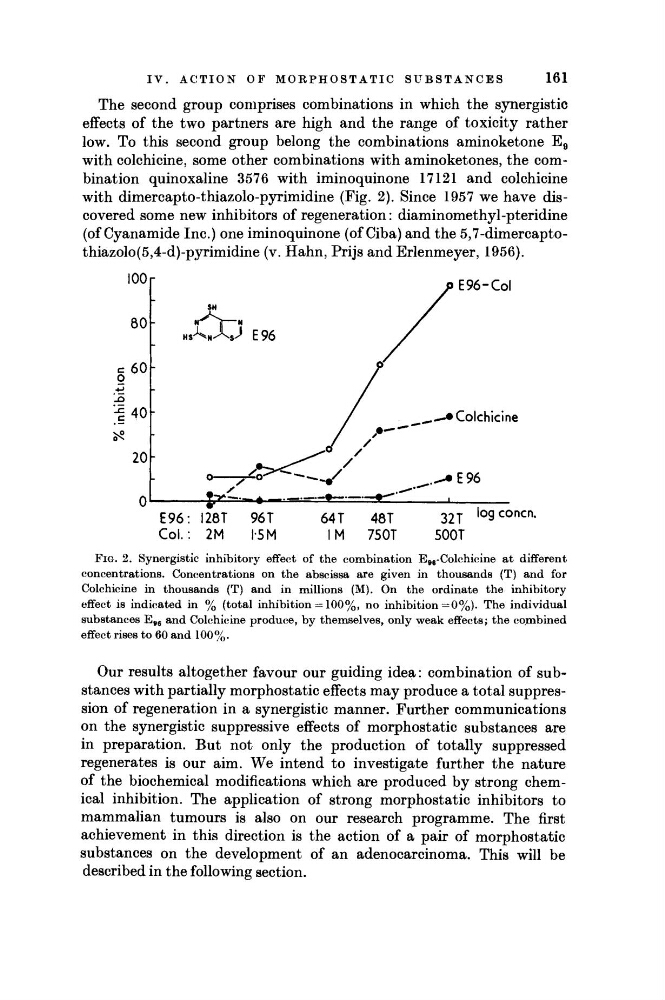
low. To this second group belong the combinations aminoketone E 9
with colchicine, some other combinations with aminoketones, the combination quinoxaline 3576 with iminoquinone 17121 and colchicine
with dimercapto-thiazolo-pyrimidine (Fig. 2). Since 1957 we have discovered some new inhibitors of regeneration: diaminomethyl-pteridine
(of Cyanamide Inc.) one iminoquinone (of Ciba) and the 5,7-dimercaptothiazolo(5,4-d)-pyrimidine (v. Hahn, Prijs and Erlenmeyer, 1956).
100 Γ
E96-Col
Colchicine
E96: I28T
Col.: 2M
96 Τ
1-5 Μ
64 Τ
IM
48T
750T
log concn,
500T
FIG. 2. Synergistic inhibitory effect of the combination E 9 6
-Colchicine at different
concentrations. Concentrations on the abscissa are given in thousands (T) and for
Colchicine in thousands (T) and in millions (M). On the ordinate the inhibitory
effect is indicated in % (total inhibition = 100%, no inhibition =0%). The individual
substances E 9e and Colchicine produce, by themselves, only weak effects; the combined
effect rises to 60 and 100%.
Our results altogether favour our guiding idea: combination of substances with partially morphostatic effects may produce a total suppression of regeneration in a synergistic manner. Further communications
on the synergistic suppressive effects of morphostatic substances are
in preparation. But not only the production of totally suppressed
regenerates is our aim. We intend to investigate further the nature
of the biochemical modifications which are produced by strong chemical inhibition. The application of strong morphostatic inhibitors to
mammalian tumours is also on our research programme. The first
achievement in this direction is the action of a pair of morphostatic
substances on the development of an adenocarcinoma. This will be
described in the following section.
ACTION
OF MORPHOSTATIC
SUBSTANCES
161
The second group comprises combinations in which the synergistic
effects of the two partners are high and the range of toxicity rather
low. To this second group belong the combinations aminoketone E 9
with colchicine, some other combinations with aminoketones, the combination quinoxaline 3576 with iminoquinone 17121 and colchicine
with dimercapto-thiazolo-pyrimidine (Fig. 2). Since 1957 we have discovered some new inhibitors of regeneration: diaminomethyl-pteridine
(of Cyanamide Inc.) one iminoquinone (of Ciba) and the 5,7-dimercaptothiazolo(5,4-d)-pyrimidine (v. Hahn, Prijs and Erlenmeyer, 1956).
100 Γ
E96-Col
Colchicine
E96: I28T
Col.: 2M
96 Τ
1-5 Μ
64 Τ
IM
48T
750T
log concn,
500T
FIG. 2. Synergistic inhibitory effect of the combination E 9 6
-Colchicine at different
concentrations. Concentrations on the abscissa are given in thousands (T) and for
Colchicine in thousands (T) and in millions (M). On the ordinate the inhibitory
effect is indicated in % (total inhibition = 100%, no inhibition =0%). The individual
substances E 9e and Colchicine produce, by themselves, only weak effects; the combined
effect rises to 60 and 100%.
Our results altogether favour our guiding idea: combination of substances with partially morphostatic effects may produce a total suppression of regeneration in a synergistic manner. Further communications
on the synergistic suppressive effects of morphostatic substances are
in preparation. But not only the production of totally suppressed
regenerates is our aim. We intend to investigate further the nature
of the biochemical modifications which are produced by strong chemical inhibition. The application of strong morphostatic inhibitors to
mammalian tumours is also on our research programme. The first
achievement in this direction is the action of a pair of morphostatic
substances on the development of an adenocarcinoma. This will be
described in the following section.