

136
R .
J .
G O S S
muscle and bone underneath the healthy posterior skin was sufficient to
interfere with the regenerative potential of the latter. Another experiment involved the removal of the posterior half of the internal limb
tissues, leaving the entire complement of leg skin intact. This procedure
alone results in the regeneration of whole feet (Section VI, B). However,
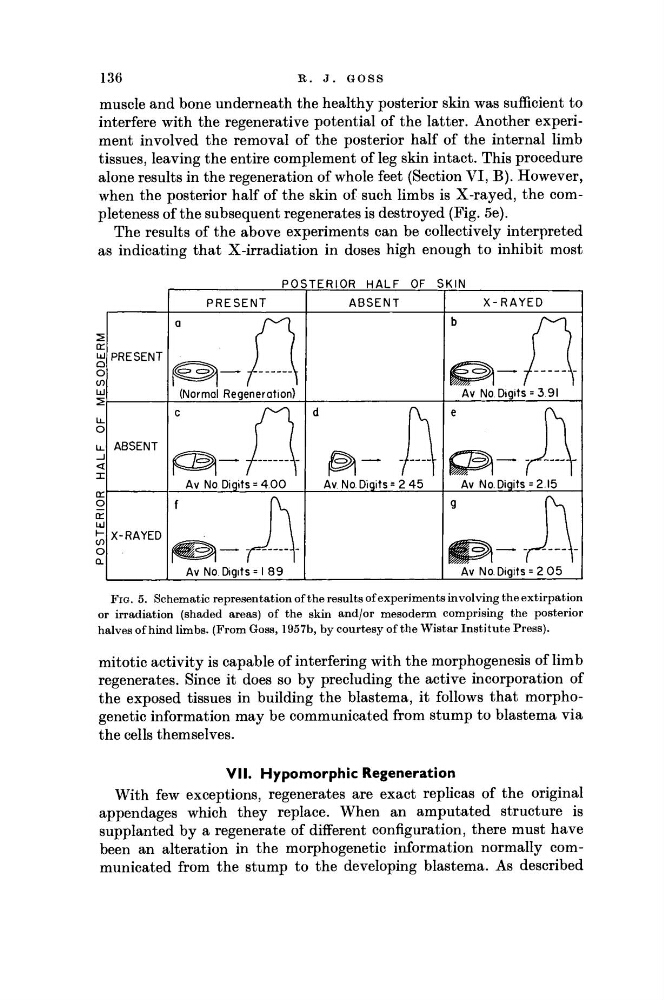
when the posterior half of the skin of such limbs is X-rayed, the completeness of the subsequent regenerates is destroyed (Fig. 5e).
The results of the above experiments can be collectively interpreted
as indicating that X-irradiation in doses high enough to inhibit most
P O S T E R I O R H A L F OF SKIN
P R E S E N T
A B S E N T
X - R A Y E D
PRESENT
(Normal Regeneration)
Av No Digits = 3 91
ABSENT
Av No Digits = 4 . 0 0
Av. No. Digits = 2 4 5
Av No. Digits = 2 15
X-RAYED
Av No. Digits = 1 8 9
Av No. Digits = 2 0 5
FIG. 5. Schematic representation of the results of experiments involving the extirpation
or irradiation (shaded areas) of the skin and/or mesoderm comprising the posterior
halves of hind limbs. (From Goss, 1957b, b y courtesy of the W i s t a r Institute Press).
mitotic activity is capable of interfering with the morphogenesis of limb
regenerates. Since it does so by precluding the active incorporation of
the exposed tissues in building the blastema, it follows that morphogenetic information may be communicated from stump to blastema via
the cells themselves.
V I I . Hypomorphic Regeneration
With few exceptions, regenerates are exact replicas of the original
appendages which they replace. When an amputated structure is
supplanted by a regenerate of different configuration, there must have
been an alteration in the morphogenetic information normally communicated from the stump to the developing blastema. As described
R .
J .
G O S S
muscle and bone underneath the healthy posterior skin was sufficient to
interfere with the regenerative potential of the latter. Another experiment involved the removal of the posterior half of the internal limb
tissues, leaving the entire complement of leg skin intact. This procedure
alone results in the regeneration of whole feet (Section VI, B). However,
when the posterior half of the skin of such limbs is X-rayed, the completeness of the subsequent regenerates is destroyed (Fig. 5e).
The results of the above experiments can be collectively interpreted
as indicating that X-irradiation in doses high enough to inhibit most
P O S T E R I O R H A L F OF SKIN
P R E S E N T
A B S E N T
X - R A Y E D
PRESENT
(Normal Regeneration)
Av No Digits = 3 91
ABSENT
Av No Digits = 4 . 0 0
Av. No. Digits = 2 4 5
Av No. Digits = 2 15
X-RAYED
Av No. Digits = 1 8 9
Av No. Digits = 2 0 5
FIG. 5. Schematic representation of the results of experiments involving the extirpation
or irradiation (shaded areas) of the skin and/or mesoderm comprising the posterior
halves of hind limbs. (From Goss, 1957b, b y courtesy of the W i s t a r Institute Press).
mitotic activity is capable of interfering with the morphogenesis of limb
regenerates. Since it does so by precluding the active incorporation of
the exposed tissues in building the blastema, it follows that morphogenetic information may be communicated from stump to blastema via
the cells themselves.
V I I . Hypomorphic Regeneration
With few exceptions, regenerates are exact replicas of the original
appendages which they replace. When an amputated structure is
supplanted by a regenerate of different configuration, there must have
been an alteration in the morphogenetic information normally communicated from the stump to the developing blastema. As described