

I I I .
R E G E N E R A T I O N
O F
V E R T E B R A T E
A P P E N D A G E S
135
half of the foot and thus have, on the average, about half the normal
number of digits (cf. Lomoskaia, 1948). Therefore, X-irradiation of
part of a limb eliminates that region from participation in regeneration.
Moreover, the remaining unirradiated portion, while able to regenerate,
cannot in any way compensate morphogenetically for the radiation
induced deficiency.
In view of the apparent importance of the skin in morphogenetic
mechanisms in extremity regeneration (cf. Section VI, B) particular
attention has been directed toward this tissue in experiments utilizing
selective irradiation techniques. In one series of experiments, the
posterior half of the skin of the lower leg was irradiated, while all other
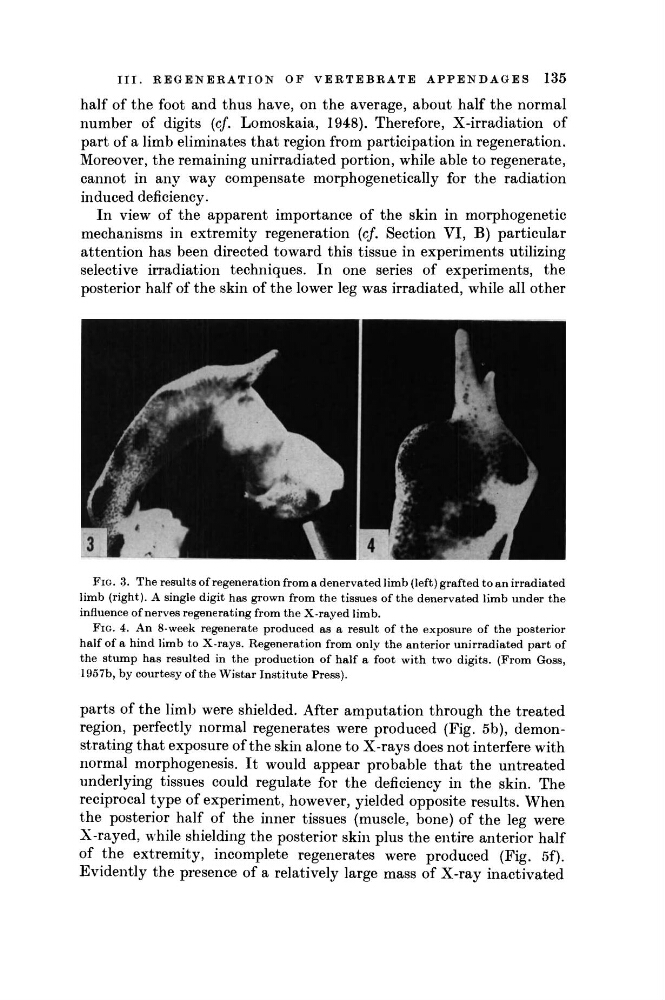
F I G . 3. The results of regeneration from a denervated limb (left) grafted to an irradiated
limb (right). A single digit has grown from the tissues of the denervated limb under the
influence of nerves regenerating from the X - r a y e d limb.
FIG. 4. A n 8-week regenerate produced as a result of the exposure of the posterior
half of a hind limb to X - r a y s . Regeneration from only the anterior unirradiated part of
the s t u m p has resulted in the production of half a foot with two digits. (From Goss,
1957b, b y courtesy of the W i s t a r Institute Press).
parts of the limb were shielded. After amputation through the treated
region, perfectly normal regenerates were produced (Fig. 5b), demonstrating that exposure of the skin alone to X-rays does not interfere with
normal morphogenesis. It would appear probable that the untreated
underlying tissues could regulate for the deficiency in the skin. The
reciprocal type of experiment, however, yielded opposite results. When
the posterior half of the inner tissues (muscle, bone) of the leg were
X-rayed, while shielding the posterior skin plus the entire anterior half
of the extremity, incomplete regenerates were produced (Fig. 5f).
Evidently the presence of a relatively large mass of X-ray inactivated
R E G E N E R A T I O N
O F
V E R T E B R A T E
A P P E N D A G E S
135
half of the foot and thus have, on the average, about half the normal
number of digits (cf. Lomoskaia, 1948). Therefore, X-irradiation of
part of a limb eliminates that region from participation in regeneration.
Moreover, the remaining unirradiated portion, while able to regenerate,
cannot in any way compensate morphogenetically for the radiation
induced deficiency.
In view of the apparent importance of the skin in morphogenetic
mechanisms in extremity regeneration (cf. Section VI, B) particular
attention has been directed toward this tissue in experiments utilizing
selective irradiation techniques. In one series of experiments, the
posterior half of the skin of the lower leg was irradiated, while all other
F I G . 3. The results of regeneration from a denervated limb (left) grafted to an irradiated
limb (right). A single digit has grown from the tissues of the denervated limb under the
influence of nerves regenerating from the X - r a y e d limb.
FIG. 4. A n 8-week regenerate produced as a result of the exposure of the posterior
half of a hind limb to X - r a y s . Regeneration from only the anterior unirradiated part of
the s t u m p has resulted in the production of half a foot with two digits. (From Goss,
1957b, b y courtesy of the W i s t a r Institute Press).
parts of the limb were shielded. After amputation through the treated
region, perfectly normal regenerates were produced (Fig. 5b), demonstrating that exposure of the skin alone to X-rays does not interfere with
normal morphogenesis. It would appear probable that the untreated
underlying tissues could regulate for the deficiency in the skin. The
reciprocal type of experiment, however, yielded opposite results. When
the posterior half of the inner tissues (muscle, bone) of the leg were
X-rayed, while shielding the posterior skin plus the entire anterior half
of the extremity, incomplete regenerates were produced (Fig. 5f).
Evidently the presence of a relatively large mass of X-ray inactivated