

VITELLINE MEMBRANE AND CORTICAL PARTICLES 317
replaced by energy released in respiration. Processes that require this
kind of energy are designated [Resp].
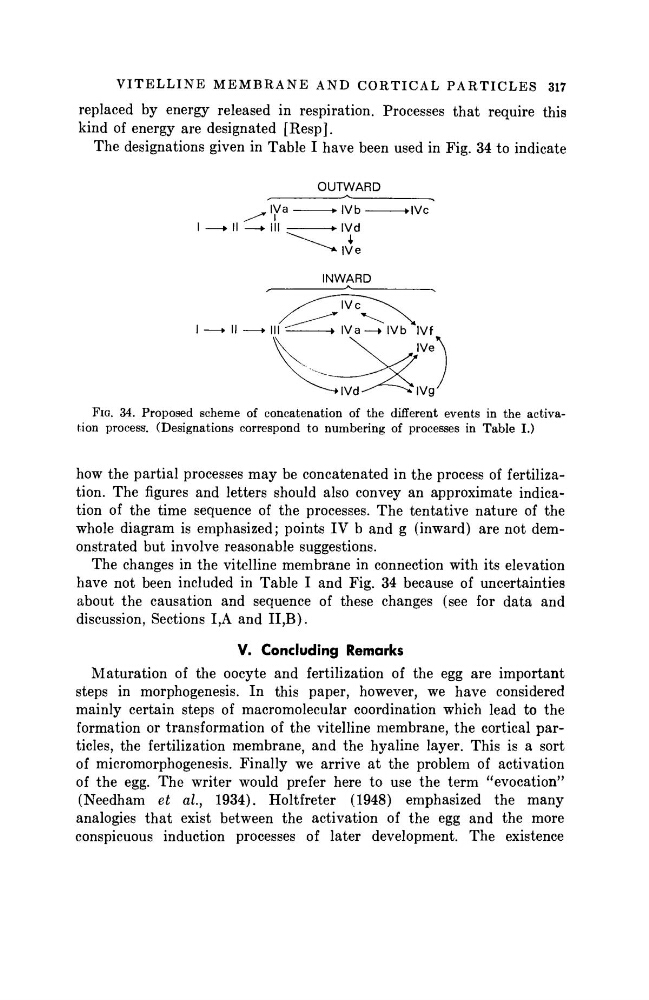
The designations given in Table I have been used in Fig. 34 to indicate
OUTWARD
. IVa
• IVb
•IVc
III
• IVd
IV e
INWARD
FIG. 34. Proposed scheme of concatenation of the different events in the activation process. (Designations correspond to numbering of processes in Table I.)
how the partial processes may be concatenated in the process of fertilization. The figures and letters should also convey an approximate indication of the time sequence of the processes. The tentative nature of the
whole diagram is emphasized; points IV b and g (inward) are not demonstrated but involve reasonable suggestions.
The changes in the vitelline membrane in connection with its elevation
have not been included in Table I and Fig. 34 because of uncertainties
about the causation and sequence of these changes (see for data and
discussion, Sections I,A and ΙΙ,Β).
V. Concluding Remarks
Maturation of the oocyte and fertilization of the egg are important
steps in morphogenesis. In this paper, however, we have considered
mainly certain steps of macromolecular coordination which lead to the
formation or transformation of the vitelline membrane, the cortical particles, the fertilization membrane, and the hyaline layer. This is a sort
of micromorphogenesis. Finally we arrive at the problem of activation
of the egg. The writer would prefer here to use the term "evocation"
(Needham et al., 1934). Holtfreter (1948) emphasized the many
analogies that exist between the activation of the egg and the more
conspicuous induction processes of later development. The existence
replaced by energy released in respiration. Processes that require this
kind of energy are designated [Resp].
The designations given in Table I have been used in Fig. 34 to indicate
OUTWARD
. IVa
• IVb
•IVc
III
• IVd
IV e
INWARD
FIG. 34. Proposed scheme of concatenation of the different events in the activation process. (Designations correspond to numbering of processes in Table I.)
how the partial processes may be concatenated in the process of fertilization. The figures and letters should also convey an approximate indication of the time sequence of the processes. The tentative nature of the
whole diagram is emphasized; points IV b and g (inward) are not demonstrated but involve reasonable suggestions.
The changes in the vitelline membrane in connection with its elevation
have not been included in Table I and Fig. 34 because of uncertainties
about the causation and sequence of these changes (see for data and
discussion, Sections I,A and ΙΙ,Β).
V. Concluding Remarks
Maturation of the oocyte and fertilization of the egg are important
steps in morphogenesis. In this paper, however, we have considered
mainly certain steps of macromolecular coordination which lead to the
formation or transformation of the vitelline membrane, the cortical particles, the fertilization membrane, and the hyaline layer. This is a sort
of micromorphogenesis. Finally we arrive at the problem of activation
of the egg. The writer would prefer here to use the term "evocation"
(Needham et al., 1934). Holtfreter (1948) emphasized the many
analogies that exist between the activation of the egg and the more
conspicuous induction processes of later development. The existence