

316
JOHN RUNNSTRÖM
II. Union of plasma membrane of the germ cells (Section II,A). Local labilization of
plasma membrane (Sections IIA,C, and D) [Ca
2+
, SE].
III. The activation impulse spreads over the eggs (Section II,C) [Ca
2+
, SE].
IV. Outward changes
a. Color change in dark field, indicator of opening of cortical particles
(Section II,C). Acid formation
enhanced (Section ΙΙ,Β). Activation of ATPase (Section II,D).
[Ca
2+
, SE].
b. Release of the lamellae (Section
ΙΙΙ,Α) [Ca
2
+, SE].
c. Sliding of the lamellae (Section
ΙΙΙ,Α and B) [Ca
2+
, SE].
d. Formation of proximal concavity.
Inclusion of the filling substance
into the fertilization membrane—
membrane elevating factor, MbElF
(Section III,C) [Ca
2+
, SE].
e. Tanning of the membrane (Section III,D) [Ca
2+
].
Inward changes
a. Accumulation of endoplasmic vesicles,
particularly inside the reception cones
(Section IV,D) [Ca
2+
, SE].
b. Ca
2+ uptake in the endoplasmic vesicles (Section IV,C) [SE].
c. Shift in activity of gelating enzyme
Ε 2, and hydrolyzing enzymes, Ε 1 and
Ε 3 (Section IV,C) [-Ca
2 +
, SE].
d. Rise in respiration, release of respiratory control (Section IV,A) [ADP].
e. Release of protein synthesis (Section
II,G) [Resp].
f. Release of factor inducing replication
of centrosome (Section II,D).
g. Transport of Ca
2+
-containing vesicles
along with the male nucleus (Section
IV,C) [Resp].
"Abbreviations: SE, stored energy; Resp, energy released in respiration; — Ca
2+
absence of Ca
2+ in medium.
are also made to the sections of this survey in which the partial change
is subject to discussion.
Also indicated are those processes which are dependent on the presence
or the absence of Ca
2+ in the medium [Ca
2+ or —Ca
2 +
]. The designation
[SE] means that the process is able to work at the expense of stored
energy which under normal conditions may be partly but not wholly
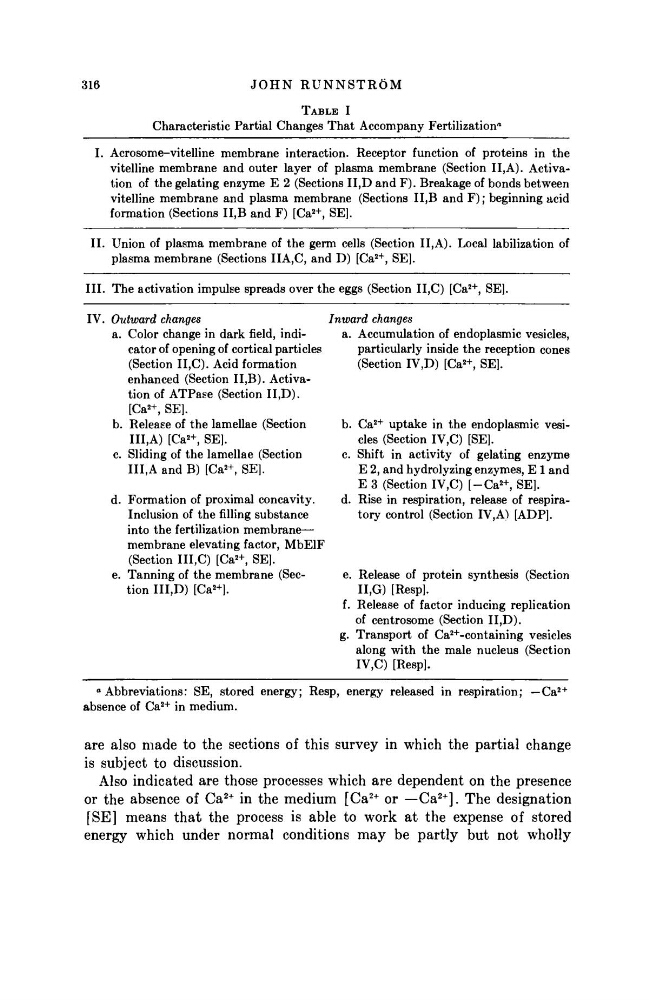
TABLE I
Characteristic Partial Changes That Accompany Fertilization"
I. Acrosome-vitelline membrane interaction. Receptor function of proteins in the
vitelline membrane and outer layer of plasma membrane (Section II,A). Activation of the gelating enzyme Ε 2 (Sections II,D and F). Breakage of bonds between
vitelline membrane and plasma membrane (Sections II,Β and F) ; beginning acid
formation (Sections ΙΙ,Β and F) [Ca
2+
, SE].
JOHN RUNNSTRÖM
II. Union of plasma membrane of the germ cells (Section II,A). Local labilization of
plasma membrane (Sections IIA,C, and D) [Ca
2+
, SE].
III. The activation impulse spreads over the eggs (Section II,C) [Ca
2+
, SE].
IV. Outward changes
a. Color change in dark field, indicator of opening of cortical particles
(Section II,C). Acid formation
enhanced (Section ΙΙ,Β). Activation of ATPase (Section II,D).
[Ca
2+
, SE].
b. Release of the lamellae (Section
ΙΙΙ,Α) [Ca
2
+, SE].
c. Sliding of the lamellae (Section
ΙΙΙ,Α and B) [Ca
2+
, SE].
d. Formation of proximal concavity.
Inclusion of the filling substance
into the fertilization membrane—
membrane elevating factor, MbElF
(Section III,C) [Ca
2+
, SE].
e. Tanning of the membrane (Section III,D) [Ca
2+
].
Inward changes
a. Accumulation of endoplasmic vesicles,
particularly inside the reception cones
(Section IV,D) [Ca
2+
, SE].
b. Ca
2+ uptake in the endoplasmic vesicles (Section IV,C) [SE].
c. Shift in activity of gelating enzyme
Ε 2, and hydrolyzing enzymes, Ε 1 and
Ε 3 (Section IV,C) [-Ca
2 +
, SE].
d. Rise in respiration, release of respiratory control (Section IV,A) [ADP].
e. Release of protein synthesis (Section
II,G) [Resp].
f. Release of factor inducing replication
of centrosome (Section II,D).
g. Transport of Ca
2+
-containing vesicles
along with the male nucleus (Section
IV,C) [Resp].
"Abbreviations: SE, stored energy; Resp, energy released in respiration; — Ca
2+
absence of Ca
2+ in medium.
are also made to the sections of this survey in which the partial change
is subject to discussion.
Also indicated are those processes which are dependent on the presence
or the absence of Ca
2+ in the medium [Ca
2+ or —Ca
2 +
]. The designation
[SE] means that the process is able to work at the expense of stored
energy which under normal conditions may be partly but not wholly
TABLE I
Characteristic Partial Changes That Accompany Fertilization"
I. Acrosome-vitelline membrane interaction. Receptor function of proteins in the
vitelline membrane and outer layer of plasma membrane (Section II,A). Activation of the gelating enzyme Ε 2 (Sections II,D and F). Breakage of bonds between
vitelline membrane and plasma membrane (Sections II,Β and F) ; beginning acid
formation (Sections ΙΙ,Β and F) [Ca
2+
, SE].