

296
JOHN RUNNSTRÖM
nation. The delay in ribonuclease-treated eggs may be due to a mobilization of gelating enzyme (E 2) by the treatment with ribonuclease (Runnström, 1962). A gradual increase in reducing substances may cause a
breakup of the connections. At the same time the results obtained by
exposure to basic proteins, such as lysozyme, must be considered. These
point to the conclusion that acid groups play a role in the connections.
However, both basic proteins and proteolytic enzymes may act on acid
mucopolysaccharides. Pretreatment of the egg of Psammechinus
miliaris
with 10"
4 M 2,4-dinitrophenol and fertilization in this medium caused
a weakening or breakup of the vitelline membrane. The membrane
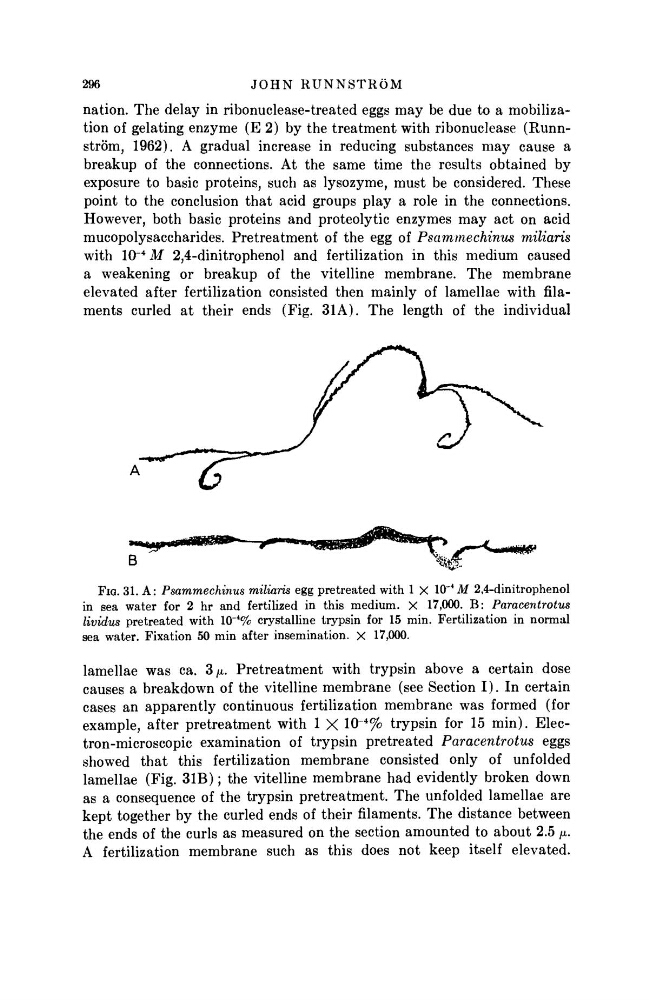
elevated after fertilization consisted then mainly of lamellae with filaments curled at their ends (Fig. 31 A). The length of the individual
FIG. 31. A: Psammechinus miliaris egg pre treated with 1 X 10"
4
ilf 2,4-dinitrophenol
in sea water for 2 hr and fertilized in this medium. X 17,000. B: Paracentrotus
lividus pre treated with 10"
4
% crystalline trypsin for 15 min. Fertilization in normal
sea water. Fixation 50 min after insemination. X 17,000.
lamellae was ca. 3 μ. Pretreatment with trypsin above a certain dose
causes a breakdown of the vitelline membrane (see Section I). In certain
cases an apparently continuous fertilization membrane was formed (for
example, after pretreatment with 1 X 10"
4
% trypsin for 15 min). Electron-microscopic examination of trypsin pretreated Paracentrotus
eggs
showed that this fertilization membrane consisted only of unfolded
lamellae (Fig. 31B) ; the vitelline membrane had evidently broken down
as a consequence of the trypsin pretreatment. The unfolded lamellae are
kept together by the curled ends of their filaments. The distance between
the ends of the curls as measured on the section amounted to about 2.5 μ.
A fertilization membrane such as this does not keep itself elevated.
JOHN RUNNSTRÖM
nation. The delay in ribonuclease-treated eggs may be due to a mobilization of gelating enzyme (E 2) by the treatment with ribonuclease (Runnström, 1962). A gradual increase in reducing substances may cause a
breakup of the connections. At the same time the results obtained by
exposure to basic proteins, such as lysozyme, must be considered. These
point to the conclusion that acid groups play a role in the connections.
However, both basic proteins and proteolytic enzymes may act on acid
mucopolysaccharides. Pretreatment of the egg of Psammechinus
miliaris
with 10"
4 M 2,4-dinitrophenol and fertilization in this medium caused
a weakening or breakup of the vitelline membrane. The membrane
elevated after fertilization consisted then mainly of lamellae with filaments curled at their ends (Fig. 31 A). The length of the individual
FIG. 31. A: Psammechinus miliaris egg pre treated with 1 X 10"
4
ilf 2,4-dinitrophenol
in sea water for 2 hr and fertilized in this medium. X 17,000. B: Paracentrotus
lividus pre treated with 10"
4
% crystalline trypsin for 15 min. Fertilization in normal
sea water. Fixation 50 min after insemination. X 17,000.
lamellae was ca. 3 μ. Pretreatment with trypsin above a certain dose
causes a breakdown of the vitelline membrane (see Section I). In certain
cases an apparently continuous fertilization membrane was formed (for
example, after pretreatment with 1 X 10"
4
% trypsin for 15 min). Electron-microscopic examination of trypsin pretreated Paracentrotus
eggs
showed that this fertilization membrane consisted only of unfolded
lamellae (Fig. 31B) ; the vitelline membrane had evidently broken down
as a consequence of the trypsin pretreatment. The unfolded lamellae are
kept together by the curled ends of their filaments. The distance between
the ends of the curls as measured on the section amounted to about 2.5 μ.
A fertilization membrane such as this does not keep itself elevated.