

254
JOHN RUNNSTRÖM
maturation of the oocyte, when the germinal vesicle breaks up and its
contents spread into the cytoplasm. Runnström (1963a,b) assumed that
the ground cytoplasm also consists of different components that may
separate as different phases. Structured components may partition between these phases, and the nature of the partitioning may change with
certain cellular or local events. In maturation, a certain phase containing
the cortical particles may separate from the interior cytoplasm and
take its position in a superficial layer—a change that must presuppose
the migration of a corresponding amount of previously cortical material
into the interior. Another possibility would be that the changed conditions cause a reversion in the partition of the cortical particles so that
they are displaced from an interior to a superficial phase. Here they may
find a density gradient of the cortical material against which they move
in order to find the position of strongest interaction between the membrane of the particle and the surrounding macromolecular system. This
would also bring them in close contact with a related surface, viz., the
inside of the plasma membrane.
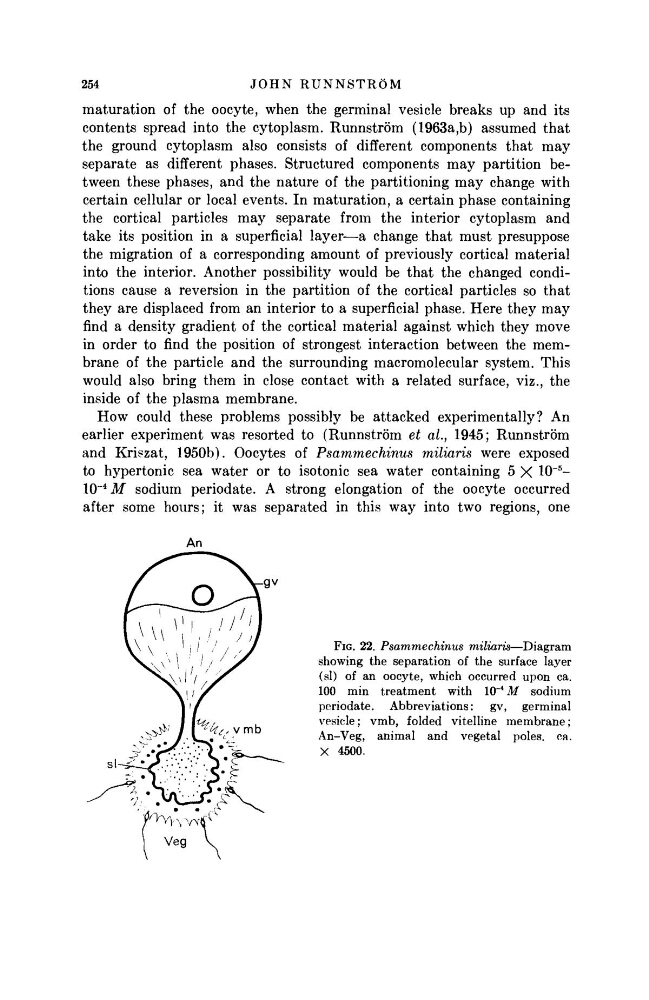
How could these problems possibly be attacked experimentally? An
earlier experiment was resorted to (Runnström et al., 1945; Runnström
and Kriszat, 1950b). Oocytes of Psammechinus
miliaris were exposed
to hypertonic sea water or to isotonic sea water containing 5 X 10~
5
-
10"
4 M sodium periodate. A strong elongation of the oocyte occurred
after some hours; it was separated in this way into two regions, one
An
FIG. 22. Psammechinus
miliaris—Diagram
showing the separation of the surface layer
(si) of an oocyte, which occurred upon ca.
100 min treatment with 10~
4 M sodium
periodate. Abbreviations: gv, germinal
vesicle; vmb, folded vitelline membrane;
An-Veg, animal and vegetal poles, ca.
X 4500.
JOHN RUNNSTRÖM
maturation of the oocyte, when the germinal vesicle breaks up and its
contents spread into the cytoplasm. Runnström (1963a,b) assumed that
the ground cytoplasm also consists of different components that may
separate as different phases. Structured components may partition between these phases, and the nature of the partitioning may change with
certain cellular or local events. In maturation, a certain phase containing
the cortical particles may separate from the interior cytoplasm and
take its position in a superficial layer—a change that must presuppose
the migration of a corresponding amount of previously cortical material
into the interior. Another possibility would be that the changed conditions cause a reversion in the partition of the cortical particles so that
they are displaced from an interior to a superficial phase. Here they may
find a density gradient of the cortical material against which they move
in order to find the position of strongest interaction between the membrane of the particle and the surrounding macromolecular system. This
would also bring them in close contact with a related surface, viz., the
inside of the plasma membrane.
How could these problems possibly be attacked experimentally? An
earlier experiment was resorted to (Runnström et al., 1945; Runnström
and Kriszat, 1950b). Oocytes of Psammechinus
miliaris were exposed
to hypertonic sea water or to isotonic sea water containing 5 X 10~
5
-
10"
4 M sodium periodate. A strong elongation of the oocyte occurred
after some hours; it was separated in this way into two regions, one
An
FIG. 22. Psammechinus
miliaris—Diagram
showing the separation of the surface layer
(si) of an oocyte, which occurred upon ca.
100 min treatment with 10~
4 M sodium
periodate. Abbreviations: gv, germinal
vesicle; vmb, folded vitelline membrane;
An-Veg, animal and vegetal poles, ca.
X 4500.