

FEATHERS AND PATTERNS
21
within 30 sec. The cultures were not gassed. Cultures were examined 48
hr later, and some were fixed in formol calcium and stained lightly with
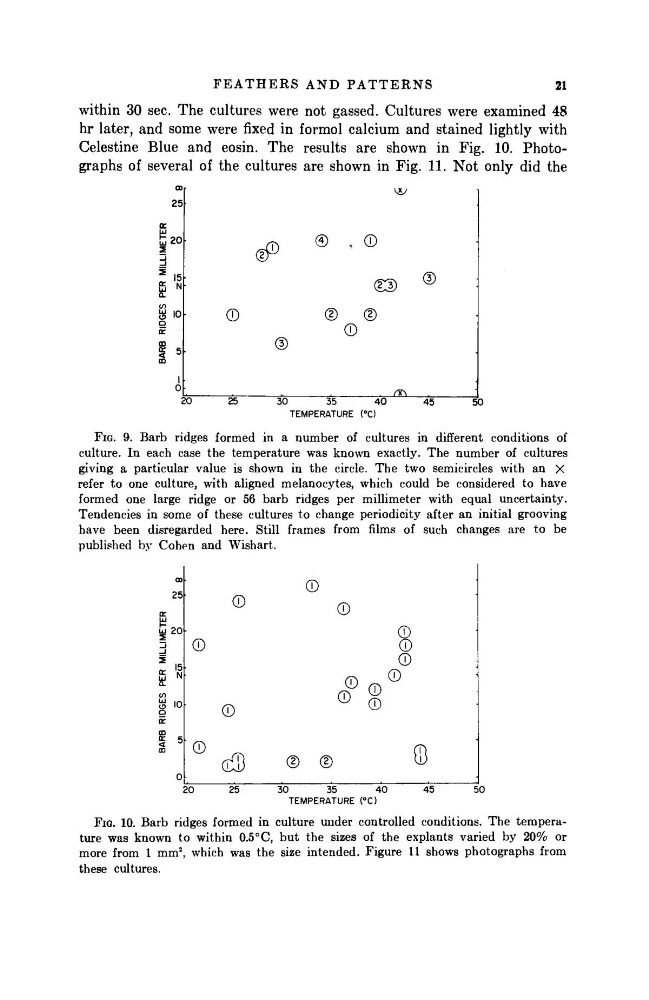
Celestine Blue and eosin. The results are shown in Fig. 10. Photographs of several of the cultures are shown in Fig. 11. Not only did the
cr
l±J 20
_J
_l
Σ 15
er Ν
£
Ν
CO
»
10
ο
er
ω
© . ®
CD
®
© ©
©
20
25
30
35
40
TEMPERATURE (°C)
45
50
FIG. 9. Barb ridges formed in a number of cultures in different conditions of
culture. In each case the temperature was known exactly. The number of cultures
giving a particular value is shown in the circle. The two semicircles with an X
refer to one culture, with aligned melanocytes, which could be considered to have
formed one large ridge or 56 barb ridges per millimeter with equal uncertainty.
Tendencies in some of these cultures to change periodicity after an initial grooving
have been disregarded here. Still frames from films of such changes are to be
published by Cohen and Wishart.
25
ώ 20
3
9
a
10
©
©
©
©
©
©
©
0
©
ω
©
©
©
© ©
20
30
35
40
TEMPERATURE (°C)
45
50
FIG. 10. Barb ridges formed in culture under controlled conditions. The temperature was known to within 0.5°C, but the sizes of the expiants varied by 20% or
more from 1 mm
2
, which was the size intended. Figure 11 shows photographs from
these cultures.
21
within 30 sec. The cultures were not gassed. Cultures were examined 48
hr later, and some were fixed in formol calcium and stained lightly with
Celestine Blue and eosin. The results are shown in Fig. 10. Photographs of several of the cultures are shown in Fig. 11. Not only did the
cr
l±J 20
_J
_l
Σ 15
er Ν
£
Ν
CO
»
10
ο
er
ω
© . ®
CD
®
© ©
©
20
25
30
35
40
TEMPERATURE (°C)
45
50
FIG. 9. Barb ridges formed in a number of cultures in different conditions of
culture. In each case the temperature was known exactly. The number of cultures
giving a particular value is shown in the circle. The two semicircles with an X
refer to one culture, with aligned melanocytes, which could be considered to have
formed one large ridge or 56 barb ridges per millimeter with equal uncertainty.
Tendencies in some of these cultures to change periodicity after an initial grooving
have been disregarded here. Still frames from films of such changes are to be
published by Cohen and Wishart.
25
ώ 20
3
9
a
10
©
©
©
©
©
©
©
0
©
ω
©
©
©
© ©
20
30
35
40
TEMPERATURE (°C)
45
50
FIG. 10. Barb ridges formed in culture under controlled conditions. The temperature was known to within 0.5°C, but the sizes of the expiants varied by 20% or
more from 1 mm
2
, which was the size intended. Figure 11 shows photographs from
these cultures.