

20
JACK COHEN
these, three were judged successful (by the failure of the comb to grow)
and provided the plasma. Blood was drawn from the underwing vein
into all-glass syringes lubricated with M.S. 550 and centrifuged in sterile
polythene tubes. Plasma was then drawn off, pooled, and freeze-dried in
1-ml ampules. [Sterilization of the apparatus by chemical means was
uncertain and introduced variables, so it was sterilized under vacuum by
radio-frequency discharge. The author is most grateful to Mr. S. V. Hill
3
for this suggestion and for all the time he spent implementing it.] Pooled
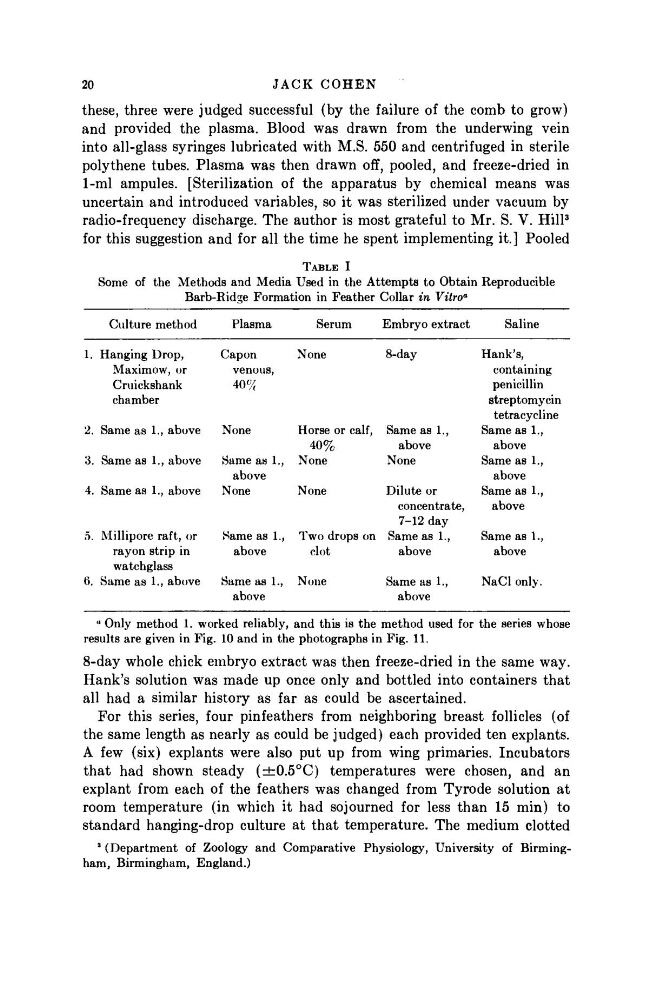
TABLE I
Some of the Methods and Media Used in the Attempts to Obtain Reproducible
Barb-Ridge Formation in Feather Collar in Vitro*
Culture method
Plasma
Serum
Embryo extract
Saline
1. Hanging Drop,
Capon
None
8-day
Hank's,
Maximow, or
venous,
containing
Cruickshank
40%
penicillin
chamber
streptomycin
tetracycline
2. Same as 1., above
None
Horse or calf, Same as 1.,
Same as 1.,
40%
above
above
3. Same as 1., above
Same as 1., None
None
Same as 1.,
above
above
4. Same as 1., above
None
None
Dilute or
Same as 1.,
concentrate,
above
7-12 day
5. Millipore raft, or
Same as 1., Two drops on Same as 1.,
Same as 1.,
rayon strip in
above
clot
above
above
watchglass
6. Same as 1., above
Same as 1., None
Same as 1.,
NaCl only.
above
above
" Only method 1. worked reliably, and this is the method used for the series whose
results are given in Fig. 10 and in the photographs in Fig. 11.
8-day whole chick embryo extract was then freeze-dried in the same way.
Hank's solution was made up once only and bottled into containers that
all had a similar history as far as could be ascertained.
For this series, four pinfeathers from neighboring breast follicles (of
the same length as nearly as could be judged) each provided ten expiants.
A few (six) expiants were also put up from wing primaries. Incubators
that had shown steady (±0.5°C) temperatures were chosen, and an
expiant from each of the feathers was changed from Tyrode solution at
room temperature (in which it had sojourned for less than 15 min) to
standard hanging-drop culture at that temperature. The medium clotted
3 (Department of Zoology and Comparative Physiology, University of Birmingham, Birmingham, England.)
JACK COHEN
these, three were judged successful (by the failure of the comb to grow)
and provided the plasma. Blood was drawn from the underwing vein
into all-glass syringes lubricated with M.S. 550 and centrifuged in sterile
polythene tubes. Plasma was then drawn off, pooled, and freeze-dried in
1-ml ampules. [Sterilization of the apparatus by chemical means was
uncertain and introduced variables, so it was sterilized under vacuum by
radio-frequency discharge. The author is most grateful to Mr. S. V. Hill
3
for this suggestion and for all the time he spent implementing it.] Pooled
TABLE I
Some of the Methods and Media Used in the Attempts to Obtain Reproducible
Barb-Ridge Formation in Feather Collar in Vitro*
Culture method
Plasma
Serum
Embryo extract
Saline
1. Hanging Drop,
Capon
None
8-day
Hank's,
Maximow, or
venous,
containing
Cruickshank
40%
penicillin
chamber
streptomycin
tetracycline
2. Same as 1., above
None
Horse or calf, Same as 1.,
Same as 1.,
40%
above
above
3. Same as 1., above
Same as 1., None
None
Same as 1.,
above
above
4. Same as 1., above
None
None
Dilute or
Same as 1.,
concentrate,
above
7-12 day
5. Millipore raft, or
Same as 1., Two drops on Same as 1.,
Same as 1.,
rayon strip in
above
clot
above
above
watchglass
6. Same as 1., above
Same as 1., None
Same as 1.,
NaCl only.
above
above
" Only method 1. worked reliably, and this is the method used for the series whose
results are given in Fig. 10 and in the photographs in Fig. 11.
8-day whole chick embryo extract was then freeze-dried in the same way.
Hank's solution was made up once only and bottled into containers that
all had a similar history as far as could be ascertained.
For this series, four pinfeathers from neighboring breast follicles (of
the same length as nearly as could be judged) each provided ten expiants.
A few (six) expiants were also put up from wing primaries. Incubators
that had shown steady (±0.5°C) temperatures were chosen, and an
expiant from each of the feathers was changed from Tyrode solution at
room temperature (in which it had sojourned for less than 15 min) to
standard hanging-drop culture at that temperature. The medium clotted
3 (Department of Zoology and Comparative Physiology, University of Birmingham, Birmingham, England.)