

THE STIMULUS TO HYPERTROPHIC GROWTH
117
trophic response to removal of less than about 30% of the liver mass. With
larger hepatectomies the response is very much greater. The response in
weanling rats is similar, except that the sharp change in the slope of the
response curve occurs at a smaller degree of hepatectomy and is less marked.
There is no true threshold in either case (even very small hepatectomies
elicit a small hypertrophic response).
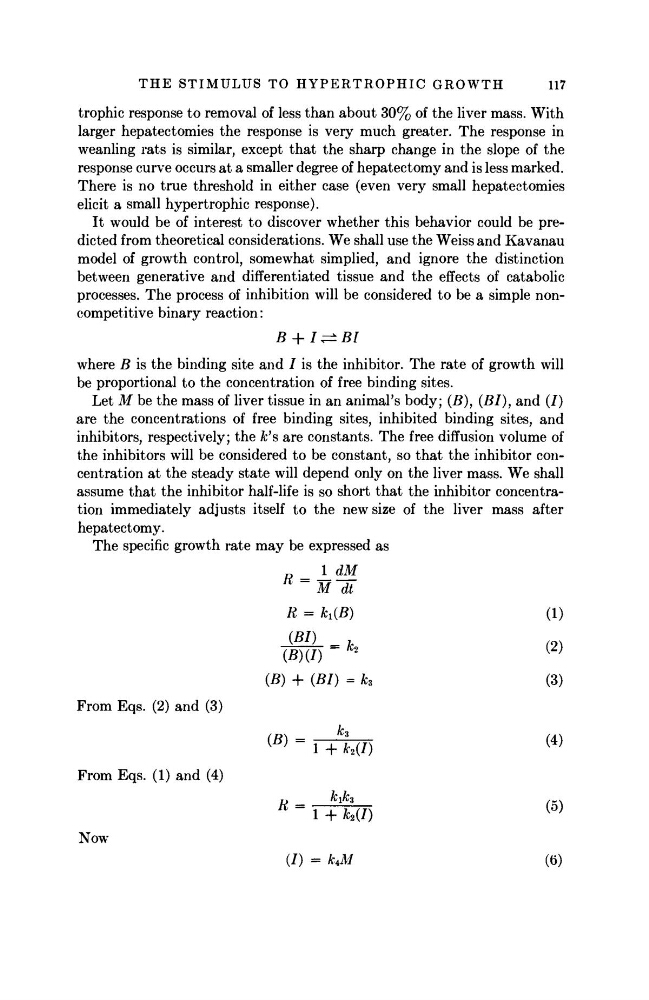
It would be of interest to discover whether this behavior could be predicted from theoretical considerations. We shall use the Weiss and Kavanau
model of growth control, somewhat simplied, and ignore the distinction
between generative and differentiated tissue and the effects of catabolic
processes. The process of inhibition will be considered to be a simple noncompetitive binary reaction :
where Β is the binding site and / is the inhibitor. The rate of growth will
be proportional to the concentration of free binding sites.
Let M be the mass of liver tissue in an animal's body; (Β), (BI), and (/)
are the concentrations of free binding sites, inhibited binding sites, and
inhibitors, respectively; the k's are constants. The free diffusion volume of
the inhibitors will be considered to be constant, so that the inhibitor concentration at the steady state will depend only on the liver mass. We shall
assume that the inhibitor half-life is so short that the inhibitor concentration immediately adjusts itself to the new size of the liver mass after
hepatectomy.
The specific growth rate may be expressed as
B +
I^±BI
1 " M dt
R = fci(£)
(1)
(2)
(B) + (BI) = *,
(3)
From Eqs. (2) and (3)
(B)
1 + *,(/)
(4)
From Eqs. (1) and (4)
R
(5)
1 +
Now
(/) - k 4 M
(6)
117
trophic response to removal of less than about 30% of the liver mass. With
larger hepatectomies the response is very much greater. The response in
weanling rats is similar, except that the sharp change in the slope of the
response curve occurs at a smaller degree of hepatectomy and is less marked.
There is no true threshold in either case (even very small hepatectomies
elicit a small hypertrophic response).
It would be of interest to discover whether this behavior could be predicted from theoretical considerations. We shall use the Weiss and Kavanau
model of growth control, somewhat simplied, and ignore the distinction
between generative and differentiated tissue and the effects of catabolic
processes. The process of inhibition will be considered to be a simple noncompetitive binary reaction :
where Β is the binding site and / is the inhibitor. The rate of growth will
be proportional to the concentration of free binding sites.
Let M be the mass of liver tissue in an animal's body; (Β), (BI), and (/)
are the concentrations of free binding sites, inhibited binding sites, and
inhibitors, respectively; the k's are constants. The free diffusion volume of
the inhibitors will be considered to be constant, so that the inhibitor concentration at the steady state will depend only on the liver mass. We shall
assume that the inhibitor half-life is so short that the inhibitor concentration immediately adjusts itself to the new size of the liver mass after
hepatectomy.
The specific growth rate may be expressed as
B +
I^±BI
1 " M dt
R = fci(£)
(1)
(2)
(B) + (BI) = *,
(3)
From Eqs. (2) and (3)
(B)
1 + *,(/)
(4)
From Eqs. (1) and (4)
R
(5)
1 +
Now
(/) - k 4 M
(6)