

240
RUTH BELLAIRS
width, c and d are the two membranes of which the dense lining layer is
composed and together they measure about 150 Â. For these reasons we
have reluctantly introduced a new term, 'lining body' instead of
Schjeide's term 'pre-mitochondrion'.
In a later paper Schjeide et al. (1963b) draw attention to the two layers
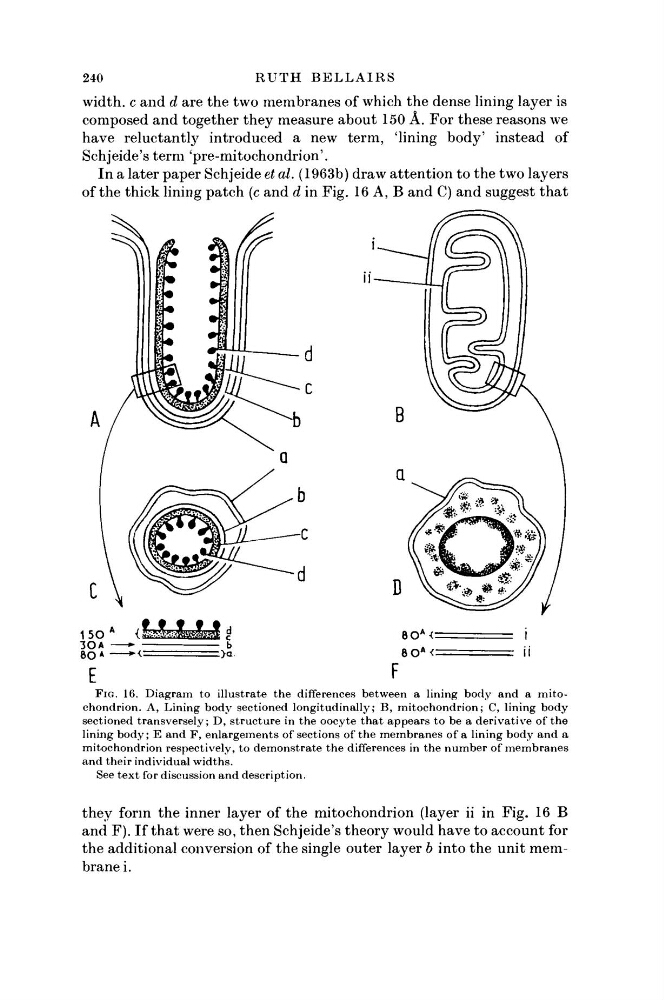
of the thick lining patch (c and d in Fig. 16 A, B and C) and suggest that
150
A
(llAlJd
30A
60
A
b
E
8 0
A <=
ÔO
A <"
F
FIG. 16. Diagram to illustrate the differences between a lining body and a mitochondrion. A, Lining body sectioned longitudinally; B, mitochondrion; C, lining body
sectioned transversely; D, structure in the oocyte that appears to be a derivative of the
lining body ; E and F, enlargements of sections of the membranes of a lining body and a
mitochondrion respectively, to demonstrate the differences in the number of membranes
and their individual widths.
See text for discussion and description.
they form the inner layer of the mitochondrion (layer ii in Fig. 16 B
and F). If that were so, then Schjeide's theory would have to account for
the additional conversion of the single outer layer b into the unit membrane i.
RUTH BELLAIRS
width, c and d are the two membranes of which the dense lining layer is
composed and together they measure about 150 Â. For these reasons we
have reluctantly introduced a new term, 'lining body' instead of
Schjeide's term 'pre-mitochondrion'.
In a later paper Schjeide et al. (1963b) draw attention to the two layers
of the thick lining patch (c and d in Fig. 16 A, B and C) and suggest that
150
A
(llAlJd
30A
60
A
b
E
8 0
A <=
ÔO
A <"
F
FIG. 16. Diagram to illustrate the differences between a lining body and a mitochondrion. A, Lining body sectioned longitudinally; B, mitochondrion; C, lining body
sectioned transversely; D, structure in the oocyte that appears to be a derivative of the
lining body ; E and F, enlargements of sections of the membranes of a lining body and a
mitochondrion respectively, to demonstrate the differences in the number of membranes
and their individual widths.
See text for discussion and description.
they form the inner layer of the mitochondrion (layer ii in Fig. 16 B
and F). If that were so, then Schjeide's theory would have to account for
the additional conversion of the single outer layer b into the unit membrane i.