

196
H E N R I E T T E HERLANT-MEEWIS
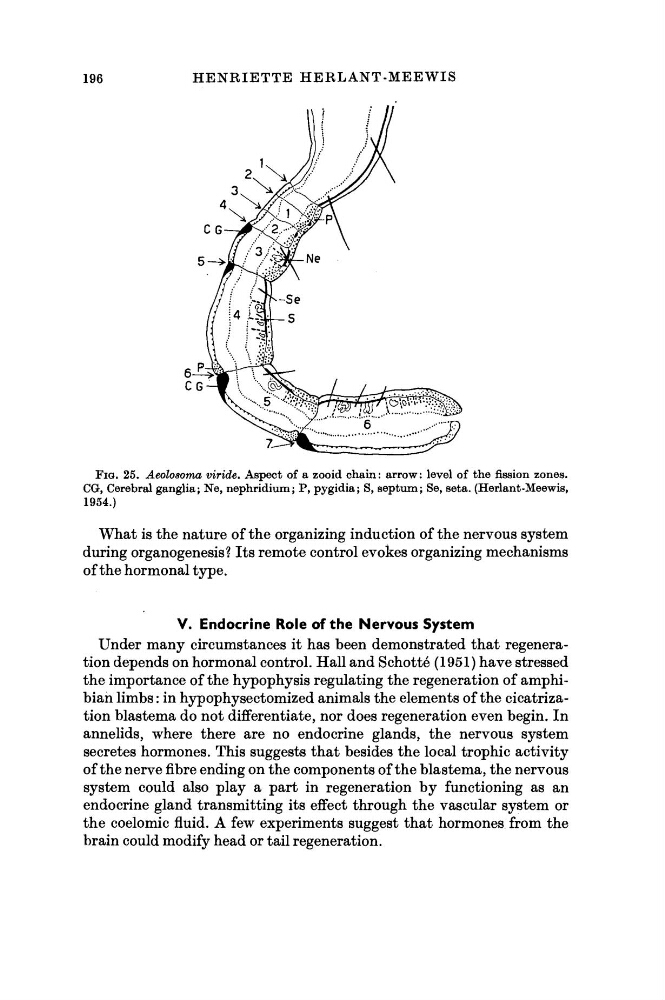
FIG. 25. Aeolosoma viride. Aspect of a zooid chain: arrow: level of the fission zones.
CG, Cerebral ganglia; Ne, nephridium; P, pygidia; S, septum; Se, seta. (Herlant-Meewis,
1954.)
What is the nature of the organizing induction of the nervous system
during organogenesis? Its remote control evokes organizing mechanisms
of the hormonal type.
V. Endocrine Role of the Nervous System
Under many circumstances it has been demonstrated that regeneration depends on hormonal control. Hall and Schotte (1951) have stressed
the importance of the hypophysis regulating the regeneration of amphibian limbs : in hypophysectomized animals the elements of the cicatrization blastema do not differentiate, nor does regeneration even begin. In
annelids, where there are no endocrine glands, the nervous system
secretes hormones. This suggests that besides the local trophic activity
of the nerve fibre ending on the components of the blastema, the nervous
system could also play a part in regeneration by functioning as an
endocrine gland transmitting its effect through the vascular system or
the coelomic fluid. A few experiments suggest that hormones from the
brain could modify head or tail regeneration.
H E N R I E T T E HERLANT-MEEWIS
FIG. 25. Aeolosoma viride. Aspect of a zooid chain: arrow: level of the fission zones.
CG, Cerebral ganglia; Ne, nephridium; P, pygidia; S, septum; Se, seta. (Herlant-Meewis,
1954.)
What is the nature of the organizing induction of the nervous system
during organogenesis? Its remote control evokes organizing mechanisms
of the hormonal type.
V. Endocrine Role of the Nervous System
Under many circumstances it has been demonstrated that regeneration depends on hormonal control. Hall and Schotte (1951) have stressed
the importance of the hypophysis regulating the regeneration of amphibian limbs : in hypophysectomized animals the elements of the cicatrization blastema do not differentiate, nor does regeneration even begin. In
annelids, where there are no endocrine glands, the nervous system
secretes hormones. This suggests that besides the local trophic activity
of the nerve fibre ending on the components of the blastema, the nervous
system could also play a part in regeneration by functioning as an
endocrine gland transmitting its effect through the vascular system or
the coelomic fluid. A few experiments suggest that hormones from the
brain could modify head or tail regeneration.