

136
LUISE STANGE
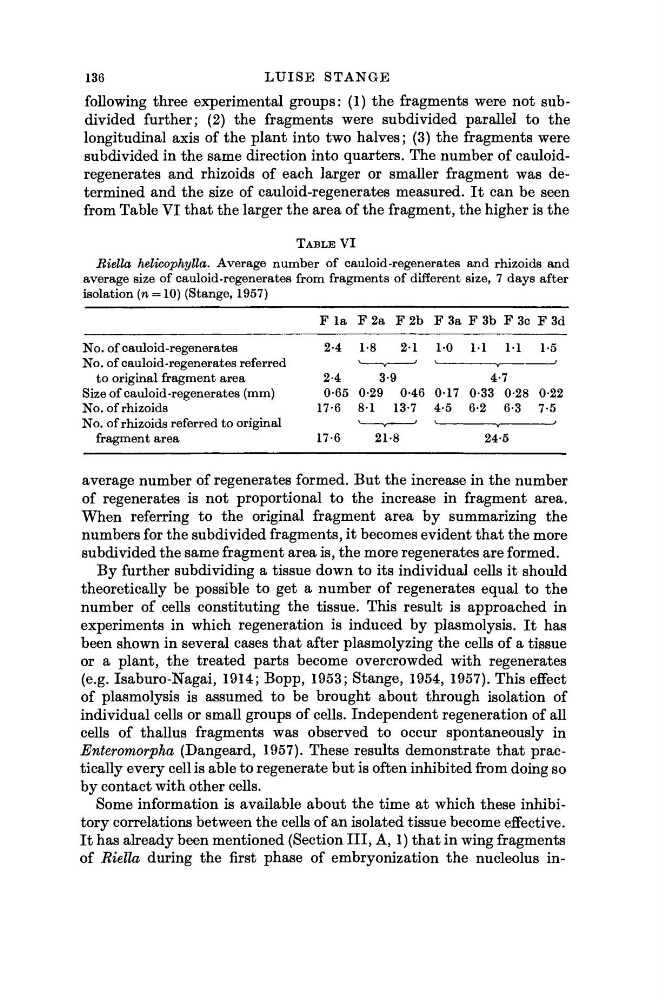
following three experimental groups: (1) the fragments were not subdivided further; (2) the fragments were subdivided parallel to the
longitudinal axis of the plant into two halves; (3) the fragments were
subdivided in the same direction into quarters. The number of cauloidregenerates and rhizoids of each larger or smaller fragment was determined and the size of cauloid-regenerates measured. It can be seen
from Table VI that the larger the area of the fragment, the higher is the
TABLE VI
Riella helicophylla. Average number of cauloid-regenerates and rhizoids and
average size of cauloid-regenerates from fragments of different size, 7 days after
isolation (n = 10) (Stange, 1957)
F la F 2a F 2b F 3a F 3b F 3c F 3d
No. of cauloid-regenerates
2-4
No. of cauloid-regenerates referred
to original fragment area
2-4
Size of cauloid-regenerates (mm)
0-65
No. of rhizoids
17-6
No. of rhizoids referred to original
1-8
2 1
10
V
y
_
J
V . .
.
3-9
0-29 0-46 017
8 1 13-7 4-5
1 1
1 1
y
4-7
0-33 0-28
6-2 6-3
1-5
0-22
7-5
fragment area
17-6
21-8
24-5
average number of regenerates formed. But the increase in the number
of regenerates is not proportional to the increase in fragment area.
When referring to the original fragment area by summarizing the
numbers for the subdivided fragments, it becomes evident that the more
subdivided the same fragment area is, the more regenerates are formed.
By further subdividing a tissue down to its individual cells it should
theoretically be possible to get a number of regenerates equal to the
number of cells constituting the tissue. This result is approached in
experiments in which regeneration is induced by plasmolysis. It has
been shown in several cases that after plasmolyzing the cells of a tissue
or a plant, the treated parts become overcrowded with regenerates
(e.g. Isaburo-Nagai, 1914; Bopp, 1953; Stange, 1954, 1957). This effect
of plasmolysis is assumed to be brought about through isolation of
individual cells or small groups of cells. Independent regeneration of all
cells of thallus fragments was observed to occur spontaneously in
Enteromorpha (Dangeard, 1957). These results demonstrate that practically every cell is able to regenerate but is often inhibited from doing so
by contact with other cells.
Some information is available about the time at which these inhibitory correlations between the cells of an isolated tissue become effective.
It has already been mentioned (Section III, A, 1) that in wing fragments
of Riella during the first phase of embryonization the nucleolus in-
LUISE STANGE
following three experimental groups: (1) the fragments were not subdivided further; (2) the fragments were subdivided parallel to the
longitudinal axis of the plant into two halves; (3) the fragments were
subdivided in the same direction into quarters. The number of cauloidregenerates and rhizoids of each larger or smaller fragment was determined and the size of cauloid-regenerates measured. It can be seen
from Table VI that the larger the area of the fragment, the higher is the
TABLE VI
Riella helicophylla. Average number of cauloid-regenerates and rhizoids and
average size of cauloid-regenerates from fragments of different size, 7 days after
isolation (n = 10) (Stange, 1957)
F la F 2a F 2b F 3a F 3b F 3c F 3d
No. of cauloid-regenerates
2-4
No. of cauloid-regenerates referred
to original fragment area
2-4
Size of cauloid-regenerates (mm)
0-65
No. of rhizoids
17-6
No. of rhizoids referred to original
1-8
2 1
10
V
y
_
J
V . .
.
3-9
0-29 0-46 017
8 1 13-7 4-5
1 1
1 1
y
4-7
0-33 0-28
6-2 6-3
1-5
0-22
7-5
fragment area
17-6
21-8
24-5
average number of regenerates formed. But the increase in the number
of regenerates is not proportional to the increase in fragment area.
When referring to the original fragment area by summarizing the
numbers for the subdivided fragments, it becomes evident that the more
subdivided the same fragment area is, the more regenerates are formed.
By further subdividing a tissue down to its individual cells it should
theoretically be possible to get a number of regenerates equal to the
number of cells constituting the tissue. This result is approached in
experiments in which regeneration is induced by plasmolysis. It has
been shown in several cases that after plasmolyzing the cells of a tissue
or a plant, the treated parts become overcrowded with regenerates
(e.g. Isaburo-Nagai, 1914; Bopp, 1953; Stange, 1954, 1957). This effect
of plasmolysis is assumed to be brought about through isolation of
individual cells or small groups of cells. Independent regeneration of all
cells of thallus fragments was observed to occur spontaneously in
Enteromorpha (Dangeard, 1957). These results demonstrate that practically every cell is able to regenerate but is often inhibited from doing so
by contact with other cells.
Some information is available about the time at which these inhibitory correlations between the cells of an isolated tissue become effective.
It has already been mentioned (Section III, A, 1) that in wing fragments
of Riella during the first phase of embryonization the nucleolus in-